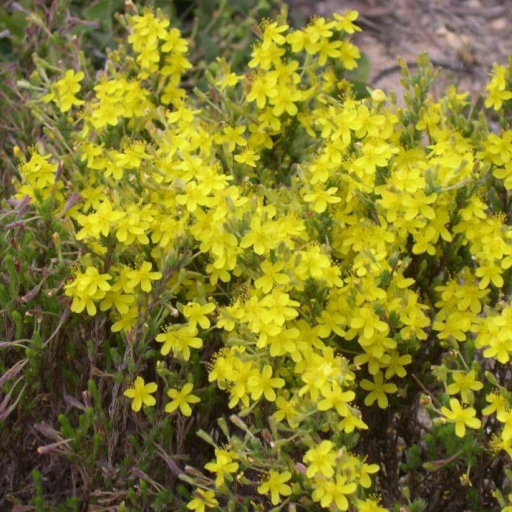
Plant Overview
Often mistaken for the heather of the Scottish highlands, Hudsonia tomentosa is a rugged North American native known as "Woolly Beach Heath" or "Poverty Grass." It thrives where most plants perish—on the shifting, sun-scorched sand dunes and barren coastal plains. Its silver-grey, velvet-like appearance is actually a clever survival strategy to trap moisture and reflect the intense seaside sun.
🔍 How to Identify
- 🌿 The Foliage: Tiny, scale-like leaves that overlap closely against the stems, giving the plant a textured, braided appearance.
- ☁️ The Texture: The entire plant is covered in a dense, white, woolly "fuzz" (tomentum) that gives it a soft, hoary-grey or sage-green color.
- 🌼 The Flowers: In early summer, the plant is transformed by a carpet of small, bright yellow flowers with five petals that typically open only in the sunshine.
- 👣 The Habit: It grows as a low, mounded cushion or "mat," rarely reaching more than 8 inches in height, acting as a natural anchor for loose sand.
🏡 In Your Garden
- ⏳ Soil Patience: This plant earns the name "Poverty Grass" because it demands nutrient-poor, acidic, and extremely sandy soil. In rich garden soil, it will quickly rot or be outcompeted by weeds.
- 🚫 Don't Move Me: It possesses a delicate and deep taproot system designed to find water deep beneath the dunes. Because of this, it is notoriously difficult to transplant and should be started from seed or left in its natural habitat.
- ☀️ Sun Worshiper: It requires maximum UV exposure; even partial shade can cause the plant to lose its compact shape and silvery sheen.
⚠️ Safety & Toxicity
- ✅ Status: Non-toxic and safe.
- 🐾 Details: There are no known toxic effects for humans, cats, or dogs. However, the plant is ecologically "fragile." Its woody stems are brittle, meaning it can be easily killed by foot traffic or "trampling," even if it isn't chemically dangerous.
✨ Fun Fact
- 🌊 Sand Swallower: Hudsonia tomentosa is a master of the "sand-dune dance." As wind-blown sand covers the plant, it simply grows upward through the new layer, creating hidden, buried stems that help stabilize the entire dune against erosion!

Detailed Care Instructions
To grow Hudsonia tomentosa, also known as woolly beachheather, follow these steps:
- Climate: Determine if the climate in your region is suitable for growing this plant. Hudsonia tomentosa is native to coastal areas, specifically sand dunes, so it thrives in a maritime climate. It can tolerate salt spray, wind, and poor soil conditions.
- Location: Choose a well-drained area with full sun exposure. The plant prefers sandy or gravelly soil with low fertility. Ensure that the site has good air circulation.
- Propagation: Hudsonia tomentosa can be propagated from seeds or cuttings. If using seeds, scarify them by lightly nicking the outer coating with sandpaper or a knife. Soak the scarified seeds in water for 24 hours before planting. If using cuttings, take 2-3 inch (5-7.5 cm) stem cuttings from a healthy plant and root them in a well-draining soil mix.
- Soil preparation: Before planting, prepare the soil by loosening it with a garden fork or tiller. Avoid adding heavy amendments or fertilizer, as Hudsonia tomentosa prefers nutrient-poor soil. You can incorporate some sand or gravel into the soil to improve drainage if needed.
- Planting: If starting from seeds, sow them in the prepared soil at a depth of about 1/4 inch (0.6 cm). Space the seeds or seedlings at least 12 inches (30 cm) apart to allow air circulation.
- Watering: Water the newly planted seeds or cuttings lightly but consistently until they establish. Once established, Hudsonia tomentosa is drought-tolerant and requires minimal watering. Avoid overwatering, as it can lead to root rot.
- Pruning: Prune back any dead or overgrown branches in early spring to promote fresh growth. Be mindful not to prune too heavily, as Hudsonia tomentosa has a dense, rounded growth habit.
- Maintenance: Provide regular weeding and remove any competing plants in the vicinity to allow Hudsonia tomentosa to thrive. Mulch the soil around the plants with a thin layer of gravel or pebbles to help control weeds and mimic its natural habitat.
- Protection: If you live in a colder climate, protect the plant from frost by providing a layer of mulch or burlap around it during winter.
By following these guidelines, you can successfully grow Hudsonia tomentosa and enjoy its beautiful yellow flowers and woolly foliage.

Place in a bright room that is sun drenched almost all day. Or directly in a south-facing window.

To water this particular plant, you should ensure that the soil is completely dry before irrigating it. When watering, you should slowly pour water onto the soil surrounding the plant, being careful not to overwater. It is important not to let the plant sit in a saucer of water. It is best to use room-temperature water and to avoid pouring water directly onto the plant's leaves or flowers. Maintaining proper soil moisture is important, but be cautious not to keep the soil too saturated as this can lead to root rot. You should also take care to avoid getting water on the leaves, which can lead to issues with mold and fungus.
To fertilize this plant, apply a slow-release fertilizer with an NPK ratio of 10-10-10 in early spring. Follow the package instructions for dosage and frequency of application. Avoid over-fertilizing, as this can damage the plant's root system. Water the plant thoroughly after fertilization.
The recommended soil for this plant is a well-drained and acidic soil with a pH level between 4.5 and 6.5. It prefers sandy or loamy soils that are low in fertility and with a low nutrient content. The plant is adapted to growing in harsh environments such as salt marshes and sandy dunes, where the soil is often nutrient-poor and dry. Therefore, it is important to avoid using a high-nutrient soil mix for this plant, as it can cause the plant to become too lush and susceptible to disease. A soil mix that contains a high percentage of sand or perlite mixed with peat moss or other organic material is ideal. Additionally, the soil should be moist but not waterlogged, as excess moisture can cause root rot.
To propagate this plant, you will first need to identify a healthy specimen with mature stems. Using a clean, sharp blade, take a cutting of a stem about 4-6 inches in length. Make sure that the cutting has several pairs of healthy leaves on it.
Remove the leaves from the bottom pair of nodes on the stem, leaving only a few leaves at the top for photosynthesis. Dip the cut end of the stem into a rooting hormone and place it in a pot filled with well-draining soil. Water the soil thoroughly and cover the pot with a plastic bag to increase humidity.
Place the pot in a bright location, but out of direct sunlight. Keep the soil moist, but not soggy, and remove the plastic bag once the cutting has rooted and new growth appears.
It may take several weeks to a few months for the cutting to root and establish itself. Once it has grown to a suitable size, it can be transplanted to a larger pot or directly into the ground.








