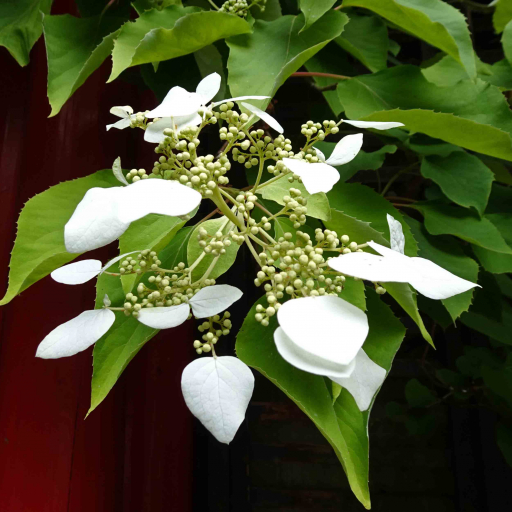
Plant Overview
Often called the Japanese Climbing Hydrangea, this elegant woody vine is the secret weapon of the woodland gardener. Native to the cool, moist forests of Japan and Korea, it is famous for its "lacecap" floral displays that seem to float against dark garden walls. Unlike many aggressive vines, this climber is a slow-burn beauty that rewards the patient gardener with a stunning vertical tapestry of heart-shaped foliage.
🔍 How to Identify
- 🍃 Heart-Shaped Leaves: The foliage is deep green, broadly ovate, and features sharply "toothed" or serrated edges that give it a crisp, clean look.
- 🌸 Showy Bracts: While it looks like a standard hydrangea, its flower clusters are unique. Each small fertile flower is surrounded by a single, large, creamy-white teardrop-shaped bract (modified leaf) rather than the four-petaled florets seen on common hydrangeas.
- 🧗 Aerial Rootlets: Look for small, fuzzy "holdfasts" along the woody stems. These allow the plant to glue itself to surfaces like brick or tree bark without the need for a trellis.
🏡 In Your Garden
- ⏳ The Patience Factor: This plant is notorious for being a "sleeper." It often spends its first few years focusing on root development rather than upward growth. Don't be discouraged—once it settles in, it becomes a vigorous and permanent architectural feature.
- 🌲 Vertical Ambition: It is one of the few flowering vines that thrives in deep or dappled shade. It is particularly effective when allowed to scale a mature, rough-barked tree or a north-facing stone wall, where its roots can stay cool and moist.
- 💧 Thirsty Roots: Because it climbs, it is often planted near foundations or under tree canopies where the soil can be dry. It requires consistent moisture and rich, organic soil to prevent its large leaves from wilting in the summer heat.
⚠️ Safety & Toxicity
- 🐾 Toxic to Pets: Like all members of the Hydrangea family, this plant contains cyanogenic glycosides. If ingested in large quantities, it can cause nausea, vomiting, and lethargy in dogs, cats, and horses.
- 👶 Human Caution: While not usually fatal, the leaves and flower buds can cause stomach upset if eaten by children. It is best treated as an ornamental-only plant.
- 🧤 Sap Sensitivity: Some gardeners report mild skin irritation when pruning the woody stems; wearing gloves is recommended for those with sensitive skin.
✨ Fun Fact
The genus name Schizophragma (often used synonymously with this species) comes from the Greek words for "split" and "wall." This refers to the way the plant's seed capsules eventually split apart to release their bounty to the wind!

Detailed Care Instructions
To grow a Hydrangea Hydrangeoides plant, follow these steps:
- Choose a suitable location: Hydrangeas prefer partial shade, ideally receiving morning sun and afternoon shade. They also require well-draining soil with good organic matter.
- Planting: Dig a hole that is twice as wide and just as deep as the root ball of the plant. Place the plant in the hole and backfill with soil, gently firming it around the roots. Water thoroughly after planting.
- Watering: Keep the soil consistently moist, but not waterlogged. Hydrangeas require regular watering, especially during hot and dry periods. Deep watering is preferred over frequent shallow watering.
- Mulching: Apply a layer of organic mulch around the plant to help conserve moisture, suppress weeds, and improve soil quality.
- Fertilizing: Hydrangeas benefit from regular feeding, especially during the growing season. Use a slow-release fertilizer or a balanced fertilizer with equal amounts of nitrogen, phosphorus, and potassium. Follow the instructions on the fertilizer packaging for application rates.
- Pruning: Prune your Hydrangea Hydrangeoides plant in early spring, just before new growth begins. Remove any dead or damaged wood and shape the plant if desired. Avoid pruning late in the season, as it may remove next year's flower buds.
- Winter protection: In colder regions, provide winter protection for your plant by adding a thick layer of mulch around the base of the plant. This will help insulate the roots and protect them from freezing temperatures.
- Pest and disease control: Monitor your plant regularly for any signs of pests or diseases, such as aphids or powdery mildew. Treat any issues promptly using appropriate organic or chemical controls.
With proper care and maintenance, your Hydrangea Hydrangeoides plant should thrive and produce beautiful blooms.
To properly water the Hydrangea Hydrangeoides plant, you must consider its specific watering needs. Here are the details for watering this plant:
- Hydrangea Hydrangeoides prefers slightly moist soil, so monitor the moisture level regularly. Stick your finger about an inch into the soil to ensure it is not overly dry or soaked.
- Water deeply but infrequently: When watering, make sure to provide enough water to thoroughly saturate the root zone. Aim to moisten the top 6 to 8 inches of soil. This encourages the roots to grow deeply and keeps the plant hydrated for longer periods. However, avoid overwatering as it can lead to root rot.
- Time watering appropriately: Water the Hydrangea Hydrangeoides plant early in the morning or late in the evening. This allows the plant to absorb water before the sun's heat accelerates evaporation.
- Consider rainfall: If there is adequate rainfall, you may not need to water your Hydrangea Hydrangeoides as frequently. However, ensure the soil is not waterlogged, as excessive moisture can harm the plant.
- Use the right watering method: Avoid overhead watering, as this can cause issues such as leaf diseases. Instead, focus on watering the soil around the base of the plant. Use a watering can, soaker hose, or drip irrigation system to deliver water directly to the roots.
- Mulch to retain moisture: Apply a layer of organic mulch, such as wood chips or bark, around the base of the Hydrangea Hydrangeoides plant. This helps conserve moisture by reducing evaporation from the soil surface.
- Monitor the plant's response: Observe the plant for signs of overwatering or underwatering. If the leaves wilt or turn yellow, it may indicate underwatering, while root rot or yellowing leaves with black spots may indicate overwatering. Adjust your watering practices accordingly.
Remember, each individual plant may have slightly different watering requirements, so it's vital to pay attention to your Hydrangea Hydrangeoides plant's specific needs rather than rely solely on general guidelines.
To properly fertilize Hydrangea Hydrangeoides, follow these instructions:
- Choose a balanced, slow-release fertilizer with equal amounts of nitrogen (N), phosphorus (P), and potassium (K). Look for a formulation like 10-10-10 or 20-20-20.
- Begin fertilizing in the early spring when new growth starts to appear. This is typically around late February or early March, depending on your climate.
- Apply the fertilizer according to the package instructions. Generally, you'll sprinkle the granules evenly around the base of the plant, avoiding direct contact with the stems or leaves.
- Gently work the fertilizer into the top inch of soil using a small garden rake or your hand. Be careful not to damage the plant's shallow roots.
- Water the plant thoroughly after applying the fertilizer to help dissolve and distribute the nutrients.
- Repeat the fertilization process every 4-6 weeks during the growing season, from spring to mid-summer. This promotes healthy growth and vibrant blooms.
- Discontinue fertilizing by late summer to allow the plant to prepare for dormancy in the colder months.
- In late fall or early winter, mulch the base of the plant with organic matter like shredded leaves or bark chips. This helps protect the roots and add nutrients to the soil.
- Monitor the plant's growth and health throughout the year. Adjust the fertilization schedule as needed based on its performance, following the guidelines provided by the manufacturer.
- If you notice any signs of fertilizer burn or excessive growth, reduce the amount or frequency of fertilization and water the plant to flush out any excess nutrients.
When caring for the Hydrangea Hydrangeoides plant, it is crucial to select the appropriate soil type that suits its growth requirements. This plant prefers a well-draining soil composition that retains just the right amount of moisture. The ideal soil for Hydrangea Hydrangeoides is slightly acidic to neutral with a pH level ranging between 5.5 and 6.5.
To create the ideal soil mixture for this plant, it is recommended to combine organic matter, such as compost or peat moss, with loamy soil. This combination helps improve the soil's structure, drainage, and ability to retain nutrients. Additionally, the organic matter enriches the soil, providing essential nutrients and promoting healthy root development.
The soil should be loose and airy to allow for proper root aeration and prevent waterlogging. This promotes the overall health of the plant and reduces the risk of root rot. It is important to avoid using heavy clay soils as they tend to retain excessive amounts of water and can suffocate the roots.
When planting Hydrangea Hydrangeoides, ensure that the soil is well-prepared and of suitable composition to encourage vigorous growth and blooming. Regularly monitoring the moisture levels in the soil and maintaining proper watering practices will help create an ideal growing environment for this beautiful plant.
To propagate the Hydrangea Hydrangeoides plant, you can follow these steps:
- Select a healthy parent plant: Choose a mature, disease-free, and strong Hydrangea Hydrangeoides plant as the parent for propagation.
- Timing: Spring or early summer is the ideal time for propagation. This allows the new plant to establish itself before the cold season.
- Prepare the materials: Gather sharp pruning shears or a sterilized knife, a rooting hormone (optional), a clean container for the cutting, a well-draining soil mix, and a clear plastic bag or a propagator.
- Prepare the cutting: Select a young, non-flowering shoot that is about 4-6 inches (10-15 cm) long. It should have 2-3 pairs of leaves. Make a clean, angled cut just below a leaf node.
- Remove lower leaves: Strip off the lower pair of leaves, allowing at least one or two leaves to remain at the top.
- Apply rooting hormone: Dip the cut end of the stem into a rooting hormone, if desired, to stimulate root growth.
- Plant the cutting: Insert the cut end of the stem into a small container filled with well-draining soil mix. Firmly press the soil around the cutting to hold it in place. Ensure that at least one or two leaves remain above the soil line.
- Provide optimum conditions: Place the container in a warm, bright location without direct sunlight to avoid scorching the cutting. Keep the soil evenly moist but not waterlogged.
- Enclose in a propagator or use a plastic bag: To create a humid environment, cover the container with a clear plastic bag or place it inside a propagator, ensuring the plastic doesn't touch the leaves. This helps retain moisture and promotes successful rooting.
- Monitor and mist: Regularly check the cutting for moisture levels. If the soil becomes dry, mist the cutting and replace the cover. Avoid overwatering, as it can cause rotting.
- Be patient and wait for roots to develop: It may take several weeks or even a couple of months for roots to develop. You can gently tug on the cutting to see if there is resistance, indicating root development.
- Transplant to a bigger container: Once the cutting has developed a healthy root system, carefully transplant it into a larger container with well-draining soil mix. Continue to provide appropriate care, gradually acclimating it to outdoor conditions if desired.
Remember to label your newly propagated Hydrangea Hydrangeoides plant to keep track of its progress and to avoid confusion with other plants you may be propagating simultaneously.








