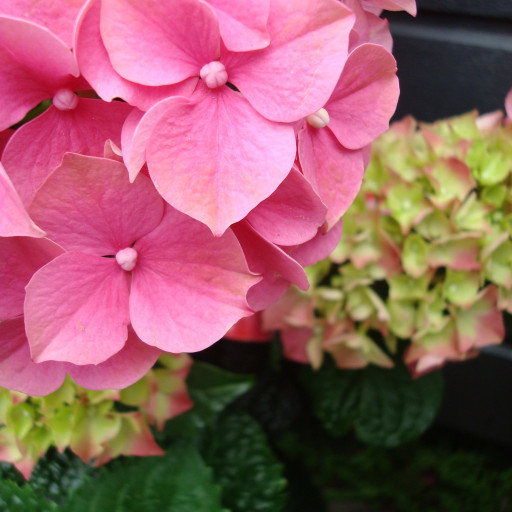
Plant Overview
Often called the "Mophead" or "French Hydrangea," this stunning shrub is the crown jewel of the summer garden. Native to the seaside cliffs of Japan, it has captivated gardeners for centuries with its lush, oversized blooms and dramatic foliage. Its name, derived from the Greek words for "water vessel," perfectly describes both its intense thirst and its unique, bowl-shaped blossoms that seem to drink in the morning mist.
🔍 How to Identify
- 🍃 Lush Foliage: Large, thick, heart-shaped leaves with distinct serrated (toothed) edges and a deep green, slightly waxy finish.
- 🌸 Bloom Style: Flowers appear in two main forms: the "Mophead" (large, round globes of sterile flowers) or the "Lacecap" (flat discs with tiny fertile buds in the center ringed by showy outer petals).
- 🌿 Growth Habit: A rounded, deciduous shrub that can reach heights of 3 to 7 feet, often featuring sturdy, woody stems that become more "bark-like" as the plant matures.
🏡 In Your Garden
- 💧 The "Water Vessel" Rule: These plants are notorious for "fainting" or wilting in the afternoon heat. They require consistently moist, well-draining soil and vastly prefer morning sun followed by dappled afternoon shade to prevent scorched leaves.
- 🎨 The pH Mood Ring: This is one of the few plants where you can "choose" the flower color. In acidic soils (low pH), the blooms turn blue; in alkaline soils (high pH), they shift to pink. This is caused by the plant’s ability to move aluminum from the soil into the petals.
- ✂️ Pruning Caution: Most varieties bloom on "old wood" (stems from the previous year). If you prune them back too hard in late winter, you might accidentally cut off all of next summer's flower buds!
⚠️ Safety & Toxicity
- 🐾 Status: Mildly to moderately toxic to humans and pets.
- 🤢 Details: The plant contains cyanogenic glycosides (hydrangin). If leaves or flower buds are ingested, they can cause stomach upset, vomiting, and lethargy in dogs, cats, and horses. Contact with the sap may also cause minor skin irritation for sensitive gardeners.
✨ Fun Fact
In Japanese culture, the Hydrangea is associated with heartfelt emotion, gratitude, and sometimes apology. Legend says an ancient emperor gave hydrangeas to the family of a girl he loved to show how much he cared for her after neglecting her for business duties.

Detailed Care Instructions
In the right growing conditions, hydrangeas very often live for many decades. Shooting star hydrangea is typical in this regard. Lifespans of 50 years are not uncommon, and this plant sometimes continues on through several homeowner generations.
How should I use this plant in the landscape?
Shooting star hydrangea, like other varieties, works well when planted in groups in a shrub border, or as a foundation planting. And it is better than most varieties as a potted specimen. With its large, long-lasting flowers, it can also work well as an isolated specimen plant.
Do the blossoms on shooting star hydrangea work well as cut flowers?
Yes. In peak bloom, the blossoms are long-lasting when displayed in a water-filled vase. They blend well in mixed arrangements with roses surrounding them. They also make good dried flowers if cut as the blossoms are just beginning to dry on the living plant in early fall. Dried hydrangea flowers can serve as attractive indoor arrangements for months through the winter.
| Color | Varies From Reddish To Violet-Blue Depending On The Soil Ph |
| Soil Ph | Below 5.5 For Blue Flowers, 5.5 To 6.5 For Purple Flowers, Above 6.5 For Reddish Flowers |
| Lighting | Full Sun |
| Soil Type | Fertile, Well-Drained |
| Bloom Time | July And August |
| Plant Type | Deciduous Shrub |
| Mature Size | 3 To 4 Feet High And 4 To 5 Feet Wide |
| Native Area | Hydrangea Macrophylla Is Native Both To Asia And To Parts Of The New World |
| Sun Exposure | Prefers Partial Shade Generally But Can Tolerate Some Sun Under Certain Conditions |
| Hardiness Zones | 4 To 9 |
To grow a Hydrangea Macrophylla plant, you can follow these steps:
- Choose an appropriate location: Hydrangeas prefer partial shade, so select a spot in your garden that receives morning sun and afternoon shade. It should also have well-draining soil.
- Prepare the soil: Hydrangeas thrive in moist and well-drained soil. Add organic matter like compost or peat moss to improve soil quality and drainage. This will create a favorable environment for the plant to grow.
- Dig the hole: Dig a hole that is slightly wider and deeper than the root ball of the plant. This will ensure the roots have enough space to spread out and establish.
- Plant the hydrangea: Place the plant in the hole, making sure it sits at the same level as it was in its container. Backfill the hole with soil, gently firming it around the roots.
- Water the plant: Give the newly planted hydrangea a thorough watering. The soil should be kept moist, but not waterlogged. Water consistently, especially during hot and dry periods.
- Mulch the plant: Apply a layer of organic mulch, such as wood chips or shredded leaves, around the base of the plant. This will help retain moisture, prevent weed growth, and regulate soil temperature.
- Fertilize appropriately: Hydrangeas benefit from a balanced, slow-release fertilizer. Apply it according to the manufacturer's instructions during the growing season, usually in spring and summer.
- Prune as necessary: Hydrangea Macrophylla has different varieties, including those that bloom on old wood and those that bloom on new wood. Prune accordingly to encourage healthy growth and optimal blooming.
- Protect from frost: If you live in an area with cold winters, consider protecting your plant from frost by covering it with burlap or a frost cloth.
- Monitor for pests and diseases: Keep an eye out for common pests such as aphids or powdery mildew. Take appropriate measures to control and prevent any issues.
Remember to research the specific variety of Hydrangea Macrophylla you have, as there may be some variations in care requirements.

Place in a window with dappled sun or a spot in the middle of a room. Or directly in a window facing west or east.

To water this particular plant, it is important to keep the soil evenly moist at all times, without allowing it to become waterlogged or completely dry out. To achieve this, you can water the plant deeply once or twice a week, depending on the weather and moisture levels in the soil. When watering, it is best to avoid getting water on the leaves and flowers, as this can cause them to rot and become diseased. Additionally, using a layer of mulch around the base of the plant can help to retain moisture in the soil and prevent the need for frequent watering. Finally, it is important to monitor the plant carefully and adjust your watering schedule as necessary based on its specific needs.
- Choose a balanced fertilizer with a ratio of 10-10-10 or 12-12-12.
- Apply the fertilizer in early spring before new growth appears.
- Use a granular fertilizer and sprinkle it around the base of the plant.
- Water the plant thoroughly after fertilizing.
- Repeat the fertilization process in early summer.
- Avoid over-fertilizing as it can damage the roots and leaves of the plant.
- Always follow the instructions on the fertilizer package for proper dosage and application.
Hydrangea Macrophylla prefers moist, well-draining soil that is rich in organic matter and slightly acidic. Avoid soils that are too alkaline or too compacted, as this can limit nutrient uptake and hinder drainage. Adding compost or peat moss to the soil can help improve its texture and acidity. It's also important to monitor soil moisture and avoid allowing the soil to dry out completely, as this can lead to wilted and stressed plants.
Hydrangea Macrophylla plants can be propagated through stem cuttings. First, select a healthy stem from the parent plant that is approximately 4-6 inches long and does not have any blooms. Cut the stem just below a set of leaves. Remove the leaves from the bottom half of the stem and dip the cut end in rooting hormone powder.
Fill a pot with a well-draining potting mix and create a hole in the center with a pencil or stick. Insert the stem cutting into the hole and firm the soil around it. Place a plastic bag over the top of the pot to create a greenhouse effect. Keep the soil moist and place the pot in a bright, but indirect light.
After about 4-6 weeks, check to see if roots have formed by gently tugging on the stem cutting. If there is resistance, roots have formed and the plastic bag can be removed. If not, leave the cutting covered and check again in another 2-3 weeks.
Once the cutting has rooted, it can be transplanted into a larger pot or outside in a suitable location. Over time, the new plant will grow and produce beautiful blooms like the parent plant.
Common pests of the hydrangea include Spider mites, fungus gnats, aphids. Make a habit of checking your hydrangea frequently for pests so that any infestations can be caught and managed early.








