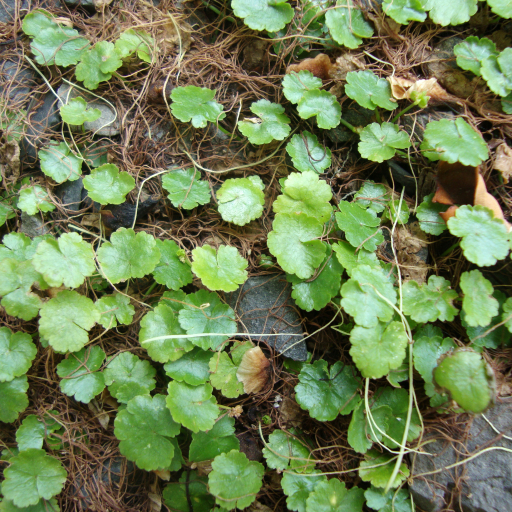
Plant Overview
Often called the Lawn Marshpennywort, this tiny powerhouse is a favorite among aquascapers and a persistent guest in damp lawns. With its perfectly round, scalloped leaves, it looks like a miniature fairy garden made of floating lily pads. While some see it as a stubborn weed, others treasure it as "Crystal Confetti" for its ability to create a lush, emerald carpet in any moist environment.
🔍 How to Identify
- 🍃 Leaf Shape: Small, round leaves (usually less than an inch wide) with distinct scalloped or lobed edges that resemble tiny umbrellas or pennies.
- 🌱 Growth Habit: A low-growing, creeping perennial that spreads via horizontal stems (stolons) that root at every node, creating a dense mat.
- 🌼 Flowers: Produces inconspicuous, tiny greenish-white flower clusters that often hide beneath the foliage, appearing mostly in the warmth of summer.
🏡 In Your Garden
- 💧 Moisture Lover: This plant is a natural "indicator species" for wet soil; it thrives in boggy areas where traditional grass struggles to survive.
- ✂️ Vigorous Spreader: Because it roots wherever it touches the ground, it can be difficult to relocate once established. If you are using it in a terrarium or aquarium, regular "haircuts" are necessary to prevent it from overtaking smaller plants.
⚠️ Safety & Toxicity
- 🐾 Pet Friendly: Hydrocotyle sibthorpioides is generally considered non-toxic to cats, dogs, and horses, making it a safe choice for pet-accessible gardens.
- 🛡️ Skin Sensitivity: While it isn't poisonous, the sap can occasionally cause mild skin irritation for those with sensitive skin. It is always a good idea to wear gloves when performing heavy pruning.
✨ Fun Fact
In the world of "aquascaping" (underwater gardening), this plant is highly prized for its "Crystal Confetti" variation, which features white variegation on the leaves, making it look like the aquarium floor has been sprinkled with snow!

Detailed Care Instructions
To grow Hydrocotyle Sibthorpioides plant, also known as dwarf marsh pennywort or crystalwort, you can follow these steps:
- Choose the right location: Hydrocotyle Sibthorpioides prefers partial shade or filtered sunlight. You can grow it in a pond, water garden, or container. Ensure the water depth is suitable for the plant.
- Planting: If growing in a pond or water garden, plant the Hydrocotyle Sibthorpioides in a container with aquatic soil or a mixture of sand and clay. If growing in a container, use a pot filled with a soil mix composed of rich organic matter and clay.
- Water requirements: Since Hydrocotyle Sibthorpioides is an aquatic plant, it requires constantly moist or submerged conditions. Maintain the water level consistently; if growing in a container, keep the pot submerged in water.
- Nutrients: Provide adequate nutrients to the plant. You can use a balanced aquatic fertilizer once a month during the growing season. This will support healthy growth and development.
- Maintenance: Remove any dead or decaying leaves regularly to ensure the plant's well-being. If your Hydrocotyle Sibthorpioides grows too vigorously, you may need to trim it occasionally to keep it in check.
- Overwintering: If you live in a colder climate, bring the plant indoors before the first frost. Place it near a window or artificial light source to provide sufficient light during winter.
- Propagation: Hydrocotyle Sibthorpioides can be propagated by dividing the plant clumps. Lift the plant out of the water, trim the roots, and gently separate the clumps into smaller sections. Plant the divisions in separate containers or ponds.
Remember, each plant's growth may vary slightly based on specific environmental conditions and care provided. Observing the plant and making adjustments accordingly will help ensure its successful growth.

Place in a bright room that is sun drenched almost all day. Or directly in a south-facing window.

Hydrocotyle Sibthorpioides is a plant that requires consistent watering to maintain its health and growth. When watering this plant, it's important to ensure that the soil is thoroughly moistened, but not waterlogged.
To water Hydrocotyle Sibthorpioides, start by checking the soil moisture level with your finger. If the soil is dry up to the first inch, it's time to water the plant. When watering, use a watering can or a hose with a gentle flow, and direct the water at the base of the plant.
Be careful not to water too much or too quickly. Slowly pour water around the base of the plant, allowing it to soak into the soil. Keep adding water until the soil is moist, but not saturated or pooling.
It's important to avoid getting water on the leaves or stems of Hydrocotyle Sibthorpioides, as this can cause fungal and bacterial diseases. Instead, water only at the base, and allow excess moisture to drain away.
During periods of hot or dry weather, you may need to water Hydrocotyle Sibthorpioides more frequently. Keep an eye on the moisture level of the soil and adjust your watering schedule as needed.
Overall, Hydrocotyle Sibthorpioides is a beautiful and easy-to-care-for plant, as long as it's given the right amount of water and attention.
To fertilize this plant, use a balanced fertilizer with equal parts nitrogen, phosphorus, and potassium. Dilute the fertilizer in water according to the package instructions and apply to the soil once every two weeks during the growing season. Do not over-fertilize, as this can lead to root burn and other problems. Always water the plant thoroughly after fertilizing to avoid fertilizer buildup and ensure that nutrients are distributed evenly throughout the soil.
Hydrocotyle Sibthorpioides plant requires a well-draining soil mix that is rich in organic matter. It is recommended to use a substrate that is light and airy to promote healthy root development. A mixture of peat or coir, perlite, and vermiculite is ideal for this plant. Additionally, adding bark fines can help increase porosity and water retention. The soil should have a pH level of between 6.0 and 7.5. It is important to avoid using soils that are too heavy or clay-like as they can retain too much water and lead to root rot.
To propagate this plant, you will need to carefully separate individual stems or runners from the parent plant. Use sharp scissors or a clean knife to cut the stems or runners near the base of the plant. Make sure that each stem or runner has several healthy leaves and roots attached.
Once you have separated the stems or runners, plant them in a new aquarium or container filled with fresh water. You can also plant them in a substrate such as sand or gravel, but make sure the roots are firmly anchored in the substrate.
Provide the newly propagated plants with ample light, preferably from a full-spectrum LED or fluorescent bulb. Also, make sure the water temperature is suitable for the plant species. Ideally, the Hydrocotyle Sibthorpioides plant should be kept in temperatures between 72°F to 82°F.
Monitor the new plants regularly to ensure they are growing well. You may need to add additional nutrients to the water or substrate to promote healthy growth.
With proper care and attention, your newly propagated Hydrocotyle Sibthorpioides plants should thrive and add beauty to your aquarium or aquascape.








