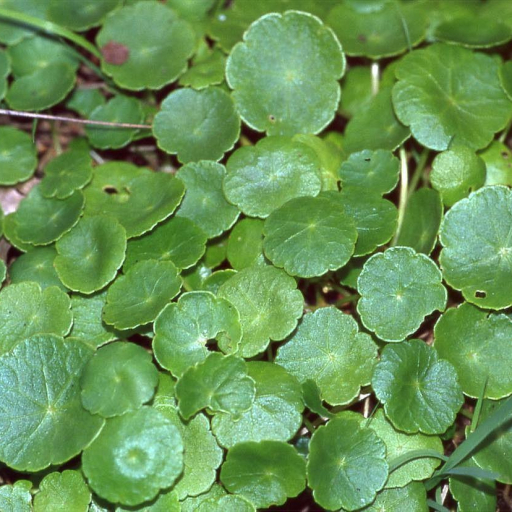
Plant Overview
Often called the Marsh Pennywort or "Water Moneywort," Hydrocotyle vulgaris looks like a collection of tiny green umbrellas scattered across a pond's edge. In various cultures, its perfectly round, coin-shaped leaves are seen as symbols of prosperity and "good luck." This creeping perennial is a master of the wetlands, effortlessly bridging the gap between soggy soil and open water.
🔍 How to Identify
- 🍃 Peltate Leaves: The most striking feature is the round, scalloped leaf where the stem attaches directly to the center of the underside, rather than the edge.
- 📏 Creeping Habit: It grows via horizontal runners (stolons) that "walk" across the ground, sending down roots at every node to form a dense, lush mat.
- 🌸 Hidden Blooms: Look closely beneath the leaves to find tiny, inconspicuous clusters of white or pinkish-green flowers that appear in mid-summer.
🏡 In Your Garden
- 💧 The Bog Specialist: This plant is essentially a "water baby." It thrives in mud, boggy soil, or shallow water up to 2 inches deep. It is the perfect choice for masking pond liners or softening the edges of a water feature.
- 🌱 Containment Strategy: Because it spreads rapidly through runners, it can become aggressive in a small garden. If you want to keep it in check, plant it in a submerged pot rather than directly in the ground to "cage" the roots.
⚠️ Safety & Toxicity
- 🐾 Pet-Friendly: Hydrocotyle vulgaris is generally considered non-toxic to cats, dogs, and horses, making it a safe addition to a family backyard.
- 🖐️ Skin Contact: While not poisonous, the plant’s juices can occasionally cause very mild skin irritation or "contact dermatitis" in humans with highly sensitive skin during heavy pruning.
✨ Fun Fact
Despite its appearance, which mimics a miniature water lily, the Marsh Pennywort is actually a distant relative of carrots and parsley! It belongs to the Apiaceae family, though you definitely shouldn't try to add this particular "parsley" to your soup.

Detailed Care Instructions
| Humidity | Normal |
| Lighting | Shade |
| Difficulty | Medium |
| Hibernation | Cold Period |
| Temperature | 18°C - 28°C |
| Hardiness Zones | 6 - 10 |
To grow Hydrocotyle vulgaris (also known as water pennywort), follow these steps:
- Obtain the plant: Hydrocotyle vulgaris can be found at local nurseries or water gardening stores. You can also consider collecting it from the wild, ensuring it is legal and sustainable in your area.
- Choose a suitable container: Select a container with sufficient depth to accommodate the plant's spreading habit and allow ample room for root growth. A shallow bowl or a pond planter would work well.
- Prepare the growing medium: Fill the container with a mixture of equal parts aquatic compost and coarse sand or fine gravel. Alternatively, you can use a specialized aquatic soil mix.
- Plant the Hydrocotyle vulgaris: Place the plant's roots gently into the growing medium, ensuring that the crown is level with the surface. Cover the roots with additional aquatic compost.
- Provide the right environment: Hydrocotyle vulgaris prefers growing in shallow water (up to 15 cm or 6 inches depth). You can either use a pond or a water-filled container, ensuring it receives adequate light. Place the container in a sunny or partially shaded area, avoiding direct exposure to intense sunlight.
- Monitor water levels: Maintain a consistent water level in the container, ensuring it covers the plant's roots without submerging the leaves. Hydrocotyle vulgaris is a water-loving plant but can tolerate occasional drying as long as its roots remain moist.
- Water quality: The plant thrives in clean, oxygenated water. Regularly check and maintain the water quality by removing debris, adding beneficial bacteria, and avoiding the use of harmful chemicals.
- Nutrient requirements: Hydrocotyle vulgaris benefits from organic fertilizers designed for aquatic plants. Follow the instructions on the fertilizer packaging to ensure balanced nutrition.
- Pruning: trim back any excessive growth to prevent the plant from overtaking the container. Use sharp scissors or pruning shears to remove any dead or yellowing leaves.
- Winter care: If you live in an area with freezing temperatures, bring the container indoors or provide protective coverings to prevent cold damage.
- Propagation: Hydrocotyle vulgaris can be propagated by separating or trimming the plant to create new rooted sections. These can be replanted into the same container or additional ones.
Remember, maintaining a healthy aquatic environment is crucial for the successful growth of Hydrocotyle vulgaris. Regularly monitor and adjust water conditions as needed, and enjoy the beauty of this versatile plant in your home or garden.

Place in a window with dappled sun or a spot in the middle of a room. Or directly in a window facing west or east.

To water the plant, pour water gently over the soil so that it absorbs into the roots, being careful not to disturb the fragile leaves and stems. Water deeply enough that the soil is evenly moist, but avoid overwatering as this can cause root rot. Monitor the plant over time and adjust your watering schedule as needed based on the moisture levels in the soil.
To fertilize this particular plant, it is recommended to use a liquid fertilizing solution. Dilute the fertilizer according to instructions on the label and apply it to the soil surrounding the plant. It is important to fertilize regularly, but not to over-fertilize, as this can damage the plant. It is also a good idea to supplement the fertilizer with trace minerals or organic compost. Consider using a balanced 10-10-10 fertilizer to provide equal amounts of nitrogen, phosphorus, and potassium to the plant.
The appropriate soil for this plant should have good drainage properties to support healthy root growth. It should also have a slightly acidic pH level (between 5.5 and 7.0) to ensure optimal nutrient uptake. The soil should be rich in organic matter to maintain soil moisture and support microbial activity, which plays a critical role in nutrient cycling. It is best to avoid heavy clay soils that hold too much moisture and can suffocate the delicate roots of this plant. Additionally, the soil should be well-aerated to prevent waterlogging and root rot. Finally, it is recommended to choose a soil that is free from contaminants and pesticides, which can harm the plant and its natural ecosystem.
Hydrocotyle vulgaris can be propagated through various methods such as division, runners and stem cuttings.
Propagation through division is done by separating plant clumps into smaller sections, ensuring that each section has roots and leaves. These sections can then be replanted in a new location or pot.
Propagation through runners involves taking a small portion of the stem and planting it into soil or water. Over time, roots and leaves will grow from this portion and develop into a new plant.
Propagation through stem cuttings is done by cutting a portion of the stem and placing it in soil or water until it forms roots. Once roots have formed, the cutting can be planted into a pot or a new location. It is important to make sure that the cutting has at least one node, which is where new roots and leaves will sprout from.
Regardless of the propagation method chosen, it is important to keep the soil or water moist, and to provide adequate light and nutrients to ensure successful growth.
Common pests of the marsh pennywort include Spider mites, larvae. Make a habit of checking your marsh pennywort frequently for pests so that any infestations can be caught and managed early.








