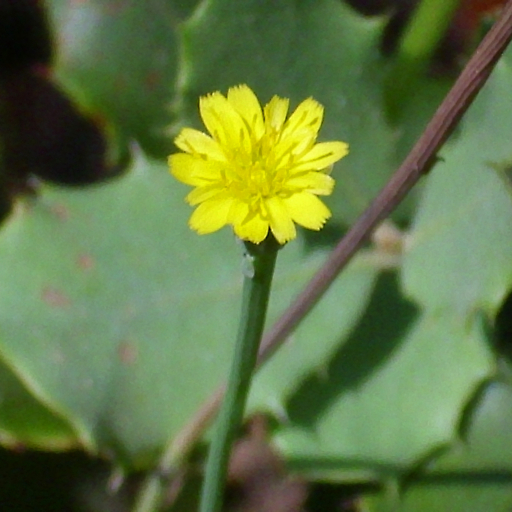
Plant Overview
Often called the Rough Swine-succory, Hyoseris scabra is a resilient, low-profile beauty native to the sun-drenched coasts and rocky hillsides of the Mediterranean. While it might look like a simple dandelion at first glance, this "tough-as-nails" wild herb has evolved to thrive in some of the harshest, saltiest, and most compact soils where other plants would wither.
🔍 How to Identify
- ☀️ The Rosette: It grows in a tight, flat circle of leaves pressed closely to the ground, a clever tactic to survive heavy winds and trampling.
- 🌼 The Flowers: Bright yellow, composite flower heads sit atop leafless stalks. Unlike the common dandelion, these stalks often become noticeably thicker and somewhat hollow near the top.
- 🌵 The "Scabra" Texture: True to its name (scabra means rough), the bracts at the base of the flower and parts of the stems have a distinctively coarse, almost scaly texture when touched.
🏡 In Your Garden
- 🌱 Soil Master: This plant is an "extremophile" of the garden world. It doesn't want nutrient-rich potting mix; it prefers poor, sandy, or alkaline soils where drainage is instant.
- 💧 Drought Strategy: Because it possesses a sturdy taproot, it can survive long periods of neglect and high heat. If you find it in your yard, it’s usually a sign that your soil is quite compacted or dry.
- 🐚 Coastal Charm: It is highly tolerant of salt spray, making it a frequent sight in seaside gardens or cracks in stone walls along the Mediterranean coast.
⚠️ Safety & Toxicity
- 🟢 Non-Toxic Status: Hyoseris scabra is generally considered non-toxic to humans and common pets.
- 🧴 Sensitive Skin: Like many members of the Asteraceae family, the milky sap inside the stems can occasionally cause mild skin irritation or "contact dermatitis" for people with very sensitive skin or ragweed allergies.
✨ Fun Fact
Hyoseris scabra is a master of "bet-hedging." It produces two different types of seeds on the same flower head: some are designed to fly away with the wind to find new homes, while others are heavier and stay exactly where the parent grew to ensure the colony survives in its original spot!

Detailed Care Instructions
To grow Hyoseris scabra, also known as rough cat's ear, you can follow the steps below:
- Choose the right location: Hyoseris scabra thrives in full sun to partial shade. Select a spot in your garden or outdoor space that receives at least 6 hours of direct sunlight each day.
- Soil preparation: Prepare the soil by loosening it with a garden fork or tiller. The soil should be well-draining and moderately fertile. If your soil is heavy clay, consider adding compost or organic matter to improve drainage.
- Sowing seeds: Hyoseris scabra plants can be grown from seeds. Sow the seeds directly into the prepared soil in early spring or early autumn. Lightly cover the seeds with a thin layer of soil.
- Watering: Keep the soil evenly moist but not waterlogged during the germination and establishment period. Water deeply every couple of days or as needed, ensuring the top few inches of soil are moist.
- Thinning and spacing: Once the seedlings have sprouted, thin them out to provide each plant with enough space to grow. Leave a spacing of about 8-10 inches between each plant.
- Mulching: Apply a layer of organic mulch around the plants to help retain moisture, suppress weed growth, and regulate soil temperature. This will also help maintain soil fertility.
- Maintenance: Regularly weed the area to reduce competition for nutrients and water. Hyoseris scabra does not require extensive maintenance, but occasional fertilization with a balanced, slow-release fertilizer during the growing season can promote healthy growth.
- Harvesting: Depending on the variety, Hyoseris scabra typically flowers in late spring to early summer. You can harvest the blooms for ornamental purposes or let them remain in the garden to attract pollinators.
- Propagation: Hyoseris scabra can also be propagated through division or root cutting. This is best done in spring or autumn.
With proper care and attention to these steps, your Hyoseris scabra plant should grow well and provide beautiful blooms in your garden.

Place in a bright room that is sun drenched almost all day. Or directly in a south-facing window.

To water this specific plant, you should check the soil moisture level on a regular basis. When the soil feels dry to the touch, it is time to water the plant. To avoid overwatering, make sure that water doesn't sit in the saucer for long periods of time, and only water the plant until the soil is evenly moist but not soaking wet. It is important to use lukewarm water and water the plant at the base, not on the foliage. In general, you should aim to keep the soil moderately moist during the growing season and allow it to dry out slightly between waterings during the winter months.
To fertilize this plant, use a slow-release fertilizer with balanced NPK (nitrogen, phosphorus, potassium) ratios, applying it during the spring and summer months. Dilute the fertilizer according to the package directions and apply it to moist soil around the base of the plant in a circular pattern. Avoid over-fertilizing, which can cause excessive growth and weak stems. Additionally, supplement with organic matter such as compost or aged manure to improve soil fertility.
Hyoseris scabra plant is a species of flowering plant that belongs to the family Asteraceae. It is a perennial plant that is native to certain regions of Asia and Europe. The plant requires a well-draining soil that is rich in nutrients, without being too wet or damp. A mixture of sand and loam with some organic compost added to it would be ideal for planting Hyoseris scabra. The plant thrives best under full sunlight or partial shade but can tolerate a range of temperatures with adequate moisture. It is important to keep the soil moist, especially during the initial stages of growth when the plant is establishing its roots. Water the plant only when the top inch of the soil is dry to the touch. Overwatering may cause root rot, so it is important to maintain proper drainage and avoid standing water around the roots. Adding a layer of mulch around the plant can help retain soil moisture and suppress weeds. The correct soil and growing environment will help the plant to bloom and propagate healthily.
Hyoseris Scabra plant can be propagated through various methods, including seed propagation and vegetative propagation. To propagate the plant through seed, collect the seeds from a mature plant in the fall or early winter. Sow the seeds in a well-draining soil mix and maintain moist conditions until germination occurs.
For vegetative propagation, select a healthy plant with strong stems and roots. Cut a stem from the plant, making sure it has at least one node. Remove any lower leaves from the stem and dip the cut end in rooting hormone powder. Plant the stem in a well-draining soil mix and maintain a moist environment until roots develop.
Another method of vegetative propagation is by dividing an established plant. Carefully dig up the root system and gently separate the plant into two or more sections. Replant each section in a well-draining soil mix and maintain moist conditions until the plants establish themselves.
Hyoseris Scabra plant propagates easily through both seed and vegetative methods, making it a great choice for propagators and gardeners alike.








