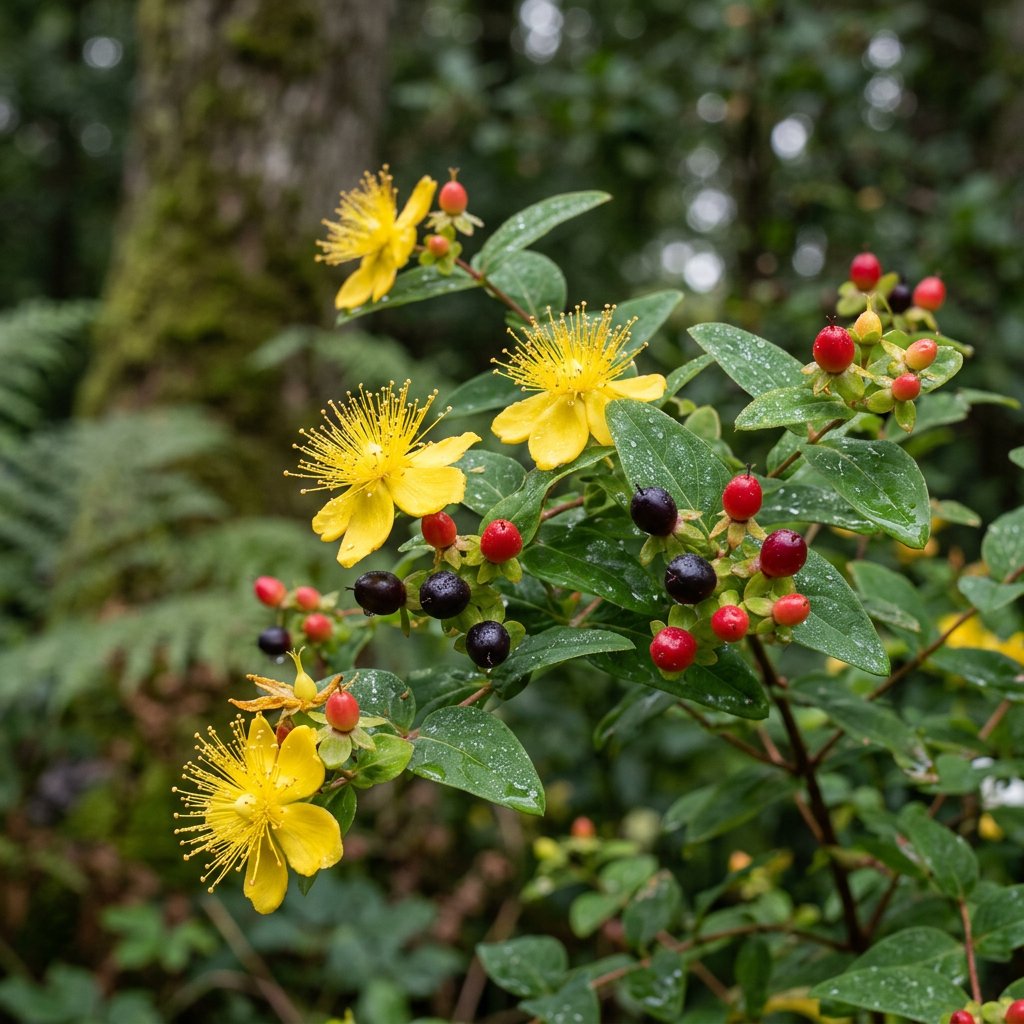
Plant Overview
Often called Tutsan or Sweet-amber, this charming semi-evergreen shrub has been a staple of European woodland gardens for centuries. Its common name, Tutsan, is a corruption of the French toute-saine, meaning "all-heal," referring to its ancient reputation as a medicinal wonder. Today, it is most loved for its "four-season" interest, offering cheerful yellow blooms followed by a dramatic display of berries that change colors like a traffic light.
🔍 How to Identify
- 🌟 Star-Burst Flowers: The blooms are bright yellow with five petals, but their most striking feature is the explosion of long, thread-like stamens that look like tiny gold fireworks erupting from the center.
- 🍃 Aromatic Foliage: The oval, leathery leaves grow in opposite pairs. If you crush a dried leaf, it releases a distinct, pleasant scent reminiscent of amber or resin.
- 🍒 Color-Shifting Berries: Unlike many plants that produce one fruit color, Tutsan berries transition from a pale green to a brilliant fleshy red, finally ripening into a glossy, ink-black finish.
🏡 In Your Garden
- 🌦️ The Shade Specialist: While many flowering shrubs crave the baking sun, Tutsan is a woodland native. It thrives in dappled shade and moist soil, making it the perfect candidate for those tricky corners of the garden where other plants struggle.
- ✂️ Low Maintenance Habit: It grows in a neat, mounded shape. Because it is a "hypericum," it is incredibly resilient; even if it looks a bit ragged after a harsh winter, a hard pruning in spring will usually result in a flush of fresh, vigorous growth.
⚠️ Safety & Toxicity
- 🚫 Status: Mildly Toxic.
- 🐾 Details: While not considered deadly, the colorful berries can cause stomach upset, nausea, or vomiting if ingested by children or pets. It is best to admire the berries visually rather than culinary. Additionally, like some other members of the Hypericum family, it may cause skin sensitivity (photosensitivity) in some livestock if consumed in large quantities.
✨ Fun Fact
In the past, Tutsan leaves were commonly used as "Bible leaves" or bookmarks. People would place a leaf inside their Bibles or prayer books; as the leaf dried, it would release a sweet, lingering fragrance that filled the air every time the book was opened during a service.

Detailed Care Instructions
Hypericum androsaemum, commonly known as Tutsan or St. John's Wort, is a sturdy and low-maintenance shrub that can be grown in various climates. Here are some steps to help you grow this plant:
- Choose the right location: Tutsan prefers a partially shaded spot in your garden or patio. It can tolerate full sun but may also thrive in areas with dappled sunlight.
- Soil preparation: Tutsan prefers well-draining soil with a slightly acidic to neutral pH. Amend the soil with organic matter like compost to improve its fertility and drainage.
- Planting: Plant your Tutsan shrub in spring or early fall. Dig a hole that is slightly larger than the plant's root ball and place the plant in it, ensuring it sits at the same level as it was in its nursery container. Backfill the hole with soil and gently pat it down to remove any air pockets.
- Watering: Water the newly planted shrub thoroughly, providing enough moisture to keep the soil consistently moist but not waterlogged. Once established, Tutsan is relatively drought-tolerant.
- Mulching: Apply a layer of organic mulch, like wood chips or straw, around the base of the plant. This helps conserve moisture, suppresses weed growth, and provides insulation to the roots.
- Pruning: Prune Tutsan in early spring or late winter to remove any dead or damaged branches. This will promote new growth and maintain the plant's shape.
- Fertilizing: Tutsan generally doesn't require regular fertilization. However, if you notice stunted growth or pale foliage, you can apply a balanced slow-release fertilizer in early spring.
- Pests and diseases: Tutsan is generally resistant to pests and diseases, but keep an eye out for spider mites, aphids, or leaf spot diseases. Treat affected plants promptly with insecticidal soap or organic fungicides, if necessary.
- Propagation: Tutsan can be propagated through seed or by taking softwood stem cuttings in late spring or early summer. Plant the seeds or cuttings in a well-draining potting mix and keep them in a warm, bright location until they root or germinate.
- Winter care: Tutsan is generally hardy in USDA zones 5-9. In colder regions, apply a thick layer of mulch around the base of the plant in late fall to insulate the roots during winter.
By following these steps, you should be able to successfully grow Hypericum androsaemum in your garden or outdoor space.

Place in a window with dappled sun or a spot in the middle of a room. Or directly in a window facing west or east.

Hypericum Androsaemum is a plant that requires regular watering to thrive. To water the plant, you should first assess the soil moisture. If the soil feels dry to the touch, it is time to water.
When watering, use a watering can or hose to apply water directly to the base of the plant. Avoid getting water on the leaves or flowers, as this can increase the risk of disease.
Water the Hypericum Androsaemum plant deeply, ensuring that the water reaches the roots. Allow the soil to drain completely after watering, as this will prevent waterlogging and root rot.
In general, the Hypericum Androsaemum plant should be watered once a week in the summer months and less frequently in the winter. However, the exact watering schedule will depend on the climate and growing conditions in your area.
Regular watering, along with adequate sunlight and fertilization, will help to promote healthy growth and flowering in the Hypericum Androsaemum plant.
To fertilize this plant, first make sure that the soil is moist before applying the fertilizer. Use a balanced fertilizer with equal parts nitrogen, phosphorus, and potassium. Apply the fertilizer to the base of the plant, avoiding contact with the leaves and stems. Water the plant immediately after fertilizing to help the nutrients soak into the soil. Repeat this process every four to six weeks during the growing season.
Hypericum Androsaemum plant thrives well in well-drained soil that is fertile and rich in organic matter. The pH of the soil should be slightly acidic to neutral, ranging from 6.0 to 7.0. The soil should be able to retain moisture, but not remain waterlogged for an extended period. The plant prefers loamy soil that is a mixture of sand, silt, and clay in equal proportions. Adding compost or well-rotted manure to the soil can enhance its quality and aid in moisture retention. It is best to avoid heavy clay soils as they tend to become waterlogged, which can lead to root rot. Sandy soils can also be too dry, making it challenging to maintain adequate moisture levels for the plant's growth. Appropriate soil preparation is essential to ensure that the plant grows well and produces healthy foliage and flowers.
To propagate this plant, you can take stem cuttings in the summer when the plant is actively growing. Choose a healthy stem with several nodes and remove the lower leaves. Dip the cut end in rooting hormone and plant it in a pot filled with a well-draining soil mix. Keep the soil moist and the cutting in a bright, but not direct, light. After a few weeks, the cutting should have rooted and can be transplanted into a larger pot or planted outside in a suitable location.








