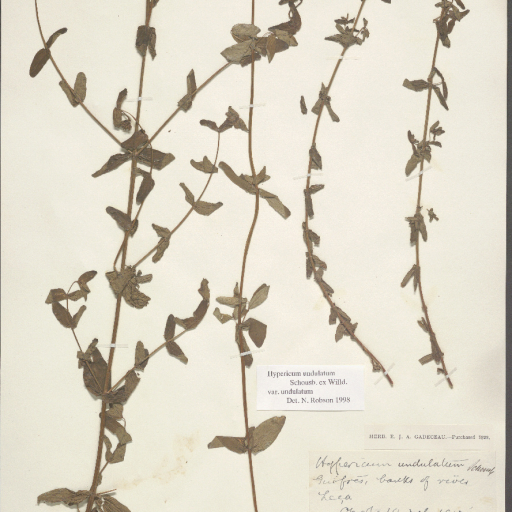
Plant Overview
Often found dancing along the edges of marshes and damp meadows, the Wavy-edged St. John's Wort (Hypericum undulatum) is a moisture-loving gem of the botanical world. While its golden blossoms resemble its famous cousins used in herbal tea, this particular species tells a story of the wetlands, favoring the cool, damp soils of Western Europe and North Africa. It is a resilient perennial that brings a splash of sunshine to the boggiest corners of a landscape.
🔍 How to Identify
- 🌊 The "Wavy" Foliage: Its most defining feature is the undulating or "wavy" margins of the leaves, which give the plant a textured, ruffled appearance compared to other St. John's Worts.
- 🟥 Square Stems: If you run your fingers down the stem, you’ll notice it has four distinct ridges or "wings," often tinged with a deep reddish-burgundy hue.
- ✨ Golden Blooms: The flowers are a bright, buttery yellow, featuring five petals often tipped with tiny black glands (dots) and a central explosion of busy stamens.
🏡 In Your Garden
- 💧 The Water Lover: Unlike the common St. John's Wort which thrives in dry fields, this species has "wet feet." It is the perfect candidate for a rain garden, the edge of a pond, or heavy clay soils that stay damp year-round.
- ☀️ Sun and Shimmer: To see those golden petals truly shine, place it in full sun. While it can tolerate partial shade, the "waviness" of its leaves and the intensity of its floral display are most dramatic with plenty of light.
⚠️ Safety & Toxicity
- 🐾 Mildly Toxic: Like many members of the Hypericum family, this plant contains hypericin. If ingested in large quantities, it can cause photosensitivity (skin sensitivity to sunlight) in livestock and pets.
- 👶 General Caution: While not considered deadly to humans, it is best kept away from curious toddlers and pets who might be tempted to nibble, as it can cause stomach upset or skin irritation in sensitive individuals.
✨ Fun Fact
If you hold a leaf up to the light, you will see tiny translucent "perforations." These aren't actually holes, but miniature "oil wells" filled with essential oils that the plant uses to deter hungry insects!

Detailed Care Instructions
To grow a Hypericum Undulatum plant, follow these steps:
- Choose a suitable location: Hypericum Undulatum plants prefer full sun or partial shade. Select a location in your garden that receives at least 4-6 hours of direct sunlight per day.
- Prepare the soil: This plant thrives in well-draining soil. Amend the soil by adding organic matter, such as compost, to improve its fertility and drainage. Ensure the soil pH is slightly acidic to neutral (around 6.0-7.0).
- Planting: Dig a hole that is slightly larger and wider than the plant's container. Gently remove the Hypericum Undulatum plant from its container and place it in the prepared hole. Ensure the top of the root ball is level with or slightly above the soil surface. Backfill the hole with soil, lightly firming it around the plant.
- Watering: Water the plant thoroughly after planting and keep the soil consistently moist but not waterlogged. Hypericum Undulatum plants prefer regular watering, especially during dry periods. However, they should not be overwatered as this can lead to root rot.
- Mulching: Apply a layer of organic mulch, such as wood chips or shredded bark, around the base of the plant. Mulching helps conserve moisture, suppress weeds, and regulate soil temperature.
- Pruning: Hypericum Undulatum plants generally require minimal pruning. However, if necessary, prune them in late winter or early spring to remove dead or damaged branches and to maintain a desired shape.
- Fertilizing: Apply a balanced, slow-release fertilizer in the spring to promote healthy growth. Follow the manufacturer's instructions for dosage and application. Avoid over-fertilization, as it can lead to excessive foliage growth at the expense of flowering.
- Pests and diseases: Hypericum Undulatum plants are generally resistant to pests and diseases. However, they may occasionally be susceptible to aphids, scale insects, or fungal leaf spot. Monitor the plant regularly and take appropriate action if any problems arise.
- Propagation: You can propagate Hypericum Undulatum plants through division or by taking stem cuttings in early spring or late summer. Divide the plant or take 4-6 inch stem cuttings with at least two sets of leaves. Remove the lower leaves and dip the cut end in rooting hormone before planting in a well-draining soil mix. Keep the cuttings moist and in a warm, sunny location until they root.
By following these steps, you can successfully grow Hypericum Undulatum plants in your garden.

Place in a bright room that is sun drenched almost all day. Or directly in a south-facing window.

Hypericum undulatum is a plant that requires regular watering to thrive. Here are some detailed guidelines on how to properly water this plant:
1. Assess the soil moisture: Before watering, check the moisture level of the soil by inserting your finger about an inch deep into the ground. If the soil feels dry at this depth, it's time to water the plant.
2. Watering method: It is recommended to use a watering can or hose with a gentle spray nozzle to water Hypericum undulatum. This allows for precise and even watering, preventing overwatering or causing damage to the plant.
3. Watering frequency: Hypericum undulatum prefers moist but not waterlogged soil. The frequency of watering depends on various factors like the climate, humidity levels, and the plant's age. Generally, it is good to water this plant once or twice a week, especially during dry periods. However, it's best to adjust the watering frequency based on how quickly the soil dries out.
4. Water volume: When watering Hypericum undulatum, ensure that the water reaches the roots. To achieve this, water the plant until you observe water draining from the bottom of the pot or until the soil feels adequately moist. Avoid shallow watering, as it only wets the surface and may deprive the plant's deeper roots of moisture.
5. Avoid overwatering: Although Hypericum undulatum requires consistent moisture, it is important not to overwater it. Excessive water can lead to root rot and other problems. Always allow the soil to partially dry out between waterings to prevent issues caused by waterlogged conditions.
6. Consider environmental factors: Different environmental conditions such as humidity, temperature, and the amount of sunlight affect the plant's water requirements. Higher temperatures and increased exposure to sunlight may necessitate more frequent watering, while cooler or shaded areas might require less watering. Observe the plant's response over time and adjust watering accordingly.
Remember, it is important to always consider the specific needs of the plant and to adapt your watering routine accordingly. Proper watering, along with other care requirements, will help ensure the health and vitality of Hypericum undulatum.
To fertilize Hypericum Undulatum plant, apply a balanced slow-release fertilizer in early spring or late winter, just before the growing season starts. Follow these instructions:
- Choose a complete, granular or pelletized fertilizer with an N-P-K ratio around 10-10-10 or 14-14-14. This means it should contain equal proportions of nitrogen (N), phosphorus (P), and potassium (K), essential nutrients for plant growth.
- Sprinkle the fertilizer around the base of the plant, avoiding direct contact with the stems or leaves.
- Use a garden fork or rake to lightly work the fertilizer into the top inch of soil. Be gentle to avoid damaging the plant's shallow roots.
- Water the plant thoroughly after fertilizing to help dissolve and distribute the nutrients into the soil.
- Repeat the fertilization process every 4 to 6 weeks during the growing season, typically from spring to early fall. Avoid fertilizing during the dormant winter period.
- Follow the manufacturer's instructions for application rates based on the size and age of your Hypericum Undulatum plant. Adjust the quantities accordingly.
Remember to always water the plant adequately after fertilization to prevent the roots from burning and to aid in nutrient absorption. Additionally, proper sunlight, watering, and overall care are crucial for the plant's health and growth.
When choosing soil for the Hypericum Undulatum plant, it is important to consider its growing requirements. This plant typically thrives in well-drained and moderately fertile soil. A recommended soil type is loamy soil, which provides a good balance of moisture retention and drainage.
Loamy soil is a combination of sand, silt, and clay that allows for adequate water movement while still retaining enough moisture for the plant's roots. It also offers good aeration, ensuring that oxygen can reach the plant's root system.
Additionally, the soil should be slightly acidic to neutral, with a pH ranging between 6.0 and 7.0. This pH range is ideal for the Hypericum Undulatum plant to properly absorb essential nutrients from the soil.
To improve the soil's fertility, organic matter can be added in the form of compost or well-rotted manure. This will enrich the soil's nutrient content, promoting healthy growth and overall vigor of the plant. It also enhances the soil's ability to retain moisture, reducing the frequency of watering.
It is important to note that the Hypericum Undulatum plant is sensitive to overwatering and poor drainage. Therefore, the soil should never become waterlogged or remain consistently wet. Adequate drainage can be achieved by adding perlite, vermiculite, or coarse sand to the soil mixture.
Regularly monitoring the soil moisture level is crucial. Allow the top few inches of soil to dry out between watering sessions to prevent issues such as root rot. However, be cautious not to completely dry out the soil, as this can negatively affect the plant's health.
Overall, using a well-draining loamy soil with a slightly acidic to neutral pH, enriched with organic matter, is essential for the successful growth and development of the Hypericum Undulatum plant.
Hypericum undulatum is a perennial flowering plant that can easily be propagated by various methods. Here are the details on how to propagate Hypericum undulatum:
- Propagation by Seeds:
- Collect mature seed capsules from the plant when they have turned brown and start to split open.
- Place the capsules in a paper bag and allow them to dry further for a week or two.
- Shake the dried capsules in the bag to release the seeds.
- Sow the seeds in a well-draining soil mix in pots or seed trays, lightly covering them with a thin layer of soil.
- Place the pots or trays in a warm, bright location, ensuring they receive indirect sunlight.
- Keep the soil consistently moist but not waterlogged.
- Germination usually occurs within 2-4 weeks. Once the seedlings are large enough, they can be transplanted into individual pots or directly into the garden.
- Collect mature seed capsules from the plant when they have turned brown and start to split open.
- Propagation by Cuttings:
- Take 4-6 inch (10-15 cm) long stem cuttings from the plant in the spring or early summer.
- Remove the lower leaves from the bottom 2 inches (5 cm) of the cutting.
- Dip the cut end of the stem into a rooting hormone powder to encourage root development (optional).
- Insert the cutting into a well-draining soil mix or a mixture of perlite and peat moss.
- Place the pot or tray with the cutting in a warm, bright location but out of direct sunlight.
- Keep the soil moderately moist, misting the cutting occasionally to promote humidity.
- Roots should develop within 4-6 weeks. Once rooted, the new plant can be potted up or transplanted into the garden.
- Take 4-6 inch (10-15 cm) long stem cuttings from the plant in the spring or early summer.
- Propagation by Division:
- Dig up the entire Hypericum undulatum plant in early spring or fall when it is not actively growing.
- Gently separate the plant into smaller sections, ensuring each section has a healthy portion of roots and shoots.
- Replant the divided sections in well-prepared soil, ensuring they are at the same depth they were previously growing.
- Water the newly divided plants thoroughly and keep the soil moist until they establish themselves.
Remember to provide proper care, such as regular watering, adequate sunlight, and a suitable growing environment, for the propagated plants to thrive.
- Dig up the entire Hypericum undulatum plant in early spring or fall when it is not actively growing.








