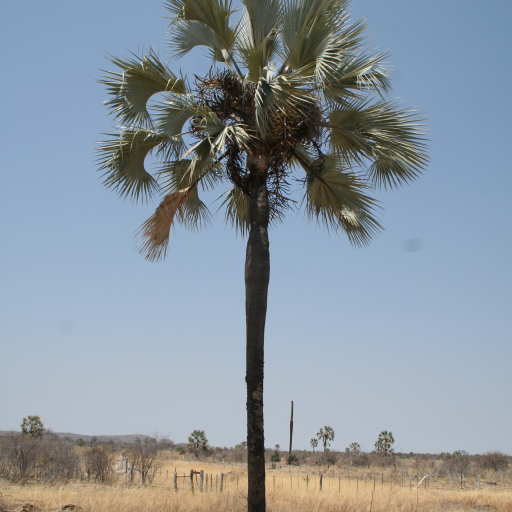
Plant Overview
Known as the Real Mokola Palm, this iconic African giant is the backbone of traditional craftsmanship in the Okavango Delta. Often found silhouetted against a savanna sunset, it is cherished for its "vegetable ivory" seeds and its role in creating world-famous woven baskets. In many southern African cultures, it is considered a "tree of life," providing food, fiber, and even a potent palm wine to local communities.
🔍 How to Identify
- 🌿 The Crown: Features striking, fan-shaped (costapalmate) leaves that are a dusty grey-green color. They spread out like giant, stiff accordions at the top of a tall, slender trunk.
- 🥥 The Fruit: It produces heavy clusters of round, shiny, dark brown fruits. The outer skin looks almost like polished wood, while the inside contains a hard, white nut.
- 🦒 The Trunk: Unlike many other palms that clump together, Hyphaene petersiana usually grows as a single, straight grey pillar, marked with ring-like scars from old leaves.
🏡 In Your Garden
- ☀️ Sun & Space: This palm is a sun-worshiper and requires full, intense light to thrive. Because it develops a massive, deep taproot early in life, it hates being moved; choose its permanent "forever home" in your garden carefully to avoid transplant shock.
- 🧺 Cultural Value: If you are growing this for its fiber, the young, unopened heart leaves are what artisans use for weaving. However, for the home gardener, it serves as a dramatic, drought-tolerant focal point that can handle sandy soils and dry spells with ease once established.
⚠️ Safety & Toxicity
- 🛡️ Physical Warning: While not chemically toxic, the leaf stalks (petioles) are armed with sharp, curved black thorns. These can easily snag skin or clothing, so wear heavy gloves when pruning.
- 🐕 Pet & Child Safety: The fruit pulp is edible for humans (often described as tasting like gingerbread), and the seeds are non-toxic. However, the hard seeds could pose a choking hazard for large dogs who like to chew.
✨ Fun Fact
The seeds of the Mokola Palm are so hard and white inside that they are known as "Vegetable Ivory." They are frequently carved into intricate buttons, jewelry, and small figurines, serving as a sustainable alternative to animal ivory!

Detailed Care Instructions
To grow a Hyphaene petersiana plant, also known as the ilala palm, follow these steps:
- Climate and Location: Ensure you are in a suitable climate for this plant. Hyphaene petersiana grows best in tropical or subtropical regions and requires a hot and humid climate. It can tolerate occasional frosts but prefers temperatures above freezing. Choose a sunny location for planting.
- Soil: Ensure the soil is well-draining and sandy. Ilala palm prefers sandy or loamy soil. It cannot tolerate waterlogged conditions.
- Planting: Select a healthy ilala palm seed or seedling. Soak the seed in water for 24 hours before planting. Prepare a hole in the soil that is deep enough to accommodate the roots of the seedling. Place the seedling in the hole, ensuring that the roots are covered with soil. If planting from seed, sow it at a depth of 5 cm (2 inches) in the soil.
- Watering: Hyphaene petersiana requires regular watering, especially during the establishment phase. Keep the soil moist but not waterlogged. Provide enough water to keep the soil consistently damp.
- Fertilizer: Use a slow-release balanced fertilizer to provide essential nutrients for the plant's growth. Apply the fertilizer according to the package instructions or consult a local nursery for specific recommendations.
- Pruning: Prune any dead or damaged fronds to maintain the health and appearance of the plant. Be cautious while pruning, as the plant's large thorns can cause injury.
- Protection: Protect the plant from strong winds, as they can damage the delicate fronds and roots. Consider providing some shelter or windbreak if necessary.
- Propagation: If you want to propagate more Hyphaene petersiana plants, you can collect and plant the ripe seeds. Remove the outer husk of the seeds and sow them in a sandy soil mixture. Keep the soil consistently moist until germination occurs, which usually takes a few months.
- Patience: Hyphaene petersiana is a relatively slow-growing plant, so be patient with its growth. It may take several years to reach full maturity.
Remember that Hyphaene petersiana is a large palm tree that can grow up to 10 meters (33 feet) in height, so ensure you have enough space for it to flourish.

Hyphaene Petersiana plants require regular watering, especially during the growing season. It is important to ensure that the soil around the plant is uniformly moist and not waterlogged. This can be achieved by watering deeply but infrequently, allowing the water to penetrate the soil and reach the roots. It is recommended to water the plant once a week, and more frequently in hotter weather. Care should be taken to avoid getting water on the leaves, as this can encourage fungal growth. Additionally, if the plant is grown in a container, it is important to ensure that it has good drainage to prevent waterlogging.
To fertilize this plant, apply a balanced fertilizer with equal amounts of nitrogen, phosphorus, and potassium every three months. Ensure that the fertilizer is spread evenly around the base of the plant and not directly onto the trunk. Water the plant immediately after fertilizing to prevent burning the roots.
The ideal soil for this plant should be well-drained and have a neutral to slightly acidic pH level. It should be a mixture of organic material such as compost and sand or perlite to encourage good drainage. The soil should also have good water retention properties to ensure that the plant receives adequate moisture. Adding vermiculite or peat moss can aid in water retention. It is important to avoid compacted soils that restrict root growth. The soil should be deep enough to accommodate the plant's taproot, which can reach up to 20 feet underground. Additional nutrients can be provided through a balanced fertilizer.
To propagate this plant, one can harvest the seeds from the fruit when they are fully matured and dry. Soak the seeds in water for 24 hours before planting them in a well-draining potting soil. Keep the soil moist but not waterlogged with regular watering. The seeds should germinate within 3-6 months. Once the seedlings are large enough to handle, they can be transplanted into individual pots and grown in a sunny location with temperatures between 70-80°F. Fertilize the plant with a balanced fertilizer every 3-4 weeks during the growing season. The plant can take up to 15 years to reach maturity and will produce seeds after 8-10 years.








