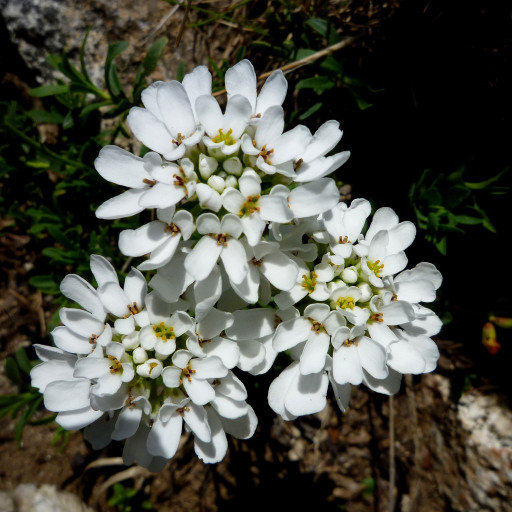
Plant Overview
Commonly known as Evergreen Candytuft, this resilient beauty is a Mediterranean native that transforms rocky landscapes into snow-white blankets every spring. Its name "Iberis" hints at its ancestral roots in the Iberian Peninsula, while "sempervirens" translates to "always green," celebrating its steadfast foliage that survives the frost. It is the ultimate "low-effort, high-reward" plant for garden borders and stone walls.
🔍 How to Identify
- ❄️ Flower Clusters: Features flat-topped clusters (umbels) of tiny, brilliant white flowers. As the season progresses, the centers may take on a delicate lavender hue.
- 🍃 Evergreen Foliage: Small, narrow, dark green leaves that are leathery to the touch. Unlike many perennials, these leaves remain vibrant and "awake" all through the winter.
- ☁️ Growth Habit: A low-growing, mounding sub-shrub that forms a dense cushion. It loves to spill elegantly over the edges of containers or stone ledges.
🏡 In Your Garden
- 🧱 The Rock Garden Star: This plant thrives in "lean" conditions, meaning it actually prefers soil that isn't overly rich. It is happiest when its roots are tucked into the crevices of stone walls where drainage is sharp and fast.
- ✂️ The "Haircut" Rule: To prevent the plant from becoming "leggy" or woody in the center, shear the foliage back by about a third immediately after the flowers fade. This encourages a tight, carpet-like shape for the following year.
⚠️ Safety & Toxicity
- 🟢 Safe for Humans: This plant is generally considered non-toxic to humans and is safe to plant near walkways or play areas.
- 🐾 Pet Caution: While not listed as highly poisonous, most Iberis species contain cucurbitacins, which can cause mild digestive upset (vomiting or drooling) if curious dogs or cats decide to munch on the leathery leaves.
✨ Fun Fact
Despite the whimsical name, "Candytuft" has nothing to do with sugar! The name actually comes from Candia, the ancient Mediterranean name for the island of Crete, which was a major source of the plant's seeds for European gardeners in the 16th century.

Detailed Care Instructions
| Color | White, Pink, Lilac, Red |
| Soil Ph | Alkaline |
| Humidity | Normal |
| Lighting | Full Sun |
| Soil Type | Gravelly |
| Bloom Time | Late Spring |
| Difficulty | Medium |
| Plant Type | Perennial |
| Mature Size | 12–18 Inches Tall |
| Native Area | Along The Mediterranean Coast |
| Sun Exposure | Full Sun To Partial Shade |
| Hardiness Zones | 4-8 |
To grow Iberis sempervirens, also known as candytuft, follow these steps:
- Choose the right location: Select a sunny spot with well-drained soil for planting. Iberis sempervirens prefers full sun or partial shade.
- Prepare the soil: Before planting, make sure the soil is well-drained and loamy. Improve the soil structure by adding compost or well-rotted manure.
- Planting: Dig a hole slightly larger than the plant's root ball. Place the Iberis sempervirens in the hole, making sure the top of the root ball is level with the soil surface. Space multiple plants about 12-18 inches apart.
- Watering: After planting, thoroughly water the soil to settle it around the roots. Water regularly to keep the soil moist but not waterlogged. Reduce watering during the winter months.
- Fertilization: Apply a balanced slow-release fertilizer or a well-balanced, organic fertilizer once or twice during the growing season. Follow the manufacturer's instructions for application rates.
- Mulching: Mulch around the base of the plant with organic matter like straw or wood chips. This helps retain moisture, control weeds, and regulate soil temperature.
- Pruning: After the plant has finished flowering, trim back the spent blooms to encourage more flower production. Cut back any lanky or overgrown growth to maintain a neat appearance.
- Pest control: Monitor for common pests such as aphids, caterpillars, or spider mites. Use organic pest control methods or insecticidal soap to address any infestations.
- Winter care: Iberis sempervirens is a hardy perennial but may benefit from winter protection in colder climates. Mulch around the base of the plant with straw or shredded leaves to provide insulation.
- Division: Every few years, consider dividing the plant in early spring or fall to renew its vigor. Dig up the plant and separate the clumps, then replant in prepared soil.
By following these guidelines, you can successfully grow Iberis sempervirens and enjoy its beautiful flowers in your garden.

Place in a bright room that is sun drenched almost all day. Or directly in a south-facing window.

Iberis Sempervirens is a type of flowering plant that requires regular watering to survive and thrive. To water this plant, you should first check the soil around it to see if it is dry or damp. If the soil feels dry to the touch, you should give the plant a thorough watering, making sure to saturate the soil around the base of the plant.
It is best to water this plant early in the morning when the sun is not yet too strong. This gives the plant ample time to absorb the water before the heat of the day sets in. When watering, be careful not to get water on the leaves or flowers of the plant, as this can encourage fungal growth and lead to disease.
It is important not to overwater Iberis Sempervirens, as this can cause root rot and other problems. As a general rule, you should water the plant deeply once a week during the growing season, and reduce watering in the winter months when growth slows down.
If the leaves of the plant start to yellow or wilt, this may be a sign of under or overwatering. Adjust your watering schedule accordingly and monitor the plant closely to ensure it receives the proper amount of moisture. With proper watering and care, Iberis Sempervirens can grow and thrive for many years, providing beautiful foliage and stunning flowers for your garden.
For best results, fertilize this plant in early spring just before new growth appears and again in early summer. Use a balanced, slow-release fertilizer with equal amounts of nitrogen, phosphorus, and potassium. Apply the fertilizer at the base of the plant, being careful not to allow it to touch the foliage. Water the plant thoroughly after fertilizing. Avoid over-fertilizing as this can cause excessive growth and reduce flowering.
For optimal growth and health, it is recommended to use a well-draining soil with a pH level between 6.0 and 7.0. The soil should be rich in organic matter and nutrients, such as nitrogen, phosphorus, and potassium. A mix of sand, peat moss, and loam is a good choice for this plant. It is important to avoid using heavy clay soils or soils that are too compacted, as they can hinder root growth and cause the plant to suffer from poor drainage. Additionally, regular watering is necessary to maintain moisture levels in the soil and promote healthy growth.
To propagate this plant, you need to select a healthy plant and locate the stem tip. Cut the tip off the stem using a sharp, sterile cutting tool. Make sure the cutting is around 4 inches long and has several leaf nodes.
In order to promote root growth, dip the cut end of the stem into rooting hormone powder. Fill a small pot or container with well-draining soil and make a hole in the center. Insert the cutting into the hole and gently press the soil around it.
Place the pot in a warm, bright location but not in direct sunlight. Water the soil when it starts to dry out. After a few weeks, new growth should appear, indicating that roots have formed. At this point, you can transfer the new plant to a larger pot or into the ground outside.
Common pests of the edging candytuft include Aphids, thrips. Make a habit of checking your edging candytuft frequently for pests so that any infestations can be caught and managed early.








