Plant Overview
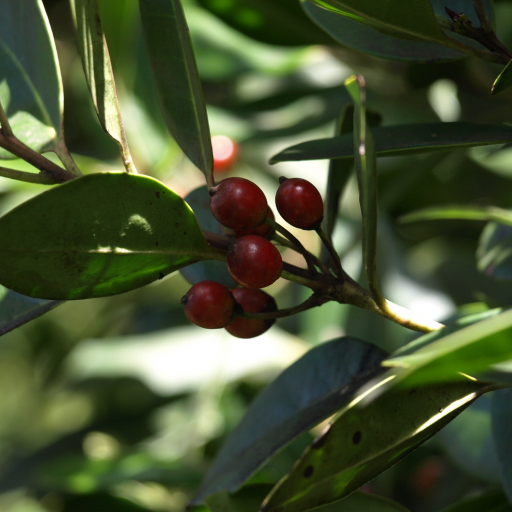
Known locally as the Acebiño, the Canary Island Holly is a living relic from a prehistoric era. It is a signature resident of the "Laurisilva" (laurel forests) of the Canary Islands and Madeira—misty, ancient cloud forests that look like something out of a dinosaur movie. While it shares the festive red berries of its famous cousins, this Macaronesian native has a much softer, more elegant personality.
🔍 How to Identify
- 🍃 The Leaves: Unlike the common English Holly, the Acebiño’s leaves are mostly smooth and oval. They are thick, leathery, and a deep glossy green, usually lacking the sharp, "stabbing" spines people expect from a holly.
- 🔴 The Fruit: In late autumn, female trees produce clusters of small, round, brilliant red berries. These sit nestled against the dark foliage, providing a vivid splash of color against the green.
- 🌳 The Form: It can grow as a large, multi-stemmed shrub or a tall, slender tree. Its bark is remarkably smooth and light gray, often becoming a canvas for silvery lichens and soft mosses.
🏡 In Your Garden
- ☁️ Atmospheric Needs: This plant is a "fog-drinker." In the wild, it survives on "horizontal rain"—the moisture trapped from passing clouds. In a garden setting, it craves high humidity and will struggle in dry, desert-like air or near indoor heating vents.
- 🌱 Root Stability: The Acebiño is a slow-growing soul that values stability. It dislikes being moved once established, as its root system is sensitive to disturbance. Choose its "forever home" in a spot with filtered light and rich, acidic soil.
⚠️ Safety & Toxicity
- 🚫 Status: Toxic if ingested.
- 🐾 Details: While the berries are a vital food source for specialized island pigeons, they are poisonous to humans, dogs, and cats. Ingesting the fruit can lead to severe stomach upset, vomiting, and dehydration. Keep this plant away from areas where curious toddlers or pets might be tempted by the "candy-red" berries.
✨ Fun Fact
- 🕰️ A Botanical Time Traveler: The Ilex canariensis is a survivor of the Tertiary period. While its close relatives were wiped out in mainland Europe by the Ice Age, the sheltered, volcanic microclimates of the Canary Islands allowed this ancient species to survive for millions of years virtually unchanged.

Detailed Care Instructions
To grow Ilex canariensis (Canary Island Holly), follow these steps:
- Climate and Location: Ensure that you live in a suitable climate for Ilex canariensis, which is warm and subtropical. This plant thrives in areas with mild winters and humid summers.
- Sunlight: Ilex canariensis prefers full sun to partial shade. Choose a location in your garden which receives at least 6-8 hours of direct sunlight every day.
- Soil: The soil should be well-draining and slightly acidic to neutral. Amend the soil with organic matter like compost before planting to improve its fertility and drainage.
- Planting: Dig a hole that is twice as wide and deep as the plant's root ball. Place the plant in the hole, ensuring that the top of the root ball is level with or slightly above the soil surface. Backfill the hole with soil, gently firming it around the roots.
- Watering: Water the plant deeply after planting to settle the soil. Afterwards, provide regular watering to keep the soil consistently moist but not waterlogged. Avoid allowing the soil to dry out completely between waterings.
- Mulching: Apply a layer of organic mulch around the base of the plant to conserve moisture, suppress weeds, and provide insulation for the roots. Keep the mulch a few inches away from the stem to prevent rot.
- Fertilization: Feed Ilex canariensis with a balanced, slow-release fertilizer in spring, following the instructions on the packaging. This will provide necessary nutrients for growth and overall health.
- Pruning: Prune the plant lightly in late winter or early spring to remove any dead, damaged, or overgrown branches. This will help maintain its shape and promote new growth.
- Protection: In colder climates, protect the plant from freezing temperatures by covering it with a frost cloth or bringing it indoors during winter. Provide extra insulation around the root zone.
- Pests and Diseases: Watch out for common pests like aphids, scales, and mealybugs. Treat infestations using appropriate insecticides if necessary. Regularly inspect the plant for any signs of diseases, such as leaf spot or powdery mildew, and take appropriate action if needed.
Remember to regularly monitor the plant's progress, and make adjustments to watering, fertilizing, and care as needed. With proper attention, your Ilex canariensis should grow and thrive in your garden.
To water this particular plant, it is best to use a watering can or hose with a gentle spray nozzle. Water should be applied to the base of the plant, avoiding the leaves and stems as much as possible. The frequency of watering will depend on various factors such as the temperature, humidity, and soil moisture content. It is important to ensure that the soil is moist but not waterlogged. To check if the plant needs watering, simply insert your finger into the soil or use a moisture meter. If the soil feels dry to the touch, it's time to water the plant. It is recommended to water in the morning or evening to avoid water evaporation due to heat and direct sunlight. Overwatering can lead to root rot and other issues, so it is important to strike a balance between adequate watering and not overdoing it.
For optimal growth and health of this plant, fertilize with a balanced fertilizer in the early spring before new growth appears. Use a slow-release granular fertilizer applied evenly around the base of the plant and water thoroughly. Repeat this application in midsummer if desired. Avoid over-fertilizing as this can lead to excess foliage growth and weak stems. Always follow the instructions on the fertilizer packaging and adjust the application rate based on the size of your plant.
When selecting soil for the plant, it is important to choose a well-draining medium that is rich in organic matter. The soil should be slightly acidic, with a pH between 5.0 and 6.5. It should also be moist but not waterlogged, as the plant does not tolerate waterlogging well. A mixture of peat moss, perlite, and sand can create an ideal soil mix for this plant. Additionally, the soil should be regularly fertilized with a balanced fertilizer to ensure optimal growth and health.
Ilex Canariensis plant can be propagated through semi-hardwood cuttings in summer or hardwood cuttings in winter. First, select healthy shoots from the parent plant that are at least 10cm long and have several leaves. Then, remove the lower leaves and cut the stem at a 45-degree angle with a clean, sharp knife. Dip the cut end in rooting hormone powder and place it in a pot filled with a mix of compost and sand. Water the cutting and cover it with a plastic bag to create a humid environment. Place the pot in a shaded area and ensure the soil remains moist. After several weeks, roots should form, and new growth will appear. Once the new plant has established, it can be transplanted into a larger container or into the garden.








