Plant Overview
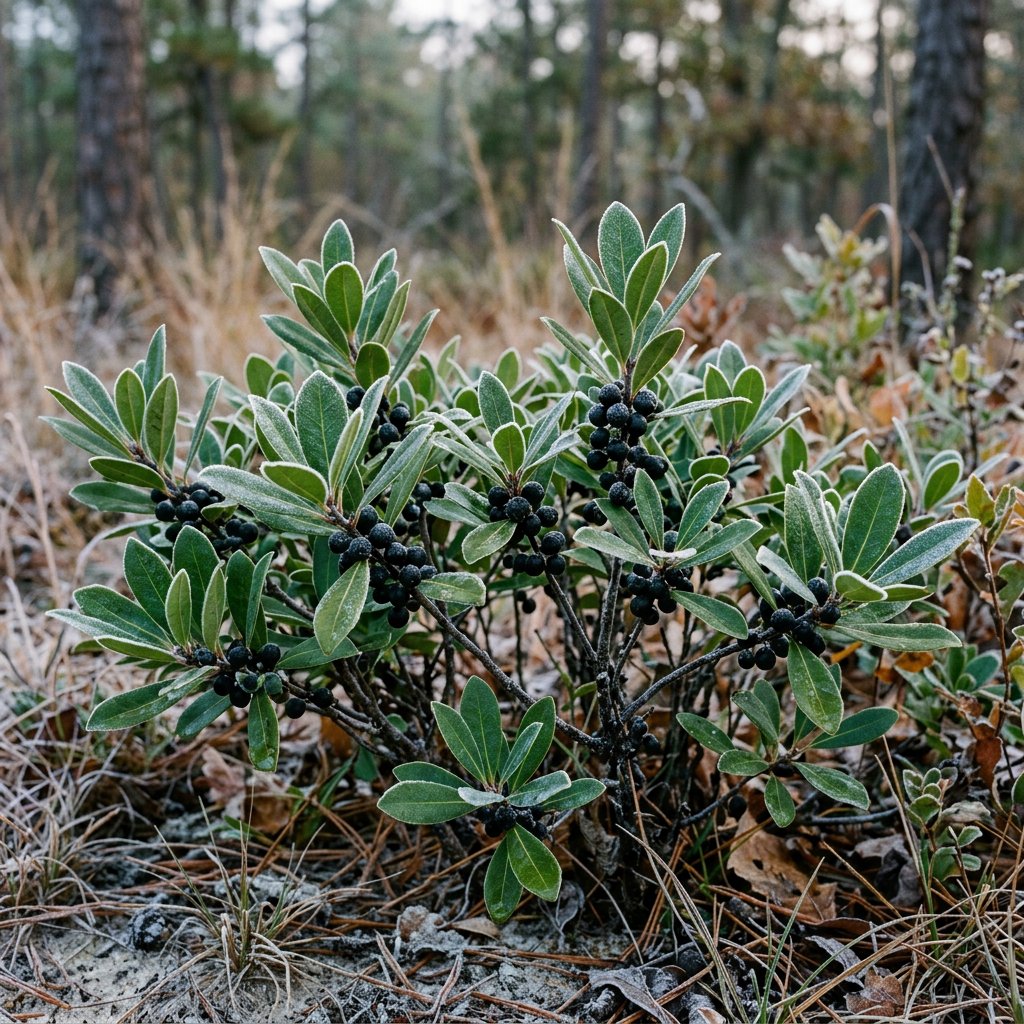
Commonly known as Inkberry or Gallberry, Ilex glabra is the "polite" member of the holly family. Native to the coastal plains of eastern North America, it lacks the sharp, prickly spines associated with its Christmas cousins. It is a versatile evergreen shrub that bridges the gap between wild woodland beauty and formal garden structure, often used as a more durable alternative to Boxwood.
🔍 How to Identify
- 🍃 The Foliage: The leaves are smooth, leathery, and dark green. They are shaped like elongated teardrops and, most importantly, they lack spines—having only a few tiny "teeth" near the tips.
- 🫐 The Fruit: Female plants produce small, ink-black berries in the fall. Unlike the showy red berries of other hollies, these are subtle and provide a vital food source for songbirds during the winter.
- 🌳 The Silhouette: It typically grows in a rounded, upright mound. Over time, it has a habit of becoming "leggy," losing its lower leaves to reveal smooth, greyish-brown stems.
🏡 In Your Garden
- 💧 The Rain Garden Hero: Unlike many shrubs that suffer from "wet feet," Inkberry thrives in moist, acidic soil. It is a perfect choice for low-lying areas of your yard or near ponds where the soil remains damp.
- ✂️ Management Tips: Because it can get thin at the base, many gardeners plant low-growing perennials in front of it to hide its "bare legs." It responds well to pruning in early spring if you want to maintain a tighter, hedge-like shape.
- 🐝 Pollinator Support: In late spring, it produces tiny, greenish-white flowers. While they aren't very flashy to humans, they are a high-energy favorite for honeybees and local pollinators.
⚠️ Safety & Toxicity
- 🐾 Pet Safety: Mildly Toxic. Like all hollies, the leaves and berries contain saponins. If ingested by dogs or cats, it can lead to drooling, vomiting, or pawing at the mouth.
- 👶 Child Safety: The black berries can be tempting to children as they resemble blueberries. Ingestion can cause significant stomach upset and nausea, so it is best planted away from play areas.
✨ Fun Fact
During the American Civil War, when tea imports were blocked, the leaves of the Inkberry were dried and brewed as a substitute. This earned it the nickname "Appalachian Tea," though it lacks the caffeine kick found in its famous relative, the Yaupon Holly!

Detailed Care Instructions
To grow Ilex glabra, also known as inkberry or gallberry, follow these steps:
- Choose a suitable location: Ilex glabra prefers moist, acidic soil and partial to full sun. It can tolerate wet soil conditions, making it suitable for planting near ponds or in rain gardens.
- Prepare the soil: Ensure the soil is well-draining by adding organic matter, such as compost or peat moss, to improve fertility and moisture retention.
- Planting: Dig a hole that is twice as wide and just as deep as the root ball. Place the plant in the hole, making sure it is level with or slightly above the soil surface. Backfill the hole with soil, firming it gently around the roots. Water thoroughly after planting.
- Watering: Keep the soil consistently moist but not waterlogged, especially during the plant's establishment period. Regular watering is important, especially during dry spells.
- Mulching: Apply a layer of organic mulch around the base of the plant to help conserve moisture, suppress weed growth, and maintain a cool root environment. Maintain a mulch depth of 2-3 inches, keeping it a few inches away from the plant stem to prevent rot.
- Pruning: Prune sparingly to maintain the plant's natural shape and remove any dead or damaged branches. Pruning can be carried out in late winter or early spring before new growth emerges.
- Fertilization: Ilex glabra typically does not require regular fertilization. However, if the plant appears weak or lacking vigor, you can apply a slow-release, acidifying fertilizer in early spring.
- Pest and disease control: Inkberry is generally resistant to pests and diseases. However, occasional issues like aphid infestations or root rot may occur. Monitor the plant regularly and take appropriate action if problems arise.
- Propagation: Ilex glabra can be propagated through seeds, but it is more commonly propagated through semi-hardwood stem cuttings or by division of established clumps.
Remember to check if Ilex glabra is native to your region and consult local gardening resources for specific tips and recommendations based on your location.

Place in a window with dappled sun or a spot in the middle of a room. Or directly in a window facing west or east.

Ilex glabra is a plant that requires a moderate amount of water. To water this plant, you should first check the soil moisture level by sticking your finger into the soil up to your first knuckle. If the soil feels dry at this depth, it is time to water the plant. When watering, you should aim to thoroughly saturate the soil around the plant roots, but you should avoid allowing the soil to become waterlogged or overly wet. It is best to water Ilex glabra in the morning or early evening when the sun is not too hot, as this will allow the plant to absorb the moisture it needs without evaporating too quickly. It might also be helpful to mulch around the plant to help retain moisture in the soil and keep the roots cool.
To fertilize this plant, you should start by choosing a slow-release fertilizer that is rich in nutrients. Apply the fertilizer in early spring, just before new growth appears, and again in the fall after the growing season has ended. Be sure to follow the instructions on the fertilizer package carefully, as over-fertilizing can damage the plant. Additionally, you should avoid fertilizing when the plant is experiencing drought or other stressors, as this can also harm the plant. Finally, be sure to water the plant thoroughly after applying fertilizer to help it absorb the nutrients properly.
The ideal soil for the plant should be well-draining and slightly acidic with a pH level between 5.0 and 6.5. The soil should also be rich in organic matter and have good water retention capacity. It is recommended to use a loamy soil or a soil mix that contains equal parts of peat moss, sand, and perlite for optimal growth and development. Additionally, the soil should be kept consistently moist but not waterlogged, and the plant should be fertilized regularly during the growing season.
Ilex Glabra plant can be propagated through both seeds and cuttings.
To propagate Ilex Glabra plant from cuttings, follow the steps mentioned below:
- Take a healthy stem cutting of 4-6 inches length from the parent plant during the active growth period.
- Remove the leaves from the lower half of the stem cutting and make a clean angled cut at the bottom.
- Dip the cut end of the stem in rooting hormone powder.
- Plant the stem cutting in a pot filled with damp, well-draining potting soil.
- Cover the pot with a plastic bag or a clear plastic container to create a mini greenhouse. This will increase the humidity required for rooting.
- Place the pot in bright, indirect light and maintain the soil moist for the next 3-4 weeks.
- After 3-4 weeks, gently tug the stem cutting to check for roots. If there are roots, remove the plastic cover and gradually expose the plant to direct light.
- After a few more weeks, transplant the rooted Ilex Glabra plant into a larger pot or in the ground outdoors.
To propagate Ilex Glabra plant from seeds, here are the steps:
- Collect the berries from the parent plant when they are ripe (usually in fall).
- Soak the berries in water for a few days to loosen the pulp.
- With a sharp knife, scrape off the pulp and expose the seeds.
- Rinse the seeds and dry them for a few days in a cool, shady place.
- Fill a tray or pot with moist, well-draining potting soil.
- Sow the dried seeds on the soil surface, spacing them apart.
- Gently press the seeds into the soil, but do not cover them.
- Cover the pot or tray with plastic wrap to create a mini greenhouse effect.
- Place the pot or tray in a warm, bright location, but not in direct sunlight.
- Keep the soil moist by misting it regularly or watering from the bottom.
- After 2-3 weeks, the seeds should start to germinate.
- Once the seedlings have grown to a few inches tall, transplant them into individual pots or directly in the ground outdoors.








