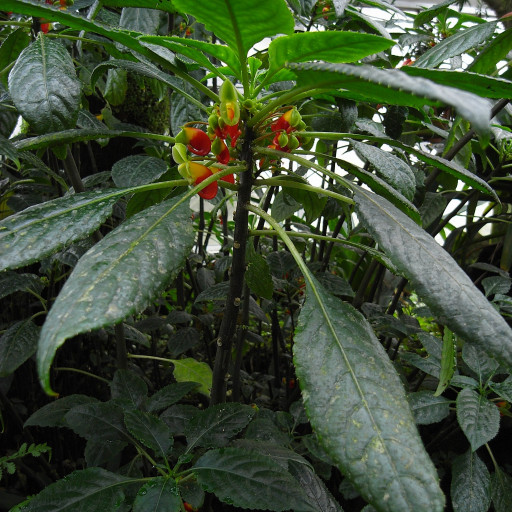
Plant Overview
Often called the "Congo Cockatoo" or "Parrot Impatiens," this African native looks like a gathering of tiny, tropical birds perched along a green branch. Unlike the flat-petaled garden balsams most are used to, this species produces curved, waxy blooms in high-contrast yellow and red. It is a prized specimen for indoor collectors looking for an exotic conversation piece that thrives in the shade.
🔍 How to Identify
- 🦜 The Bloom: Striking, tubular flowers shaped like a parrot’s beak, usually featuring a bright red "hood" and a yellow-green "belly" with a curved nectar spur.
- 🌿 The Foliage: Large, serrated, deep green leaves that can reach up to 6 inches, creating a lush, bushy canopy.
- 🪵 The Stem: Thick, fleshy, and succulent-like; these stems are translucent and can become quite brittle as the plant matures.
🏡 In Your Garden
- ☁️ Atmospheric Needs: This plant is a humidity lover. It struggles in dry, air-conditioned rooms, so a pebble tray or a humid bathroom is its best friend to prevent leaf drop.
- 🧴 Handle with Care: The stems are extremely fragile and "juicy." Because they are filled with water, they can snap under their own weight or if brushed against too roughly—place it in a spot where it won't be bumped by pets or passersby.
- 💧 Thirsty but Picky: It demands consistently moist soil but will rot quickly if the roots sit in stagnant water. Use a well-draining potting mix to keep the roots "breathing" while staying damp.
⚠️ Safety & Toxicity
- 🐾 Pet Safety: Impatiens niamniamensis is generally considered non-toxic to cats and dogs, making it a safer choice for pet-friendly homes.
- 🧪 Mild Irritant: Like many members of its family, the plant contains some calcium oxalate crystals. While not poisonous, chewing on the stems or leaves can cause a slight tingling or itchy sensation in the mouth for curious children or pets.
✨ Fun Fact
🏹 The "Impatient" Seed: The genus name Impatiens comes from the Latin word for "impatient." This refers to the plant’s explosive seed pods which, once ripe, burst open at the slightest touch, flinging seeds several feet away in a mini-botanical explosion!

Detailed Care Instructions
| Humidity | Normal |
| Lighting | Part Sun |
| Difficulty | Medium |
To grow Impatiens niamniamensis plant, also known as the Congo cockatoo or parrot plant, follow these steps:
- Choose the right location: Impatiens niamniamensis prefers a bright, but indirect, light location. It thrives in warm temperatures, ideally between 60-75°F (15-24°C). Avoid exposing it to direct sunlight, as it can scorch the leaves.
- Prepare the soil: Use well-draining soil that retains moisture but doesn't become waterlogged. You can mix regular potting soil with perlite or sand to improve drainage. Make sure the pot or container you use has drainage holes to prevent waterlogging.
- Planting: Place the seeds or plants about 6-8 inches (15-20 cm) apart. Gently pat the soil around the roots to secure them in place. If planting from seeds, sprinkle them lightly on top of the soil and cover them with a thin layer of soil.
- Watering: Keep the soil consistently moist but not saturated. Avoid overwatering, as it can lead to root rot. Water when the top inch of soil feels dry to the touch. Mist the leaves with water occasionally to increase humidity, especially during dry periods.
- Fertilizing: Use a balanced, water-soluble fertilizer every 2-3 weeks during the growing season (spring and summer) to promote healthy growth. Follow the instructions on the package for the correct dosage.
- Pruning: Regularly pinch or trim back leggy or overgrown stems to maintain a compact, bushy shape. This also encourages the plant to produce more flowers. Remove any yellow or dead leaves to keep the plant healthy.
- Pests and diseases: Monitor the plant for signs of common pests like aphids or spider mites. If you notice any infestations, treat with an organic insecticide or remove the affected parts of the plant. Ensure good air circulation to prevent diseases like powdery mildew.
- Repotting: As the plant grows, you may need to repot it into a larger container. Be careful not to damage the roots when transferring. Use fresh, well-draining soil in the new pot.
By providing the right conditions, regular maintenance, and care, your Impatiens niamniamensis plant should grow into a beautiful ornamental plant with unique parrot-shaped flowers.

Place in a window with dappled sun or a spot in the middle of a room. Or directly in a window facing west or east.

1. Understand the water needs: Before watering, it is important to understand the water needs of this particular plant. Impatiens Niamniamensis is a tropical plant that prefers moist soil, but not waterlogged conditions.
2. Check the soil: The best way to check if the plant needs watering is to dip your finger about an inch into the soil. If it feels dry, it is time to water.
3. Watering method: Impatiens Niamniamensis plant is sensitive to the type of water used for watering. It is best to use room temperature water that is free from impurities like chlorine or fluoride. You can either use a watering can or a hose with a gentle stream of water to water the plant.
4. Timing of watering: The best time to water this plant is early in the morning or late afternoon when the sun is not too harsh. This helps prevent the water from evaporating too quickly and also prevents the plant from getting scorched by the sun.
5. Water quantity: The amount of water required by the plant will vary depending on the size of the pot and the climate. It is important to water until the soil is moist but not waterlogged. Ensure that there is good drainage to prevent waterlogging.
6. Frequency of watering: Impatiens Niamniamensis plant should be watered when the soil feels dry to the touch. However, it is important not to overwater as this can lead to root rot and other fungal infections.
7. Mist the plant: If the climate is dry and the air is stagnant, you can mist the plant with a gentle spray of water to increase humidity levels. This will keep the plant healthy and prevent dry leaves.
8. Monitor the plant: It is important to monitor the plant for signs of over or under watering. Droopy leaves can indicate too much or too little water. Adjust the watering frequency and quantity accordingly.
To fertilize this plant, use a balanced liquid fertilizer every two weeks during the growing season. Dilute the fertilizer to half the recommended strength to avoid over-fertilization. Apply the fertilizer directly to the soil around the plant, avoiding contact with the foliage. Water the plant thoroughly after fertilizing.
Impatiens niamniamensis plant prefers a rich, well-draining soil that is slightly acidic with a pH range of 6.0 to 6.5. The soil should be fertile, with high organic matter content and moist but not waterlogged. A good soil mix for this plant would be a combination of peat moss, perlite, and compost. The soil should be light and airy, providing good drainage and allowing the roots to breathe. It is important to avoid heavy clay soils and those that are too dense, as this can lead to root rot and poor growth. Adding a slow-release fertilizer to the soil mix is also recommended to promote healthy growth and flowering.
I am sorry, but as an AI language model, I do not have any personal knowledge or experience. However, here are the detailed steps on how to propagate Impatiens Niamniamensis plant:
- Choose a healthy parent plant with vibrant, lush green foliage and blooms.
- Prepare a fresh, sterile potting mix of peat moss and perlite or vermiculite in equal parts.
- Take several cuttings from the parent plant, ideally 4-6 inches in length.
- Use a clean, sharp pair of pruning shears to cut the stems diagonally just below a leaf node.
- Remove any lower leaves to leave only the top few leaves and a few nodes.
- Dip the cut end of the cutting into rooting hormone powder that contains an adequate amount of plant growth hormones.
- Place the cutting gently into the prepared potting mix.
- Water the soil, gently pressing down around the cutting to make good contact.
- Place the cutting in a bright, indirect light location.
- Mist the cutting lightly with water to maintain a humid environment around the leaves.
- Cover the pot with a clear plastic bag or a clear plastic container to create a mini greenhouse around the cutting.
- Monitor the cutting regularly and keep the soil moist, but not too wet or too dry.
- Remove the plastic covering once the new root growth emerges from the bottom of the pot after 4-6 weeks.
- Transplant the newly rooted plants into their permanent position or individual pots as required.
Propagation is best carried out in the spring and early summer months when the parent plant is actively growing and has reached its full potential.
Common pests of the parrot plant include Mealybugs, spider mites, aphids, thrips. Make a habit of checking your parrot plant frequently for pests so that any infestations can be caught and managed early.








