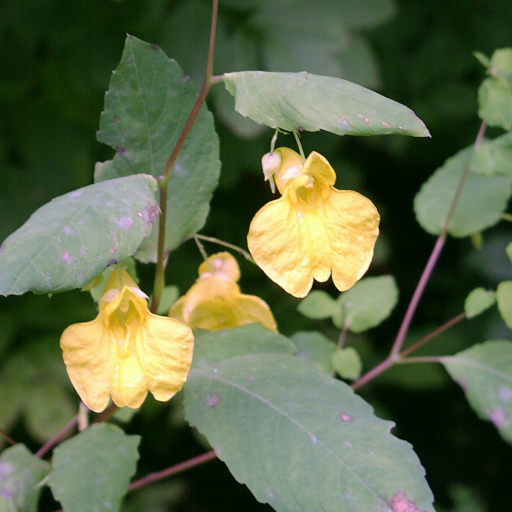
Plant Overview
Known commonly as the Touch-Me-Not Balsam, this charming woodland resident is famous for its "explosive" personality. Its Latin name, noli-tangere, literally translates to "do not touch," a nod to the way its ripe seed pods burst open at the slightest graze, catapulting seeds several feet away. Found dancing in the damp shadows of European and Asian forests, it provides a splash of sunny yellow to the cool forest floor.
🔍 How to Identify
- 🌼 Golden Blooms: The flowers are pendant and orchid-like, featuring a bright yellow hue with tiny, reddish-orange spots hidden deep within the throat to guide pollinators.
- 🍃 Toothed Foliage: It sports soft, oval-shaped leaves with prominent "teeth" along the edges. Interestingly, when submerged in water, these leaves take on a beautiful silvery sheen.
- 🧪 Succulent Stems: The plant features translucent, watery stems that are pale green and feel cooling to the touch. The joints (nodes) are often noticeably swollen.
🏡 In Your Garden
- 💧 Thirst for Dampness: Unlike many garden plants, this balsam thrives in "wet feet" conditions. It is an ideal choice for the edges of ponds, rain gardens, or those shaded, boggy corners where most flowers would suffer from root rot.
- 🌱 The Great Escape: Because of its ballistic seed dispersal mechanism, this plant is a "wanderer." It doesn't stay put and will likely pop up in new, shady nooks every year, effectively planting itself for the next season.
- 🌲 Shade Lover: This is a true forest-dweller. It hates the harsh afternoon sun, which will quickly wilt its delicate, water-filled leaves.
⚠️ Safety & Toxicity
- 🚫 Mildly Irritating: While not considered highly toxic, the plant contains high levels of calcium oxalate crystals.
- 🐾 Pets & Children: If ingested in large quantities, it can cause an upset stomach or a scratchy, burning sensation in the throat. It is best treated as an ornamental beauty rather than a snack.
- 🧤 Skin Sensitivity: Some sensitive individuals may experience a mild skin tingle or rash from the sap, though it is generally far less irritating than its cousin, the Stinging Nettle.
✨ Fun Fact
Despite its name warning you not to touch it, the juice from the crushed stems has been used in traditional folk medicine for centuries as a remedy for skin rashes. It is a close relative of "Jewelweed," which is often used to neutralize the sting of Nettle or the itch of Poison Ivy!

Detailed Care Instructions
Growing an Impatiens Noli-tangere plant (also known as touch-me-not or silver jewelweed) requires specific conditions and care. Here are some steps to help you successfully grow this plant:
- Climate: Impatiens Noli-tangere prefers cool, moist environments. It is most commonly found in temperate regions with partial shade or dappled sunlight. Ensure your climate is suitable for this plant before starting.
- Light: Provide the plant with partial shade or filtered sunlight. Too much direct sunlight can scorch its delicate leaves.
- Soil: The plant thrives in consistently moist, well-draining soil. Add organic matter such as compost to retain moisture and improve soil quality. The soil should be slightly acidic to neutral (pH around 6.0-7.0).
- Sowing: You can start growing impatiens noli-tangere from seeds. Sow the seeds in spring or early summer in small containers filled with moist, well-draining potting soil. Press the seeds gently into the soil surface without covering them completely.
- Watering: Keep the soil consistently moist but not waterlogged. Water when the top layer of soil feels dry to the touch. Avoid overwatering, as it can lead to root rot.
- Transplanting: Once the seedlings are a few inches tall and have developed a few sets of leaves, you can transplant them into larger pots or directly into the garden. Space them about 10-12 inches apart to allow room for growth.
- Fertilization: Impatiens noli-tangere doesn't require heavy fertilization. You can use a balanced, slow-release fertilizer or add compost to the soil during planting. Avoid excessive use of nitrogen-based fertilizers, as they can promote excessive foliage growth at the expense of flowers.
- Mulching: Apply a layer of organic mulch around the base of the plant to help retain moisture and suppress weeds. This will also keep the soil temperature cooler, which is beneficial for the plant.
- Pruning: Regularly remove any damaged or dead foliage to maintain the plant's health and appearance. Pinch back the stems to encourage bushier growth.
- Pests and diseases: Monitor the plants for common pests like aphids, spider mites, and slugs. Treat them promptly using organic or chemical insecticides, if necessary. Ensure good air circulation around the plant to minimize the risk of fungal diseases.
Following these guidelines should help you successfully grow Impatiens Noli-tangere plants. Remember to adjust your care routine based on the specific conditions of your location.
To water the plant, it is recommended to use a watering can or a hose with a gentle spray nozzle. It is important to avoid getting water on the leaves or flowers, as this can lead to fungal diseases. Water the soil around the base of the plant until it is evenly moist, but not waterlogged. It is best to water in the morning or evening when the sun is not as intense, to prevent evaporation and allow the water to penetrate the soil. The frequency of watering will depend on factors such as temperature, humidity, and soil type. It is important to monitor the plant and adjust watering accordingly. Over-watering can lead to root rot, while under-watering can cause the plant to wilt and become stressed.
To fertilize this plant, use a balanced fertilizer with equal amounts of nitrogen, phosphorus, and potassium. Apply the fertilizer once a month during the growing season, from early spring to late summer. Dilute the fertilizer to half strength and water the plant thoroughly before and after applying. Avoid over-fertilizing or using fertilizer on dry soil, as this can damage the plant's roots.
The optimal soil for the Impatiens Noli-tangere plant is a well-draining soil with high organic content. The soil should be slightly acidic with a pH range of 5.5 to 6.5. It is important that the soil is not too compact to allow for proper water drainage and oxygen circulation to the plant’s roots. Additionally, a mixture of peat moss, vermiculite, and perlite is recommended to promote healthy growth and moisture retention. A balanced fertilizer should also be added to the soil to provide necessary nutrients for the plant to thrive.
Impatiens Noli-tangere can be propagated through several methods such as division, stem cuttings, and seed propagation.
For division, carefully dig up the parent plant and separate its root system into multiple sections. Each section should have its own stem and root system. These sections can then be replanted into separate containers or directly into the ground.
For stem cuttings, select a healthy stem with at least two sets of leaves and cut it just below a node. Remove all the leaves from the bottom half of the stem and dip the cut end in rooting hormone. Plant the cutting in a pot filled with moist soil and keep it in a warm and humid environment until new growth appears.
For seed propagation, collect seeds from the parent plant when the seed pods have turned brown and started to split open. Sow the seeds in a tray or pot filled with moist soil and keep it in a warm and bright environment until the seeds germinate. Transplant the seedlings into separate pots or directly into the garden once they have developed their first set of true leaves.








