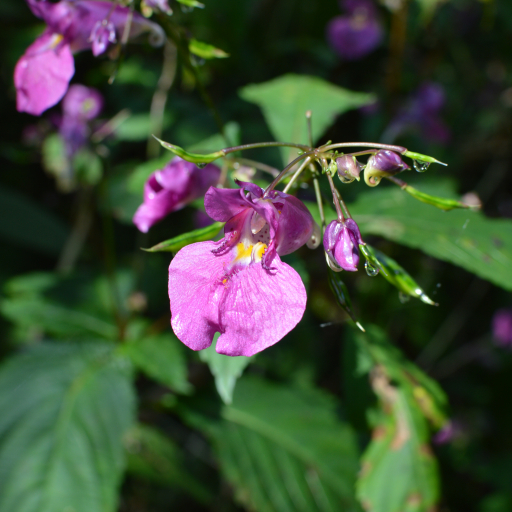
Plant Overview
Known as the Japanese Touch-Me-Not, Impatiens textorii is an elegant woodland gem native to the moist valleys of East Asia. Its delicate, nodding flowers look like suspended jewels dancing in the breeze, earning it a reputation as one of the most graceful wild balsams. In its native Japan and Korea, it is a hallmark of late summer, signaling the transition into the cooler autumn months.
🔍 How to Identify
- 🌸 Orchid-like Blooms: The flowers are typically a vibrant pinkish-purple with a distinct funnel shape and a hooked "spur" at the back that hides nectar for long-tongued pollinators.
- 🍃 Serrated Foliage: The leaves are lance-shaped with sharply "toothed" or serrated edges, arranged alternately along the stem.
- 💧 Succulent Stems: The stalks are thick, translucent, and watery, often showing a reddish tint near the joints (nodes), which is common among jewelweeds.
🏡 In Your Garden
- 🌦️ Hydration Indicator: This plant is famously "dramatic" about water. Because of its high water content, it will wilt visibly the moment the soil dries out, serving as a living alarm for when your garden needs a drink.
- 🌑 The Shade Solution: It is an excellent choice for those tricky, damp corners of the yard where grass won't grow. It thrives in dappled sunlight or full shade, mimicking the cool ravines of its natural habitat.
- 🌱 Naturalizing Habit: As an annual, it lives for only one season but "lives on" through heavy self-seeding. If you plant it once, expect a fresh colony to pop up every spring.
⚠️ Safety & Toxicity
- 🐾 Mild Irritant: While not considered deadly, the plant contains high levels of calcium oxalate crystals. If ingested in large quantities by pets or curious children, it can cause a stinging sensation in the mouth or a mild stomach ache.
- 👐 Skin Friendly: Unlike its cousin "Jewelweed," which is used to treat poison ivy, Impatiens textorii is mostly ornamental, but it is perfectly safe to touch and handle.
✨ Fun Fact
The genus name Impatiens is Latin for "impatient." It refers to the plant’s high-pressure seed pods; when they are ripe, the slightest touch causes them to explode violently, launching seeds several feet away to ensure the next generation has plenty of space to grow!

Detailed Care Instructions
To grow Impatiens Textorii plants, follow these steps:
- Choose a location: Impatiens Textorii plants thrive in partially shaded areas with well-draining soil. Select a spot that receives filtered sunlight or morning sun and afternoon shade.
- Prepare the soil: Ensure the soil is loose, fertile, and rich in organic matter. Add compost or well-rotted manure to improve the soil's fertility and drainage.
- Planting: Plant Impatiens Textorii using well-established seedlings or young plants. Dig a hole slightly larger than the root ball and place the plant in the hole. Backfill with soil and gently firm it around the plant.
- Watering: Keep the soil consistently moist but avoid waterlogging. Water the plant regularly, especially during hot and dry periods. Mulching the soil around the plant helps retain moisture and control weeds.
- Fertilization: Apply a balanced, water-soluble fertilizer every 2-3 weeks during the growing season to promote healthy growth and flowering.
- Pruning: Regularly pinch or trim back the tips of the stems to encourage bushier growth and more flowers. This will also prevent the plant from becoming leggy.
- Pests and diseases: Keep an eye out for common pests like aphids, whiteflies, and spider mites. Treat them with organic pest control methods if detected. To prevent diseases, ensure good air circulation and avoid over-watering.
- Winter care: Impatiens Textorii plants are perennials but can suffer in colder climates. In areas with frost or freezing temperatures, it is best to bring them indoors before the first frost or treat them as annuals.
By following these steps, you can successfully grow Impatiens Textorii plants and enjoy their beautiful flowers throughout the growing season.

Place in a window with dappled sun or a spot in the middle of a room. Or directly in a window facing west or east.

When watering this particular plant, it is important to first assess the soil to determine whether it is dry or moist. If the soil is already moist, it may not require immediate watering. However, if the soil is dry, then watering is necessary to provide sufficient moisture for the plant. It is recommended to water the plant thoroughly, ensuring that the water reaches the roots. One way to achieve this is by using a watering can or hose with a gentle spray setting. Additionally, it is important to avoid over-watering, which can lead to root rot. It is recommended to water the plant deeply but infrequently, depending on the environment and temperature. Another factor to consider when watering is the location of the plant. If it is located in a sunny area, it may require more frequent watering compared to if it is located in a shaded area. Overall, providing adequate and regular water is crucial for the health and growth of this plant.
To fertilize the plant, use a balanced fertilizer, such as a 10-10-10 or 20-20-20, once every two weeks during the growing season. Be sure to dilute the fertilizer according to the package instructions. Apply the fertilizer to moist soil, avoiding contact with the leaves and stems. Water the plant after fertilizing to help distribute the nutrients throughout the soil.
The ideal soil to use for the Impatiens Textorii plant is a well-draining and moist soil that is rich in nutrients and organic matter. This plant prefers slightly acidic to neutral soil with a pH range between 5.6 to 7.5. The soil should be loose, airy, and able to hold moisture without becoming waterlogged or soggy. A mixture of garden soil, compost, and perlite or sand can provide the right balance of nutrients, water retention, and drainage. Additionally, adding organic fertilizers to the soil can help promote growth and improve soil structure. The soil should be kept consistently moist, but not waterlogged, to prevent the plant from drying out or developing root rot.
There are a few ways to propagate this plant, but one of the easiest is by taking stem cuttings.
- Choose a healthy, mature stem from the plant.
- Cut the stem just below a node, which is where the leaves attach to the stem.
- Remove the lower leaves from the stem, leaving only a few at the top.
- Dip the cut end of the stem in rooting hormone powder.
- Plant the cutting in a pot filled with moist, well-draining soil.
- Cover the pot with a plastic bag or container to create a humid environment.
- Place the pot in a bright, indirect light location and keep the soil moist but not waterlogged.
- After a few weeks, check for root growth by gently tugging on the stem. Once there are roots present, the plant can be transplanted to a larger pot or into the garden.
Another method for propagating Impatiens Textorii is by division. This involves carefully separating the plant’s roots into smaller sections and replanting them. This method is best done in the spring when the plant is actively growing.








