Plant Overview
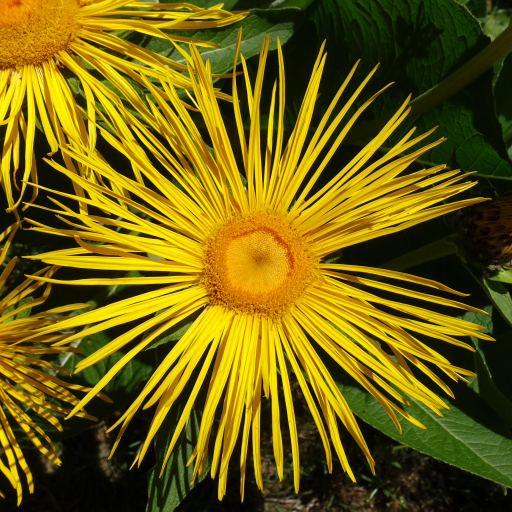
Known as the "Giant Fleabane," Inula magnifica is the undisputed titan of the daisy family. Hailing from the rugged Caucasus Mountains, this perennial is less of a garden flower and more of a living sculpture. It is prized by gardeners for its "architectural" presence, commanding attention with its sheer scale and shaggy, golden sunbursts that look like they’ve stepped out of a prehistoric landscape.
🔍 How to Identify
- 🌼 Golden Sunbursts: The flowers are massive (up to 6 inches across) with very thin, spidery yellow petals that radiate from a dark orange-yellow center.
- 🍃 Elephant Ear Leaves: The base of the plant features enormous, coarse, dark green leaves that can grow up to 2 feet long, providing a dense, tropical-looking foundation.
- 📏 Statuesque Stature: This is a true giant, easily reaching heights of 6 to 8 feet. The stems are thick, hairy, and usually tinted with a purplish hue.
🏡 In Your Garden
- 💧 The Moisture Lover: Unlike many of its drought-tolerant daisy cousins, Inula magnifica craves moisture. It is the perfect solution for "problem" areas with heavy clay or soil that stays damp, such as near a pond or a low-lying boggy patch.
- ⚓ Deep-Rooted Commitment: It develops a powerful taproot very quickly. Because of this, it "hates" being moved once it is established. You should choose its forever-home carefully, ensuring it has plenty of room to spread its massive leaves.
⚠️ Safety & Toxicity
- 👐 Mild Irritant: While not considered a "poisonous" plant, it belongs to the Asteraceae family. Like sunflowers or ragweed, its hairy leaves and sap can cause mild skin irritation or "contact dermatitis" in sensitive individuals.
- 🐾 Pet Safety: It is generally non-toxic to dogs and cats. However, the rough, hairy texture of the leaves usually discourages pets from trying to take a bite.
✨ Fun Fact
🐝 The Landing Pad: Because the flowers are so wide and flat, they act as perfect "landing pads" for heavy pollinators. You will often see large bumblebees and butterflies napping in the center of the bloom, as they don't have to work hard to balance while they drink the nectar!

Detailed Care Instructions
To grow Inula Magnifica, follow these steps:
- Choose a location: Inula Magnifica prefers a full sun to partial shade position in well-draining soil. Ensure the spot has enough space for the plant to grow, as it can reach a height of 3 to 6 feet.
- Prepare the soil: Before planting, prepare the soil by loosening it and removing any weeds or rocks. Add organic matter like compost to improve drainage and fertility.
- Planting: Dig a hole large enough to accommodate the root ball of the Inula Magnifica plant. Place the plant in the hole and backfill with soil, gently firming it around the roots.
- Watering: Give the newly planted Inula Magnifica a thorough watering to help it establish a healthy root system. Afterward, water regularly during dry periods to keep the soil moist but not waterlogged.
- Mulching: Apply a layer of mulch around the base of the plant to help retain moisture, suppress weed growth, and insulate the roots.
- Pruning: Inula Magnifica can benefit from regular pruning to maintain a compact shape and encourage bushier growth. Prune back the faded flower stalks and remove any dead or damaged foliage.
- Fertilizing: Inula Magnifica generally does not require heavy fertilization. However, you can apply a balanced, slow-release fertilizer in spring to promote healthy growth.
- Pests and diseases: Inula Magnifica is generally resistant to pests and diseases. However, keep an eye out for common issues like aphids or powdery mildew. If detected, treat the plant promptly with insecticidal soap or a suitable fungicide.
- Winter care: Inula Magnifica is generally hardy, but protection from harsh winter conditions may be necessary in colder climates. Apply a thick layer of mulch around the base of the plant to insulate the roots and protect it from freezing temperatures.
By following these steps, you should be able to successfully grow Inula Magnifica and enjoy its beautiful blooms.

Place in a bright room that is sun drenched almost all day. Or directly in a south-facing window.

In order to properly water this plant, it is important to take into consideration its specific water and drainage needs. The soil should be kept consistently moist but not waterlogged, and should be allowed to dry slightly between waterings. It is also important to make sure that water is able to drain out of the pot or planting area, so that the roots do not become waterlogged and prone to rot. Watering should be done slowly and evenly, either with a watering can or by using a gentle spray attachment on a hose. It may also be helpful to mulch around the base of the plant to help retain moisture in the soil.
To fertilize this plant, apply a balanced, slow-release fertilizer in the early spring when new growth appears. Use a granular or liquid fertilizer with equal parts nitrogen, phosphorus, and potassium. Apply at a rate of 1/2 pound per 100 square feet or according to the instructions on the package. Water thoroughly after applying the fertilizer. Repeat the application in early summer if necessary, but do not fertilize in the fall or winter. Avoid over-fertilizing as this can cause the plant to become weak and attract pests.
The ideal soil for the Inula Magnifica plant is a rich, well-draining soil that is high in organic matter. It should be slightly acidic to neutral with a pH of 6.5-7.5. A soil mix that is high in loam, sand, perlite, and peat moss will be suitable for this plant. The soil mix should allow for water to drain quickly, and not retain too much water as the plant is susceptible to root rot. It is important to ensure that the soil is moist but not soggy, which can be achieved by watering it only when the top 1-2 inches of soil have become dry. Fertilizer may be added during the growing season to promote healthy growth, but should be used sparingly to avoid over-fertilization.
Propagation of this plant can be achieved through various methods including division, seed germination, and softwood cuttings. One of the easiest ways to propagate is through division, which involves separating an established plant into several smaller ones that can be transplanted to different locations. To do this, gently dig up the plant, carefully separate the roots, and replant the divisions in soil that is rich and well-draining.
Another method of propagation is through seed germination. Seeds can be harvested from the plant once they have matured and then sown in containers filled with nutrient-rich soil and kept in a warm, moist environment until germination occurs.
Softwood cuttings can also be used to propagate Inula Magnifica. To do this, take cuttings from new growth that is still green and soft, and dip the cut end into rooting hormone. Plant the cuttings in a container filled with well-draining soil, and keep the soil moist until roots form.
Propagation can be done at any time of the year but is most successful during the plant's active growth period, which is typically in the spring and summer months. With proper care, new plants can be established relatively quickly and will begin producing their beautiful flowers in no time.








