Plant Overview
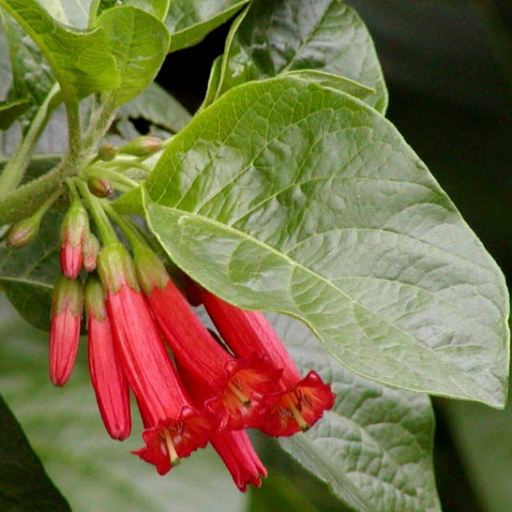
Often called the "Mini Angel’s Trumpet" or "Red Iochroma," Iochroma fuchsioides is a vibrant South American treasure that looks like a shower of hanging firecrackers. Native to the cool, misty Andean forests of Ecuador and Colombia, this shrub is a showstopper for anyone looking to bring a tropical, high-altitude energy to their space. It is a legendary favorite among hummingbird enthusiasts, as its fiery blooms act like a glowing neon sign for pollinators.
🔍 How to Identify
- 🌺 Flaming Tubes: The most striking feature is the dense clusters of tubular, nectar-rich flowers that range from deep orange to brilliant blood-red.
- 🍃 Velvety Foliage: The leaves are large, oval-shaped, and covered in a fine, soft fuzz that gives them a matte, silvery-green appearance.
- 🌳 Upright Stature: It grows as a woody, multi-stemmed shrub that can reach up to 10 feet tall, though it often takes on a slightly weeping or "fountain" shape under the weight of its flowers.
🏡 In Your Garden
- 💧 Consistent Hydration: Unlike some hardy shrubs, Iochroma is a "thirsty" plant. It hates drying out completely and will quickly drop its leaves in protest if the soil becomes parched.
- 🍴 The Heavy Feeder: Because it produces such a massive volume of flowers throughout the growing season, it requires frequent fertilizing. It’s a "hungry" plant that performs best in rich, organic soil with a boost of potassium to support those blooms.
- ✂️ Pruning for Shape: It has a tendency to get "leggy" or sparse at the bottom. Hard pruning in early spring encourages a bushier, more compact habit and more flowering tips.
⚠️ Safety & Toxicity
- 🚫 Toxic Status: Poisonous. As a member of the Solanaceae (Nightshade) family, Iochroma fuchsioides contains potent alkaloids.
- 🐾 Pets & Children: All parts of the plant—leaves, flowers, and stems—are toxic if ingested. It can cause heart palpitations, dizziness, and digestive upset. It is best planted in areas where curious pets or toddlers cannot reach the hanging blossoms.
✨ Fun Fact
In the wild, this plant has evolved a "hummingbird syndrome." Unlike many flowers that use scent to attract bees, Iochroma fuchsioides produces almost no fragrance. Instead, it puts all its energy into the color red—a wavelength of light that hummingbirds see vividly, but many insects do not!

Detailed Care Instructions
- Choose a suitable location: Iochroma Fuchsioides plants thrive in a sunny location with well-draining soil. Choose a spot in your garden that receives at least 6-8 hours of sunlight per day.
- Prepare the soil: Ensure that the soil is well-draining and rich in organic matter. You can add compost or well-rotted manure to improve soil fertility.
- Planting: Plant your Iochroma Fuchsioides in the spring or fall, when the weather is mild. Dig a hole slightly larger than the root ball of the plant and gently place the plant in the hole. Backfill with soil and water well.
- Watering: Keep the soil consistently moist but not waterlogged. Water your plant regularly, especially during hot and dry weather.
- Fertilizing: Feed your Iochroma Fuchsioides plant with a balanced fertilizer during the growing season to promote healthy growth and blooming.
- Pruning: Prune your plant to remove dead or diseased branches and to maintain a desired shape. You can also pinch back the tips of the branches to encourage bushier growth.
- Mulching: Mulch around the base of the plant to help retain moisture and suppress weeds. This will also help insulate the roots during extreme temperatures.
- Supporting: Iochroma Fuchsioides plants can become top-heavy with their large flowers and foliage. Consider staking or providing support for your plant to prevent it from falling over.
By following these tips, you can successfully grow and care for your Iochroma Fuchsioides plant, allowing it to thrive and bloom beautifully in your garden.

Place in a window with dappled sun or a spot in the middle of a room. Or directly in a window facing west or east.

Iochroma Fuchsioides plants should be watered regularly to keep the soil consistently moist but not soggy. This can typically be achieved by watering the plant deeply once or twice a week, depending on the temperature and humidity levels in your environment. It's important to allow the soil to dry out slightly between waterings to prevent root rot.
When watering, make sure to thoroughly saturate the soil around the plant, rather than just giving it a light sprinkle. This will encourage the roots to grow deeper and establish a strong foundation for the plant. It's also a good idea to water in the morning or early evening to minimize evaporation and prevent water from sitting on the leaves, which can lead to disease.
Additionally, it's important to use a well-draining potting mix to prevent the roots from becoming waterlogged. If the plant is in a container, make sure it has drainage holes to allow excess water to escape. Finally, monitor the plant closely for any signs of overwatering or underwatering, such as wilting or yellowing leaves, and adjust your watering schedule accordingly.
To fertilize the Iochroma Fuchsioides plant, apply a balanced fertilizer with an N-P-K ratio of 10-10-10 or similar formulation in the spring and summer months. Dilute the fertilizer to half the recommended strength and apply it to the soil around the base of the plant, being careful not to get any on the leaves or stems. Repeat this process every 4-6 weeks during the growing season. Avoid fertilizing in the fall and winter when the plant is dormant. Water the plant well after fertilizing to help distribute the nutrients evenly in the soil.
Iochroma Fuchsioides plants prefer a well-draining soil mixture that is rich in organic matter. A recommended soil for these plants would be a mixture of loamy soil, peat moss, and perlite or sand. This combination will provide good drainage while also retaining some moisture for the roots.
It is important to avoid heavy clay soils or soils that become compacted easily, as they can lead to root rot and other issues. Additionally, a slightly acidic soil pH of around 6.0 to 6.5 is ideal for Iochroma Fuchsioides plants.
Regularly checking the moisture levels of the soil and watering only when the top inch feels dry will help prevent overwatering and root rot. Adding a layer of mulch around the base of the plant can also help retain moisture while keeping the soil temperature stable.
Iochroma fuchsioides can be propagated through stem cuttings. Begin by selecting a healthy, non-flowering stem from the parent plant, ideally one that is around 4-6 inches in length. Use a sharp, clean pair of pruning shears to make a clean cut just below a node on the stem.
Remove any leaves from the lower half of the cutting to reduce water loss and prevent rotting. Dip the cut end of the stem in rooting hormone to encourage root development. Plant the cutting in a small pot filled with well-draining potting mix, ensuring that at least one node is buried in the soil.
Water the cutting thoroughly and place it in a warm, brightly lit location out of direct sunlight. Mist the cutting regularly to maintain high humidity levels around the plant. Over time, roots will begin to develop, and new growth will appear at the top of the cutting.
Once the cutting has established a vigorous root system and is actively growing, it can be transplanted into a larger pot or directly into the garden. Be sure to water the new plant regularly and provide it with the appropriate care to ensure its continued health and growth.








