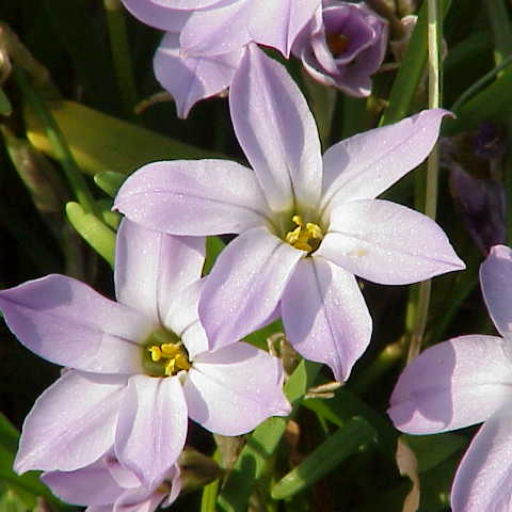
Plant Overview
Known fondly as the Spring Starflower, this South American native is a charming "blanket" plant that turns garden floors into a reflection of the night sky. While it looks delicate, it is surprisingly hardy, often pushing through the soil in late winter to signal the coming of spring. If you accidentally step on its leaves, don't be surprised by the sudden scent of onions—it’s the plant’s signature way of saying hello!
🔍 How to Identify
- 🌸 Star-Shaped Blooms: Each flower features six pointed tepals that form a perfect, symmetrical star shape, usually in shades of pale silvery-blue, violet, or white.
- 🍃 Grassy Foliage: The leaves are long, narrow, and floppy, resembling thick blades of grass or chives that stay low to the ground.
- 📏 Single Stems: True to its name (uniflorum means "one flower"), each slender, leafless stem carries exactly one solitary upright bloom.
- 👃 The Scent Test: If you crush a leaf between your fingers, it releases a sharp, pungent odor very similar to garlic or onions.
🏡 In Your Garden
- 🌱 Naturalizing Expert: This plant is famous for "naturalizing," meaning it will happily multiply and spread via tiny bulbs to form a dense flowery carpet over several years.
- 🛡️ Pest Resistance: Thanks to that onion-like scent, deer and rabbits almost always leave these flowers alone, making them excellent for "unprotected" garden borders.
- 💤 The Summer Vanish: Don’t panic when the plant disappears in mid-summer! It is a spring ephemeral that goes completely dormant once the heat hits, storing energy in its bulb for next year.
- 🧤 Easy Planting: These bulbs are incredibly forgiving. Even if you plant them slightly upside down, they usually find their way to the surface without a fuss.
⚠️ Safety & Toxicity
- 🐾 Mildly Toxic: While not usually deadly, the bulbs contain alkaloids that can cause nausea, vomiting, or diarrhea if ingested by dogs, cats, or curious children.
- 🚫 Not a Chive: Despite the tempting onion-like smell, Ipheion uniflorum is strictly ornamental and should never be used in cooking.
- 🧼 Skin Sensitivity: Some gardeners find the sap can cause mild skin irritation; wearing gloves during division is a good precaution.
✨ Fun Fact
The specific epithet uniflorum literally translates to "single-flowered." While many of its cousins in the Amaryllis family grow flowers in clusters (like Lilies or Onions), the Spring Starflower is a bit of a loner, insisting on its own private stem for every single bloom.

Detailed Care Instructions
To grow Ipheion Uniflorum (commonly known as spring starflower), follow these steps:
- Choose a suitable location: Ipheion Uniflorum thrives in full sun to partial shade. Select a spot in your garden or container where it will receive at least 6-8 hours of direct sunlight daily.
- Prepare the soil: The plant prefers well-draining soil. If your soil is heavy clay, amend it by adding organic matter such as compost or sand to improve drainage. Ensure the soil is loose and crumbly.
- Planting: Ipheion Uniflorum bulbs are planted in the fall, about 2-3 inches (5-7.5 cm) deep and spaced 3-4 inches (7.5-10 cm) apart. If you're planting in a container, make sure it has adequate drainage holes.
- Watering: After planting, water the bulbs thoroughly. Once established, water when the soil feels dry, aiming to keep the soil moist but not waterlogged. Reduce watering during winter when the plant is dormant.
- Fertilizing: Spring starflower doesn't require much fertilizer. You can apply a balanced slow-release fertilizer in early spring or sidedress with compost during the growing season. Follow package instructions for application rates.
- Mulching: Apply a thin layer of mulch around the planted bulbs to help conserve moisture, suppress weed growth, and moderate soil temperature.
- Care: Ipheion Uniflorum is relatively low-maintenance. Remove any dead flowers or foliage to ensure a neat appearance. The plant is generally resistant to pests and diseases.
- Division: After a few years, the bulbs may become overcrowded. You can dig up and divide the bulbs in late summer or early fall, replanting them at the appropriate spacing.
- Winter protection: Although this plant is fairly hardy, providing a layer of mulch or covering with a frost blanket can offer extra protection during extremely cold winters.
Ipheion Uniflorum will often naturalize over time, forming a beautiful carpet of flowers. Enjoy their delicate scent and lovely blooms in early spring!

Place in a window with dappled sun or a spot in the middle of a room. Or directly in a window facing west or east.

To water this plant, it is important to provide a consistent level of moisture in the soil. This can be achieved by watering deeply once a week, or more frequently during times of drought. It is essential to allow the soil to partially dry out between watering to avoid overwatering and root rot. When watering, avoid getting water on the foliage and aim for the soil around the base of the plant. Additionally, use well-draining soil and provide good air circulation to prevent fungal diseases.
To fertilize the Ipheion Uniflorum plant, apply a balanced, all-purpose fertilizer once a month during the growing season. Use a granular fertilizer and sprinkle it around the base of the plant. Water thoroughly after fertilizing to help the nutrients reach the roots. Avoid over-fertilizing as it can lead to excessive growth and reduced blooms.
The ideal soil for this plant should be well-draining, light, and rich in organic matter. It should have a pH level between 6.0 and 7.0. A mixture of peat moss, sand, perlite, and compost is recommended. Avoid using heavy or compacted soils, as they can lead to poor drainage and root rot. Additionally, make sure the soil is moist but not waterlogged, as this can also cause damage to the plant.
Ipheion Uniflorum is a plant that can be propagated through several methods such as division, seeds or offsets. To propagate through division, the plant should be carefully lifted from the soil and the roots should be separated into smaller clumps. These smaller clumps can then be replanted to grow new plants. Propagation through seeds can be done by sowing the seeds in moist soil during the spring season. The seeds should be placed in a sunny location and kept moist until they germinate. Propagation through offsets involves waiting for the plant to produce small bulbs or offsets which can be removed and planted in a new location. It is important to keep the soil moist but not too wet during propagation to ensure successful growth.
Common pests of the springstar include Spider mites, snails. Make a habit of checking your springstar frequently for pests so that any infestations can be caught and managed early.








