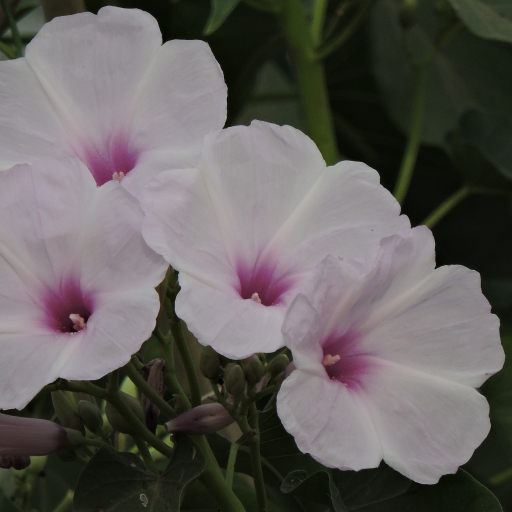
Plant Overview
Often called the Bush Morning Glory or "Matatodo" (which translates to "kills everything"), Ipomoea carnea is a striking departure from its climbing relatives. Instead of a vine, it grows into a sprawling, semi-woody shrub that can reach impressive heights. Originally from the tropical Americas, it has traveled the world as an ornamental beauty, though its aggressive growth and potent chemistry make it a plant that demands respect.
🔍 How to Identify
- 🌸 The Blooms: Features large, funnel-shaped flowers typically in shades of pale pink to deep lavender, often with a darker rose-colored throat.
- 🍃 The Foliage: Large, heart-shaped or lance-like leaves that are dull green and can grow up to 9 inches long.
- 🎋 The Stems: Unlike typical morning glories, these stems are thick, hollow, and become woody at the base as the plant matures.
- 📏 Growth Habit: It stands upright or leans heavily, forming a dense bush rather than a twisting vine.
🏡 In Your Garden
- 💧 Adaptability: This plant is an "extremist"—it is remarkably drought-tolerant once established, yet it can also survive with its roots submerged in water or mud, making it common near ditches and ponds.
- ✂️ Growth Control: Because it grows rapidly and can become leggy, it requires heavy pruning to maintain a tidy shape. In some tropical regions, it is used as a "living fence" due to its dense, fast-spreading nature.
- 🌱 Soil Nuance: It isn't picky about soil quality but thrives in full sun. Its hollow stems make it easy to propagate from cuttings, but be careful where you plant it, as it can become invasive in warm climates.
⚠️ Safety & Toxicity
- 🚫 Status: Highly Toxic.
- 🐾 Details: The plant contains swainsonine, a toxic alkaloid. It is notoriously dangerous to livestock (hence the name "Matatodo"), causing neurological damage known as "lysosomal storage disease." It is equally toxic to cats, dogs, and humans if ingested.
- 🖐️ Handling: Always wear gloves when pruning, as the milky sap can cause skin irritation for those with sensitive skin.
✨ Fun Fact
In some parts of the world, the hollow, lightweight stems of Ipomoea carnea have been used to make traditional flutes, handmade paper, and even as a substitute for tobacco pipes!

Detailed Care Instructions
| Humidity | Normal |
| Lighting | Full Sun |
| Toxicity | Poisonous |
| Difficulty | Easy |
| Temperature | 20°C - 30°C |
| Hardiness Zones | 8B - 11 |
To grow Ipomoea carnea, also known as the pink morning glory or bush morning glory, follow these steps:
- Climate and Location: This plant grows well in tropical and subtropical regions. Ensure that your location offers full sun (at least 6-8 hours of direct sunlight per day).
- Soil: Ipomoea carnea thrives in well-draining soil. Prepare the soil by adding organic matter like compost or aged manure to improve fertility and drainage.
- Watering: Water the plant regularly to keep the soil moist but not waterlogged. Let the topsoil dry slightly between watering to prevent root rot.
- Planting: Ipomoea carnea can be planted in the ground or in large containers. If planting in the ground, dig a hole twice the size of the root ball and place the plant in it, backfilling with soil. Space multiple plants about 2-3 feet apart. If using containers, choose a pot with drainage holes and fill it with a well-draining potting mix.
- Mulching: Apply a layer of mulch around the base of the plant to help retain moisture and suppress weeds. Use organic mulch like wood chips or straw.
- Fertilization: Feed the plant with a balanced fertilizer once a month during the growing season (spring to fall). Follow the instructions on the fertilizer packaging for application rates.
- Pruning: Ipomoea carnea benefits from regular pruning to maintain a compact shape and promote new growth. Remove any dead, damaged, or overcrowded branches. Prune after flowering to encourage more blooms.
- Support: Depending on the variety, Ipomoea carnea can grow as a shrub or vine. If it is a vine variety, provide a trellis or support structure for it to climb upon.
- Pests and diseases: This plant is relatively resistant to pests and diseases. However, keep an eye out for common issues like aphids, mealybugs, or fungal diseases. Treat as necessary with organic or chemical remedies.
- Propagation: Ipomoea carnea can be propagated from seeds or cuttings. Collect seeds from mature pods and sow them in seed-starting mix. For cuttings, take 6-8 inch (15-20 cm) sections of stem and plant them in a well-draining mix. Keep them moist until roots develop.
Remember, Ipomoea carnea is a hardy and fast-growing plant, so it's important to monitor its growth and provide proper care to manage its growth and prevent it from becoming invasive in some areas.

Place in a bright room that is sun drenched almost all day. Or directly in a south-facing window.

To water this plant, it is important to ensure that the soil is always slightly moist but not waterlogged. This can be achieved by watering the plant deeply once a week, allowing the water to fully soak into the soil. It is important to water the plant at the base, avoiding getting the leaves and flowers wet as this can lead to fungal diseases. In periods of high heat or drought, it may be necessary to increase watering frequency to twice a week. It is important to monitor the soil moisture level regularly by checking the top inch of soil for dryness. The plant should not be allowed to completely dry out or sit in waterlogged soil. It is also helpful to add a layer of organic mulch around the base of the plant to help retain moisture and regulate soil temperature.
To fertilize this plant, use a slow-release fertilizer, applied once every three months during the growing season. Additionally, you can use a liquid fertilizer every two weeks during the growing season, being sure to follow the manufacturer's instructions for proper dilution and application. Always water the plant after fertilizing to prevent fertilizer burn. Avoid fertilizing during the plant's dormant period.
Ipomoea Carnea plant requires a well-draining soil that is rich in nutrients. The soil should be a mix of sand, silt, and clay, with a pH level of around 6.0 to 7.0. It is recommended to add organic matter such as compost or aged manure to the soil before planting. The soil should also be moist but not waterlogged. Mixing perlite or vermiculite can also help to improve soil drainage. It is important to ensure that the soil is not contaminated with herbicides or pesticides, as these can harm the plant.
Ipomoea Carnea can be propagated through stem cuttings and seeds.
To propagate through stem cuttings, select a healthy and mature stem that has no signs of disease or damage. Cut a section of the stem that is approximately 6 inches in length. Remove any leaves that are close to the bottom of the stem and make a clean cut at an angle. Dip the cuttings in rooting hormone powder and plant them in a pot filled with well-draining soil. Water the soil thoroughly and place the pot in a location with indirect sunlight.
To propagate through seeds, collect the matured seeds from the plant and place them in a container with well-draining soil. Water the soil thoroughly and place the container in a location with direct sunlight. Keep the soil moist but not waterlogged. The seeds will germinate within 10-12 days.
It is important to note that Ipomoea Carnea can be toxic to livestock and humans, so it is important to handle it with care and avoid ingestion of any parts of the plant.








