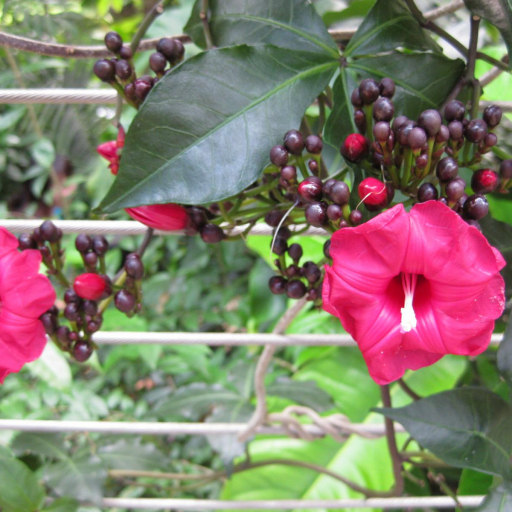
Plant Overview
Known as the "Lady Doorly’s Morning Glory" or "Prince’s Vine," this show-stopping tropical climber is the crown jewel of the morning glory family. Unlike its common blue cousins, this Caribbean native produces clusters of waxy, deep magenta flowers that look almost like polished rubies. It is a sophisticated choice for gardeners looking to add a touch of royal elegance to a sunny trellis or pergola.
🔍 How to Identify
- 🌸 Jewel-Toned Blooms: Large, trumpet-shaped flowers with a distinct waxy texture and a deep crimson or magenta-pink hue.
- 🌿 Palmate Foliage: Dark green, glossy leaves that are deeply divided into five to seven "fingers," resembling a spread hand.
- 🧗 Woody Stems: As the vine matures, its base becomes quite thick and woody, allowing it to climb much higher than many annual vines.
🏡 In Your Garden
- ☀️ Tropical Requirements: This plant is a true child of the sun. It requires high humidity and consistent warmth; if temperatures drop below 50°F (10°C), it may begin to drop its leaves in protest.
- 🧱 Structural Support: Because it is a vigorous, heavy grower, it needs a sturdy fence or a strong trellis. It uses its twining stems to wrap around supports, so it doesn't need "sticky" pads to climb.
- ✂️ Pruning Patience: It blooms on "new wood," so any major pruning should be done in late winter or early spring to encourage a massive flush of flowers during the blooming season.
⚠️ Safety & Toxicity
- 🚫 Potential Irritant: Like many members of the Ipomoea genus, the seeds can be toxic if ingested, containing alkaloids that may cause stomach upset or more serious symptoms.
- 🐾 Pet Safety: It is best to keep this plant out of reach of curious dogs and cats. Ingestion of the foliage or seeds can lead to vomiting, lethargy, or coordination issues.
✨ Fun Fact
While most morning glories are famous for opening at dawn and fading by noon, the flowers of Ipomoea horsfalliae are much more durable. They are specifically evolved to be "hummingbird magnets," staying open longer to ensure these tiny birds can find their nectar-rich centers!

Detailed Care Instructions
To grow Ipomoea horsfalliae, also known as the Cardinal Creeper or the Mexican Morning Glory, you can follow these steps:
- Climate: This plant thrives in warm and tropical climates. Ensure that your area receives full sun or partial shade, with temperatures between 70-85°F (21-29°C).
- Soil: Use well-draining soil with a slightly acidic to neutral pH level. Enhance the soil with compost or organic matter to improve its fertility and drainage.
- Planting: Sow the Ipomoea horsfalliae seeds directly into the ground or in containers. Soak the seeds overnight in warm water to improve germination rates. Plant the seeds 1/4 to 1/2 inch deep.
- Watering: Keep the soil consistently moist but avoid overwatering, as it may lead to root rot. Provide deep waterings rather than frequent shallow waterings.
- Support: Ipomoea horsfalliae is a climbing vine, so it requires support to grow vertically. Provide a trellis, arbor, or a nearby fence for the plant to climb and spread.
- Fertilizer: Feed the plant every 2-3 weeks during the growing season with a balanced, water-soluble fertilizer. Follow the package instructions for proper dilution and application rates.
- Pruning: Trim back any dead or diseased branches to maintain a healthy plant. Regularly prune to control the size and shape of the plant and encourage bushier growth.
- Pests and diseases: Keep an eye out for common pests like aphids, spider mites, or whiteflies. Use organic insecticides or insecticidal soaps and regularly inspect the plant to identify any signs of diseases like powdery mildew or root rot. Treat as necessary.
- Mulching: Apply a layer of organic mulch around the base of the plant to retain moisture, suppress weeds, and regulate soil temperature.
- Winter care: If you live in a region with frost or freezing temperatures, provide protection to your Ipomoea horsfalliae during winter. Move container-grown plants indoors or cover the plant with a frost cloth or blanket to shield it from cold temperatures.
By following these guidelines, you should be able to successfully grow Ipomoea horsfalliae and enjoy its vibrant red flowers.

Place in a bright room that is sun drenched almost all day. Or directly in a south-facing window.

The best way to water this plant is to ensure that the soil remains consistently moist but not waterlogged. The frequency of watering will depend on the temperature and humidity of the surrounding environment, as well as the type of soil in which the plant is growing. It is important to avoid allowing the soil to dry out completely between waterings, as this can lead to stress and damage to the plant. One way to ensure proper moisture levels is to use a watering gauge to monitor the soil's moisture content, or to check the soil with your finger to determine whether it feels dry to the touch. Watering should be done slowly and gently, using a watering can or hose with a gentle flow and avoiding getting water on the plant's leaves.
To fertilize this plant, use a balanced fertilizer containing equal amounts of nitrogen, phosphorus, and potassium. Apply the fertilizer once a month during the growing season, from spring to early fall. Be careful not to over-fertilize, as this can lead to leaf burn and other plant problems. Always follow the instructions on the package and dilute the fertilizer properly before application.
Ipomoea Horsfalliae plant prefers well-draining soil that is moist but not waterlogged. It thrives in sandy or loamy soil with a pH of 6 to 7.5. The soil should be rich in organic matter and should be amended with compost or well-rotted manure before planting. It is important to avoid heavy and clay soils as they tend to hold too much water, which can lead to root rot. The plant also benefits from regular fertilization with a balanced fertilizer, especially during the growing season. Additionally, it is recommended to mulch around the base of the plant to retain moisture and suppress weed growth. Overall, providing nutrient-rich, well-draining soil will ensure healthy growth and vibrant blooms for the Ipomoea Horsfalliae plant.
There are several ways to propagate this plant. One method is by taking stem cuttings. Choose a healthy stem from the plant and make a clean cut just below a node. Remove the leaves from the lower part of the stem and dip the cut end in rooting hormone. Plant the stem in a pot with well-draining soil and keep it moist but not waterlogged. Place the pot in a brightly lit area but out of direct sunlight. After several weeks, roots should begin to form and new growth will emerge.
Another method is by layering. Select a healthy stem from the plant and bend it down to the ground. Use a small stake to pin the stem in place. Cover the area where the stem meets the soil with a small amount of soil or compost. Keep the soil moist and in a few weeks, new roots should appear. After the roots have formed, cut the stem from the parent plant and transplant the new plant to its new location.
A third method is by seeds. Collect the seeds from the plant when the flowers have faded and the seed pods have turned brown. Remove the seeds from the pods and plant them in a pot with well-draining soil. Keep the soil moist and in a warm, bright location. Germination should occur within a couple of weeks. Once the seedling has developed a few sets of leaves, it can be transplanted to its new location.








