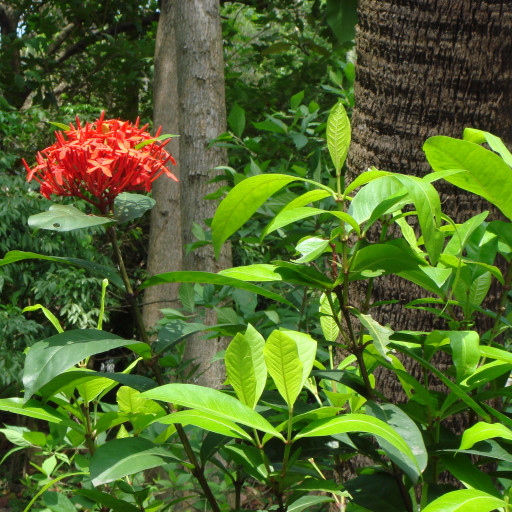
Plant Overview
Known as the Chinese Ixora or the "Jungle Flame," this vibrant evergreen shrub is a centerpiece of tropical beauty. In many Southeast Asian cultures, its star-shaped clusters are symbols of devotion and are frequently used in floral offerings at temples. It is a sun-loving powerhouse that radiates warmth with its fiery hues, making it a favorite for gardeners looking to add a "pop" of tropical drama to their landscape.
🔍 How to Identify
- 🌸 Starry Clusters: Look for large, rounded flower heads (corymbs) packed with dozens of small, four-petaled tubular flowers that look like miniature stars.
- 🍃 Glossy Foliage: The leaves are dark green, leathery, and remarkably shiny, typically growing in opposing pairs along the woody stems.
- 📏 Compact Form: Unlike some wilder shrubs, the Chinese Ixora has a naturally dense, mounding habit, making it look "manicured" even without heavy pruning.
🏡 In Your Garden
- 🧪 The Acid Test: This plant is a dedicated "acid-lover." If you notice the leaves turning yellow while the veins stay green (chlorosis), it’s a cry for help—your soil pH is likely too high, preventing the plant from "eating" iron.
- 💧 Humidity over Wet Feet: While it craves a humid atmosphere to keep its buds from dropping, it hates "wet feet." Ensure your soil is rich in organic matter but drains quickly to prevent root rot.
- ✂️ Pruning Strategy: It handles shearing exceptionally well. However, to keep the blooms coming, avoid "topping" the plant too often, as flowers develop on the tips of new growth.
⚠️ Safety & Toxicity
- 🐾 Pet Friendly: Good news for pet owners! Ixora chinensis is generally considered non-toxic to dogs, cats, and horses, making it a safe choice for a shared backyard.
- 👶 General Caution: While not considered poisonous, the berries and leaves are not edible. Ingesting large quantities may cause mild stomach upset in small children or sensitive individuals.
✨ Fun Fact
Ixora is a "butterfly magnet." Because the flowers are rich in nectar and their bright red/orange pigments are easily seen by pollinators, they act as a high-energy refueling station for various Swallowtail butterflies and even hummingbirds!

Detailed Care Instructions
To grow Ixora Chinensis plant, also known as Chinese ixora or jungle flame, follow these steps:
- Choose the right location: Ixora Chinensis thrives in full sun to partial shade, so select a spot that receives at least six hours of direct sunlight each day. It should also be protected from strong winds.
- Prepare the soil: Ixora Chinensis prefers well-draining soil that is slightly acidic (pH 5.5 to 6.5). If your soil is heavy clay, add organic matter like compost or peat moss to improve the drainage.
- Planting: Dig a hole that is at least twice as wide and deep as the plant's container. Place the plant in the hole, ensuring that the soil line of the plant is level with the ground. Fill the hole with soil and firm it gently around the base of the plant.
- Watering: After planting, water the plant thoroughly to settle the soil and remove any air pockets. Ixora Chinensis needs regular watering, especially during periods of dry weather. However, avoid overwatering, as it can cause root rot. Water deeply at the base of the plant, rather than overhead, to prevent fungal diseases.
- Mulching: Apply a layer of organic mulch, such as wood chips or bark, around the base of the plant. This helps to retain moisture, suppress weeds, and regulate soil temperature.
- Fertilizing: Ixora Chinensis benefits from regular fertilization. Use a balanced slow-release or organic fertilizer formulated for flowering plants. Apply the fertilizer according to the package instructions, usually every 2-3 months during the growing season.
- Pruning: Prune Ixora Chinensis after the blooming period to shape the plant and remove any dead or diseased branches. This will also promote bushier growth and increased flower production.
- Pest and disease control: Keep an eye out for common pests like aphids, whiteflies, and mealybugs. Treat them with organic insecticides or insecticidal soaps. Watch for signs of fungal diseases such as leaf spot or root rot, and promptly address them with appropriate fungicides or by adjusting watering practices.
- Winter care: In regions with cold winters, Ixora Chinensis may need protection from frost or freezing temperatures. Cover the plant with burlap or move it to a sheltered area during the cold season.
By following these steps, you can successfully grow and care for Ixora Chinensis plants. Remember to monitor the plant's health regularly and provide proper care to ensure its well-being.

Place in a window with dappled sun or a spot in the middle of a room. Or directly in a window facing west or east.

To properly water this particular plant, it is important to understand its soil requirements and watering needs. The soil should be well-draining, but also retain some moisture, as the plant prefers a slightly moist environment.
To water the plant, use a watering can or hose with a gentle stream to avoid disturbing the delicate roots. Water the plant thoroughly, until the soil is moist to the touch but not waterlogged. It is important to avoid letting the soil dry out completely, as this can stress the plant and cause it to wilt or drop its leaves.
It is recommended to water the plant once or twice per week, depending on the temperature and humidity levels in the surroundings. Pay attention to the soil moisture level and adjust watering frequency accordingly.
In addition to watering, it is also important to ensure the plant receives adequate sunlight and nutrients, as these factors also play a role in its overall health and growth.
To fertilize the plant, use a balanced fertilizer with an NPK ratio of 10-10-10 or similar. Apply the fertilizer every 2-3 months during the growing season, which is typically spring and summer. Mix the fertilizer with water according to the package instructions and then apply it to the soil around the base of the plant. Avoid fertilizing the plant during the dormant season, which is typically fall and winter.
For optimal growth, the plant requires a well-draining soil that is rich in organic matter. It should be slightly acidic with a pH range of 5.5-6.5. A mixture of peat moss, perlite, and pine bark is generally recommended for soil preparation. The soil should be kept consistently moist, but not waterlogged, as the plant requires moderate watering. Additionally, frequent fertilization with a balanced, slow-release fertilizer is necessary for healthy growth and flowering.
There are several ways to propagate this plant. One method is by taking stem cuttings from a healthy parent plant. Choose a stem that is at least 4 inches long, with several leaves and nodes. Cut the stem just below a node with a sharp knife. Remove all leaves from the bottom half of the stem. Dip the cut end in rooting hormone powder and plant it in a pot filled with a well-draining potting mix. Water the cutting and cover it with a plastic bag to create a humid environment. Keep the soil moist and place the pot in a bright, indirect sunlight. After a few weeks, roots should start to develop and new growth will appear.
Another way to propagate this plant is by layering. Choose a low branch on the parent plant and bend it down so that it touches the soil. Make a small wound on the underside of the branch where it touches the soil and secure it in place with a U-shaped wire or a small stake. Cover the wound with soil and keep the area moist. After several weeks, roots should start to grow from the wounded area. Once the new roots are established, cut the branch from the parent plant and transplant it to a new pot.
Lastly, this plant can also be propagated by air layering. Choose a healthy branch on the parent plant and make a small circular cut through the bark. Apply rooting hormone powder to the cut area and wrap it with damp sphagnum moss. Cover the moss with plastic wrap and secure it in place with a rubber band. Keep the moss moist and wait for roots to emerge from the wound. Once roots are established, cut the branch below the root ball and transplant it to a new pot.
Common pests of the chinese ixora include Scale insect, mealybugs, aphids, thrips. Make a habit of checking your chinese ixora frequently for pests so that any infestations can be caught and managed early.








