Plant Overview
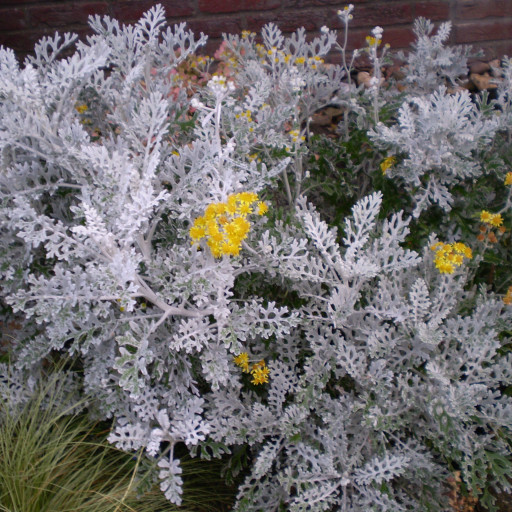
Often called "Dusty Miller" or "Silver Dust," Jacobaea maritima looks as if it has been caught in a light, permanent snowfall. Originally hailing from the sun-drenched, rocky cliffs of the Mediterranean, this plant is a staple in "moon gardens" because its pale foliage seems to glow under the light of the stars. It is a resilient survivor that trades flashy floral displays for some of the softest, most ethereal leaves in the plant kingdom.
🔍 How to Identify
- 🌿 Felted Texture: The foliage is covered in a dense layer of fine, matted white hairs (tomentum), giving the leaves a soft, "woolly" or felt-like feel.
- 🎨 Silvery Palette: The leaves are a striking silvery-gray to near-white color, providing a dramatic contrast when planted next to dark green or purple companions.
- ✂️ Lacy Architecture: Depending on the variety, the leaves can range from broad and lobed (like a white oak leaf) to finely filigreed and lace-like.
- 🌼 Yellow Blooms: In its second year, it produces clusters of small, bright yellow, daisy-like flowers, though many gardeners prune these away to keep the energy focused on the silver foliage.
🏡 In Your Garden
- ☀️ Natural Sunscreen: Those iconic silver hairs aren't just for decoration; they act as a reflective shield against intense sunlight, helping the plant stay cool and retain moisture in scorching heat.
- 🏜️ Drought Specialist: Because of its Mediterranean roots, it is exceptionally drought-tolerant. It actually prefers "lean," sandy soil and will quickly suffer from root rot if left in heavy, waterlogged earth.
- ✂️ Shape Management: To prevent the plant from becoming "leggy" or woody, it is best to prune it back by half in early spring to encourage new, compact, and extra-silvery growth.
⚠️ Safety & Toxicity
- 🚫 Toxic if Ingested: This plant contains pyrrolizidine alkaloids, which can cause liver damage if eaten in large quantities.
- 🐾 Pet & Livestock Warning: It is considered toxic to dogs, cats, and horses. While the bitter taste usually deters animals, it should be planted away from curious grazers.
- 🧤 Skin Sensitivity: Some gardeners may experience mild skin irritation (contact dermatitis) from the fine hairs, so wearing gloves during heavy pruning is recommended.
✨ Fun Fact
- 🌕 The Moon's Mirror: Jacobaea maritima is one of the top choices for "Moonlight Gardens." Its high reflectivity allows it to catch the dimmest light, making garden paths visible and beautiful even after the sun has set.

Detailed Care Instructions
| Color | Yellow |
| Soil Ph | 5.5-6.0 |
| Humidity | Dry |
| Lighting | Part Sun |
| Toxicity | Poisonous |
| Soil Type | Average And Well-Drained |
| Bloom Time | Summer |
| Difficulty | Easy |
| Plant Type | Hardy Annual |
| Mature Size | 6 To 18 Inches |
| Native Area | Mediterranean Region |
| Temperature | 15°C - 35°C |
| Sun Exposure | Full Sun |
| Hardiness Zones | 7-10 |
To grow Jacobaea Maritima, also known as Dusty Miller or Silver Ragwort, follow these steps:
- Choose the right location: Dusty Miller plants prefer full sun but can tolerate some light shade. Ensure that the soil is well-draining and loamy.
- Prepare the soil: Before planting, amend the soil with organic matter such as compost or well-rotted manure to improve its fertility and drainage.
- Start from seeds or cuttings: You can start Jacobaea Maritima from seeds or cuttings. If using seeds, sow them indoors in late winter or early spring, keeping the soil moist until germination. If using cuttings, take 3-4 inch cuttings from healthy, established plants in early spring or fall and plant them in well-draining soil.
- Transplant or thin seedlings: Once the seedlings have grown enough to handle, transplant them outdoors or thin them to provide adequate space between plants. Space them about 12-18 inches apart.
- Watering: Water the plants regularly, especially during dry periods. Avoid overwatering as this can cause root rot.
- Mulch: Apply a layer of organic mulch around the plants to retain moisture, suppress weeds, and regulate soil temperature.
- Fertilization: Dusty Miller plants don't require much fertilization. You can apply a balanced, slow-release fertilizer once in spring to promote healthy growth.
- Pruning: Regularly trim back the plant to maintain its desired size and shape. This will also encourage bushier growth.
- Pests and diseases: Dusty Miller is relatively pest and disease resistant. However, it may occasionally be affected by aphids or powdery mildew. Monitor the plants regularly and take appropriate action if any issues arise.
- Winter care: In areas with frosty winters, Jacobaea Maritima is often grown as an annual. However, in mild climates, it can be grown as a perennial. Provide mulch around the base of the plant to protect it during winter.
By following these steps, you should be able to successfully grow Jacobaea Maritima and enjoy its beautiful silver foliage.

Place in a window with dappled sun or a spot in the middle of a room. Or directly in a window facing west or east.

The plant requires regular watering during the growth period in order to keep the soil consistently moist. When watering, it is important to apply enough water to thoroughly soak the soil, but avoiding over-watering that can lead to root rot or other problems. Ensure that the soil has good drainage to prevent waterlogging. During hot or dry periods, it may be necessary to water more frequently to prevent the soil from drying out completely. To avoid getting the foliage wet, water at the base of the plant using a watering can or hose with a gentle spray attachment.
To properly fertilize this plant, it is recommended to use a fertilizer with equal parts nitrogen, phosphorus, and potassium. This can be applied every 2-3 weeks during the growing season. It is important to not over-fertilize as this can lead to burning of the plant. Additionally, adding organic matter such as compost to the soil can also provide necessary nutrients for healthy growth.
Jacobaea Maritima plant prefers a well-draining soil mixture that is low in nutrients. The soil should be a mixture of sand, loam, and perlite to ensure good drainage. Avoid using heavy, clay-like soil as it will retain too much moisture and lead to root rot. A pH level between 5.0 to 7.5 is suitable for the plant's growth. Adding compost or peat moss to the soil can help improve its organic matter content but it should be done in moderation as Jacobaea Maritima plant prefers a soil with low nutrient levels.
To propagate this plant, you will need to take a cutting from an existing plant. Locate a healthy and mature stem and take a cutting of about 4-6 inches in length. Remove any lower leaves from the stem and place the cutting in a container with water or a well-draining potting mix. Keep the container in a warm and bright location but out of direct sunlight. Change the water or mist the soil regularly to prevent it from drying out. Within a few weeks, roots should start to form and once they are established, the new plant can be transplanted into a larger container or directly into the ground.








