Plant Overview
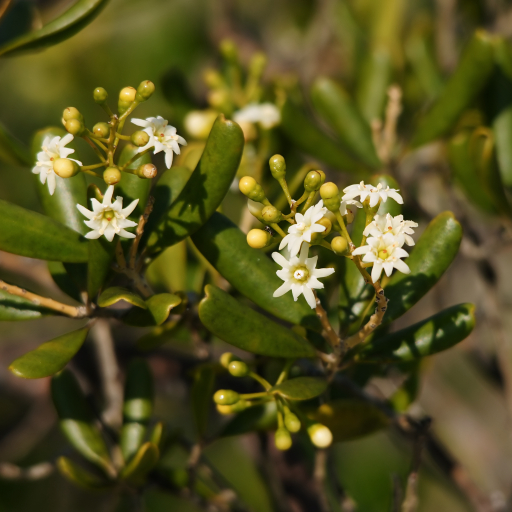
Known as the "Joewood," this slow-growing coastal gem is the epitome of tropical resilience. Native to the salty fringes of the Florida Keys and the Caribbean, it often looks like a naturally manicured bonsai shaped by the sea breeze. Its most enchanting secret is the intense, honey-sweet perfume that wafts from its tiny flowers, filling the air on warm tropical evenings.
🔍 How to Identify
- 🍃 Leathery Foliage: The leaves are thick, stiff, and "spatulate" (spoon-shaped), often slightly cupped with a pale, yellowish-green tint.
- 🌼 Fragrant Blooms: It produces small, bell-shaped, creamy-white flowers that grow in terminal clusters and smell remarkably like vanilla or jasmine.
- 🍒 Hard Berries: The fruit consists of small, round berries that start green and ripen into a dull orange or yellow-brown, staying on the branch for a long time.
🏡 In Your Garden
- 🌊 Salt Specialist: This is one of the most salt-tolerant plants in existence. It can thrive right on the dunes, shrugging off salt spray and heavy winds that would kill most other ornamental shrubs.
- ⏳ Patience Required: Joewood is notoriously slow-growing. While this means it requires almost no pruning, it also means you won't get an "instant" privacy screen; it is better used as a structural specimen or a low-maintenance border.
- ☀️ Sun Lover: To maintain its tight, attractive canopy, it needs full sun. In the shade, the branches can become "leggy" and lose that classic wind-swept look.
⚠️ Safety & Toxicity
- 🚫 Toxic if Ingested: All parts of the Joewood, especially the seeds and bark, contain saponins.
- 🐾 Pet & Child Warning: While not usually fatal, eating the berries can cause significant stomach upset, nausea, and drooling in dogs, cats, and humans. It is best treated as an ornamental-only plant.
✨ Fun Fact
Historically, Joewood was used as a "fish poison." Indigenous coastal people would crush the bark and fruit and toss them into quiet tide pools; the saponins would temporarily paralyze the fish's gills, causing them to float to the surface for easy collection!

Detailed Care Instructions
To grow Jacquinia keyensis plants, follow these steps:
- Obtain seeds or young plants from a reputable nursery or online plant supplier. Jacquinia keyensis is a rare plant, so availability may be limited.
- Choose a suitable location with partial shade. Jacquinia keyensis prefers indirect sunlight or dappled shade.
- Prepare the soil by mixing in compost or organic matter to improve drainage and fertility. Jacquinia keyensis prefers well-draining soil.
- Dig a hole that is roughly twice the size of the root ball or seedling container. Place the plant in the hole, ensuring that it is at the same soil level as it was in the container.
- Water the planted Jacquinia keyensis thoroughly and deeply to settle the soil and provide moisture to the roots. After planting, water regularly to keep the soil evenly moist but not waterlogged. Jacquinia keyensis prefers consistently moist soil.
- Apply a layer of mulch around the base of the plant to help retain moisture, control weed growth, and provide some insulation to the roots.
- Fertilize the Jacquinia keyensis plant with a slow-release, balanced fertilizer according to the package instructions. Apply in early spring and early fall for best results.
- Prune the plant, if necessary, to maintain its desired shape or remove any damaged or dead branches. Avoid heavy pruning, as Jacquinia keyensis generally has a naturally rounded form.
- Watch for any signs of pests or diseases, such as leaf spots or aphids, and take appropriate action if needed. Regularly inspect the plant's foliage and overall health.
- Be patient, as Jacquinia keyensis can be slow-growing. Ensure consistent care and provide appropriate conditions, and the plant should thrive and slowly grow over time.
Remember to consult local plant experts or resources for specific advice tailored to your region, as conditions can vary.

Place in a bright room that is sun drenched almost all day. Or directly in a south-facing window.

To water this particular plant, one should aim to provide it with enough moisture to sustain healthy growth, while avoiding overwatering which can cause root rot and other issues. It is important to water the plant consistently, but not necessarily daily or on a strict schedule. Instead, one should check the soil regularly to assess its moisture level, and only water when the surface of the soil feels dry to the touch.
When watering, it is important to use room temperature water and to avoid splashing the leaves or getting water on the plant's stem or trunk. One may choose to water from the top of the soil, or to use a tray or saucer underneath the plant to allow it to absorb water from the bottom. It may also be helpful to use a well-draining soil mix to avoid waterlogging, and to provide adequate drainage for excess water to escape.
Overall, it is crucial to monitor the plant's moisture level and adjust watering frequency as needed based on the local climate, humidity, and soil conditions. With proper care and attention to watering, this plant can thrive and bring beauty to its surroundings.
To fertilize this plant, you should use a balanced fertilizer with equal parts nitrogen, phosphorus, and potassium. Apply the fertilizer once in the spring and again in the summer, following the manufacturer's instructions for application rates. Avoid over-fertilizing, as this can lead to leaf burn or other problems. Additionally, you may want to supplement the fertilizer with organic matter such as compost or manure, which can improve soil fertility and provide additional nutrients to the plant.
The best soil to use for Jacquinia Keyensis plant is acidic, well-draining, and moderately fertile. A mix of peat moss, pine bark, and perlite or coarse sand is ideal. The plant prefers soil that has a pH level between 5.0 and 6.5. The soil should not be compacted or waterlogged, as this can cause root rot. It is recommended to repot the plant every two years to refresh the soil. When planting in outdoor soil, make sure that it has good drainage and is amended with organic matter such as compost.
Jacquinia keyensis can be propagated using various methods such as seed propagation, cutting propagation, and layering propagation. To propagate this plant using cuttings, select healthy stem cuttings with at least two nodes and remove the leaves from the bottom of the cutting. Dip the cutting into rooting hormone powder and plant it in a potting mix made of equal parts perlite and peat moss. Water the cutting thoroughly and keep the soil moist until roots start to grow. You can also propagate the plant using layering by bending a healthy stem to the ground and covering it with soil. Roots will form at the covered section of the stem. Once roots are well developed, the stem can be cut and transplanted to its new location.








