Plant Overview
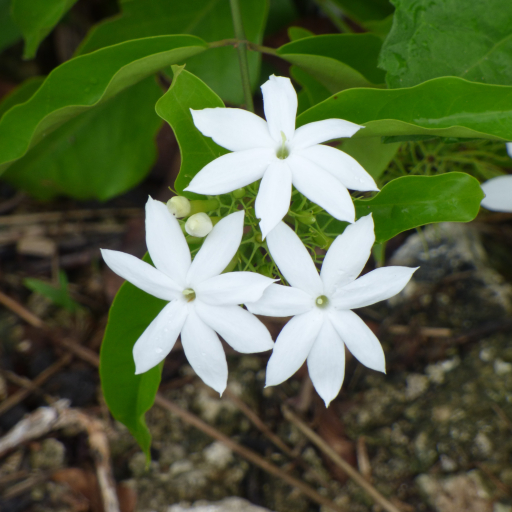
Known as the Slender Jasmine or Starry Jasmine, Jasminum elongatum is like a scattering of fallen stars across a deep green canvas. Unlike the heavy, sometimes cloying scent of its common cousins, this species offers a more delicate, refined fragrance that dances on the evening breeze. It is a favorite for gardeners who want a touch of wild, tropical elegance without the aggressive growth habits of more common vines.
🔍 How to Identify
- 🌸 The Bloom: Pure white, star-like flowers featuring 6 to 9 narrow, pointed petals that resemble tiny propellers.
- 🍃 The Foliage: Elongated, lance-shaped leaves that grow in opposite pairs; they often have a soft, velvety texture due to fine hairs on the underside.
- 🌿 The Form: A versatile "scrambler" that can be maintained as a dense, mounding shrub or trained to climb upward with the help of a trellis.
🏡 In Your Garden
- ☀️ Light & Airy: While it thrives in full sun, this jasmine is surprisingly tolerant of dappled shade, making it a perfect candidate for the tricky transition zones under larger garden trees.
- 🪴 Drainage Nuance: It possesses a sensitive root system that resents "wet feet." It is much more likely to forgive a brief dry spell than it is to survive sitting in stagnant, heavy water.
- ✂️ Structural Support: Because it is a natural scrambler rather than a twin-vining plant, it needs a bit of "hand-holding" early on. Use soft garden ties to guide its stems if you want it to cover a fence or wall.
⚠️ Safety & Toxicity
- ✅ Non-Toxic Status: Jasminum elongatum is a "true jasmine" and is generally considered non-toxic to humans, cats, and dogs.
- ⚠️ The "False" Lookalike: Always distinguish this from "Carolina Jasmine" (Gelsemium), which looks similar but is highly toxic. True Jasminum species like this one are safe for a family-friendly garden.
- 🐜 Sap Sensitivity: While not toxic, the sap can occasionally cause mild skin irritation for those with very sensitive skin during heavy pruning.
✨ Fun Fact
The specific epithet elongatum refers to its uniquely long, slender flower tubes. In many Southeast Asian cultures, these delicate blooms are traditionally used as natural "hair jewelry" because their stems are sturdy enough to be woven into braids.

Detailed Care Instructions

Place in a bright room that is sun drenched almost all day. Or directly in a south-facing window.

Some plants require more regular watering than others, which should be done every few days. It's critical to maintain the soil moist all of the time. The water requirements of the same plant placed in pots with varying sizes will differ. Because the water in the smaller pot evaporates faster than the water in the larger pot, it will require more watering. Regardless of pot size, the surface should constantly be maintained moist.








