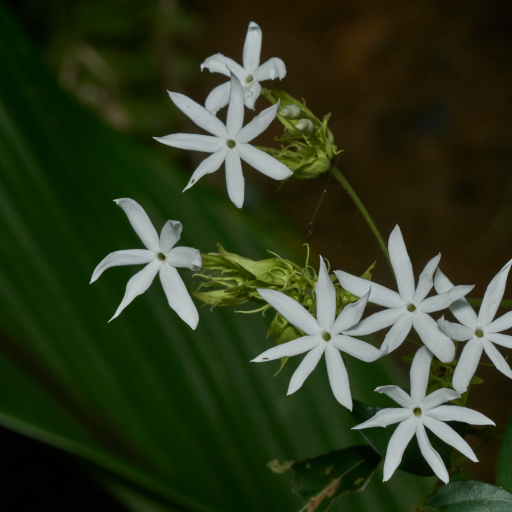
Plant Overview
Known as the Malabar Jasmine or Wild Jasmine, this enchanting climber is a jewel of the Western Ghats in India. In its native habitat, it blankets forest canopies with a snowy white veil, releasing a fragrance so heady and sweet it can be detected from dozens of yards away. Often called "Kusunda" in local dialects, it is prized not just for its beauty, but for its role in traditional storytelling and ancient herbal lore.
🔍 How to Identify
- 🌸 Starry Blooms: The flowers are pure white, featuring 6 to 9 narrow, pointed petals that resemble a delicate starburst.
- 🍃 Glossy Foliage: Its leaves are broad, oval-shaped, and come to a sharp point, possessing a deep green, waxy sheen that reflects sunlight.
- 🌿 Climbing Habit: As a woody climber (liana), it produces long, twining stems that seek out nearby structures or trees to scale toward the light.
🏡 In Your Garden
- 🧗 Support is Key: Because this jasmine is a vigorous climber, it performs best when given a sturdy trellis or fence. Without support, it will form a messy, sprawling mound.
- 🌙 Sensory Placement: Plant it near a bedroom window or a patio. The fragrance intensifies significantly after sunset, making it a perfect companion for "moon gardens" meant to be enjoyed at night.
- 💧 Thirst for Humidity: Coming from the monsoon-fed forests of India, it thrives in high humidity. If you live in a dry climate, frequent misting or placing it near a water feature will keep it lush.
⚠️ Safety & Toxicity
- ✅ Safe Status: Jasminum malabaricum is generally considered non-toxic to humans and common household pets like cats and dogs.
- ✋ Skin Sensitivity: While not poisonous, the sap of many climbing vines can cause mild skin irritation in sensitive individuals. It is always wise to wear gloves when performing heavy pruning.
✨ Fun Fact
In the Western Ghats of India, the blooming of the Malabar Jasmine is often seen as a biological "alarm clock," signaling the transition of seasons and the arrival of specific forest pollinators like the sphinx moth.

Detailed Care Instructions
When watering this plant, it is important to ensure that the soil is well-draining. This can be achieved by adding perlite or sand to the potting mix. Water should be given when the top inch of soil feels dry to the touch. Avoid overwatering, as this can lead to root rot. Allow the excess water to drain out of the pot and do not let the plant sit in standing water. It is also recommended to use lukewarm water instead of cold water.
Jasminum Malabaricum is a plant that prefers to grow in well-draining soil that is rich in organic matter. It is important to use a soil mix that is moisture-retaining but not too compact or waterlogged as the plant does not tolerate heavy, wet soil. A mix of garden soil, compost, and coarse sand or perlite can be used to provide the ideal soil conditions for Jasminum Malabaricum. This plant grows best in a slightly acidic to neutral pH soil, so it is important to ensure that the soil mix used is within this range. The soil should also be loosened and aerated periodically to prevent compaction and allow for proper root growth.








