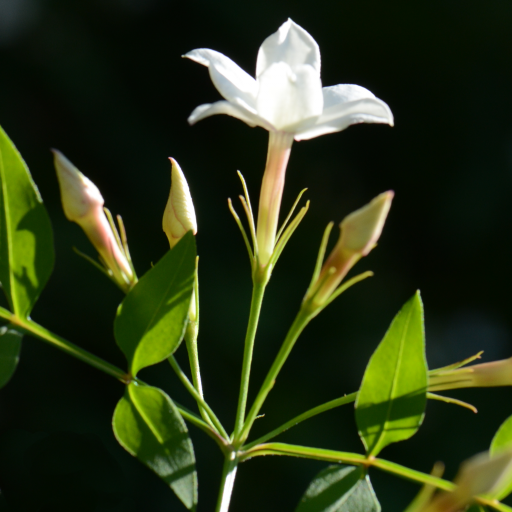
Plant Overview
Known as the "Queen of the Night" or "Poet’s Jasmine," this climbing beauty has been a staple of romantic gardens for centuries. Originating from the rugged slopes of the Himalayas, its delicate white blossoms carry one of the most intoxicating scents in the botanical world. It is a favorite among perfumers and tea drinkers alike, cherished for its ability to turn a simple evening breeze into a sensory experience.
🔍 How to Identify
- 🌸 The Blooms: Look for small, star-shaped white flowers (about 1 inch wide) that grow in clusters. They often have a faint, waxy texture and may show a tiny hint of pink on the buds before they open.
- 🍃 The Foliage: The leaves are "pinnate," meaning they consist of 5 to 9 small, oval leaflets arranged along a central stalk, giving the vine a feathery and elegant appearance.
- 🧗 The Habit: This is a vigorous, twining climber. Unlike vines with "suckers" that stick to walls, this jasmine wraps its slender, green stems around wires, trellises, or other plants to pull itself upward.
🏡 In Your Garden
- 🧱 Support Systems: Because this plant is a "twiner," it cannot climb a flat wall on its own. You must provide a trellis, mesh, or horizontal wires to give its searching stems something to grab onto.
- ✂️ Pruning Nuance: To prevent the plant from becoming a tangled, "leggy" mess at the bottom, prune it immediately after the summer flowering ends. This encourages new growth at the base and ensures more flowers next year.
- ☀️ The Sun-Root Balance: While the vines want to reach for the full sun to produce the best fragrance, the roots prefer to stay cool. Planting it behind a small shrub or using a thick layer of mulch helps mimic its natural mountain habitat.
⚠️ Safety & Toxicity
- ✅ Safe Status: Jasminum officinale is the "true" jasmine and is considered non-toxic to humans. It is even used to scent high-quality green teas.
- 🐾 Pet Friendly: This species is generally listed as non-toxic to dogs, cats, and horses by major veterinary associations. However, always ensure you haven't confused it with "Carolina Jasmine" or "Star Jasmine," which can be irritants.
✨ Fun Fact
The scent of Jasminum officinale is most intense at night and during the early morning hours. This is an evolutionary trick to attract night-flying moths, which serve as the plant's primary pollinators!

Detailed Care Instructions
| Humidity | Normal |
| Lighting | Part Sun |
| Difficulty | Medium |
| Hibernation | Cold Period |
| Temperature | 16°C - 24°C |
| Hardiness Zones | Min 9A |
To grow Jasminum officinale, also known as common jasmine or summer jasmine, you can follow these steps:
- Select a suitable location: Choose a spot that receives full sun to partial shade, ideally with at least 6 hours of direct sunlight per day. Ensure the soil is well-drained and fertile.
- Propagation: Jasminum officinale can be propagated through seeds, stem cuttings, or layering. For simplicity, stem cuttings are the most commonly used method. Take a 4-6 inch long cutting from a healthy, mature plant during the spring or early summer. Remove the lower leaves and dip the cutting in a rooting hormone powder. Plant the cutting in a pot filled with well-draining potting mix or directly in the ground.
- Planting: Dig a hole twice as wide and deep as the root ball. Place the root ball in the hole, making sure the top of the root ball is level with the ground. Backfill the hole with soil, gently firming it around the plant. Water thoroughly after planting.
- Watering: Jasminum officinale prefers consistently moist soil. Water the plant regularly, especially during hot and dry periods. However, avoid overwatering, as it can lead to root rot.
- Fertilizing: Apply a balanced, slow-release fertilizer during the growing season, following the package instructions. Alternatively, you can use a liquid fertilizer every 4-6 weeks. Avoid excessive use of nitrogen, as it can stimulate excessive vegetative growth at the expense of flowers.
- Supporting structure: Provide a trellis, arbor, or other support structure for the jasmine plant to climb. Common jasmine is a vine that can reach heights of 10-15 feet. Secure the branches to the support structure as the plant grows.
- Pruning: Prune the plant in late winter or early spring to remove dead or damaged branches and to shape the plant. You can also prune after flowering to control the size and shape.
- Pest and disease control: Monitor the plant regularly for common pests such as aphids or whiteflies. Treat infestations promptly with organic or chemical pesticides if necessary. Watch out for diseases like powdery mildew and treat accordingly.
Remember to be patient, as Jasminum officinale can take a few years to establish and start blooming. With proper care and attention, you can enjoy the beautiful fragrance and blossoms of this plant.

Place in a window with dappled sun or a spot in the middle of a room. Or directly in a window facing west or east.

To water this plant, it is important to keep the soil evenly moist. It should not be allowed to dry out completely between watering, but also should not be sitting in water. One way to check if the plant needs water is by sticking a finger into the soil to see if it feels dry. It may also be helpful to have a watering schedule, for example, watering once or twice a week depending on the climate. When watering, pour water slowly at the base of the plant directly into the soil, avoiding getting water on the leaves and flowers. This plant can benefit from occasional misting as well to increase humidity.
For optimal growth and blooming, apply a balanced fertilizer once a month during the growing season (spring and summer). Use a fertilizer with equal amounts of nitrogen, phosphorus, and potassium. Apply the fertilizer directly to the soil around the base of the plant and water well afterwards. Avoid applying fertilizer during the winter months when the plant is dormant.
Jasminum Officinale is a flowering plant that requires a specific type of soil for optimal growth. The soil should be well-draining, aerated, and nutrient-rich to support the plant's root system. It is recommended to use a soil mix that includes a combination of organic matter, such as peat moss or compost, and sand or perlite to aid in drainage. The pH level of the soil should be neutral to slightly acidic, between 6.0-7.0. Additionally, the soil should be moist but not waterlogged. It is important to avoid using heavy, clayey soil as it can cause root rot and hinder growth.
There are several methods to propagate this specific plant species. One method is through taking cuttings. To do this, select healthy and mature stems that have not yet flowered. Cut the stem at an angle to increase the surface area for rooting. Remove the bottom sets of leaves, leaving only the top sets of leaves. Use a rooting hormone powder and dip the stem cutting in it, then plant the stem cutting in a pot with well-draining soil mix. Keep the pot in a warm and bright area, but away from direct sunlight. Ensure the soil remains moist but not soggy. After four to six weeks, the cutting should show signs of rooting.
Another method of propagation is by layering. To do this, gently bend a long and flexible stem to the ground and bury a small part of it with well-draining soil mix, leaving some of the leaves above ground. Secure the stem in place with a wire or stake. Ensure the soil remains moist. After the stem develops roots, sever the new plant from the parent plant and plant it in a pot or directly in the ground.
Propagation can also be done through seeds. Collect the seeds from a mature plant and plant them in a pot with potting soil mix. Keep the soil moist and place the pot in a warm and bright area. After several weeks, the seeds should sprout. Wait until the plants have developed several sets of true leaves before transplanting them to a larger container or to directly in the ground.
Common pests of the common jasmine include Scale insect, mealybugs, spider mites, aphids, thrips. Make a habit of checking your common jasmine frequently for pests so that any infestations can be caught and managed early.








