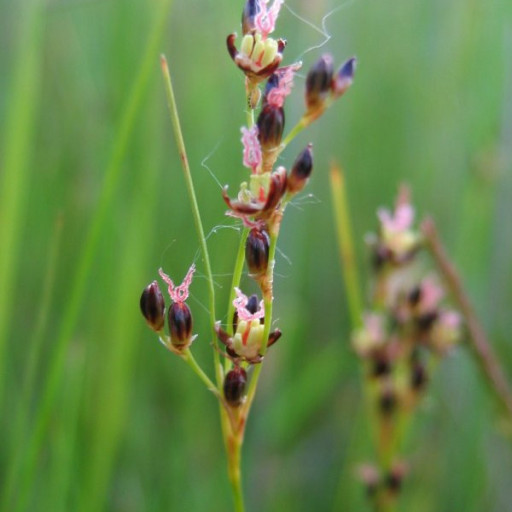
Plant Overview
Known famously as the Saltmarsh Rush or Black Grass, Juncus gerardii is the resilient "backbone" of coastal wetlands. Despite its delicate, grass-like appearance, it is a master of survival, thriving in salty environments where most other plants would quickly wither. In the 19th century, it was so highly valued for its nutrition that farmers would harvest "salt hay" from the marshes to feed their livestock through the winter.
🔍 How to Identify
- 🌾 The "Black" Seed Heads: Its most striking feature is the clusters of dark, chocolate-brown to near-black seed capsules that sit at the top of the stems, giving a meadow of these rushes a dark, smoky appearance from a distance.
- 🌿 Slender Stems: Unlike true grasses, its stems are round, smooth, and pithy. The leaves are narrow and reach up from the base, often appearing more like wires than flat blades.
- 👣 Creeping Mats: This plant doesn't grow in isolated clumps; it uses underground rhizomes to create dense, springy mats that feel like a thick carpet underfoot in a marsh.
🏡 In Your Garden & Ecology
- 🌊 Salt Specialist: This is a "halophyte," meaning it actually craves salt. If you have a coastal property or a garden near a road that gets salted in winter, this rush provides excellent green cover where other plants fail.
- 🛡️ Erosion Expert: Because it forms such dense underground networks, it is a champion at holding soil together. It protects shorelines from being washed away by tides and heavy rains.
- 💧 Soggy Feet: It prefers heavy, clay-rich soil that stays consistently moist. It isn't a fan of dry, sandy garden beds unless you are prepared to water it frequently to mimic its native boggy home.
⚠️ Safety & Toxicity
- ✅ Non-Toxic: Juncus gerardii is generally considered safe and non-toxic for humans, dogs, cats, and livestock.
- 🐄 Traditional Fodder: In maritime history, it was a primary source of grazing for cattle. While it isn't a common snack for humans, it poses no threat to curious pets or children playing nearby.
✨ Fun Fact
In the mid-1800s, "Black Grass" hay was considered so superior to inland hay that it was often sold at a premium price in city markets, specifically for carriage horses who needed high-energy forage!

Detailed Care Instructions

Place in a window with dappled sun or a spot in the middle of a room. Or directly in a window facing west or east.

To properly water this plant, it is important to consider several factors such as its location, soil type, and weather conditions. Before watering, check the soil moisture level by inserting a finger into the soil. If the soil feels dry, it is time for watering.
To water, fill a watering can with room temperature water and pour the water slowly and gently around the base of the plant. It is important to avoid watering the foliage as this can lead to fungal diseases. Water the plant until the excess water starts to drain out from the bottom of the container or until the soil is thoroughly moistened.
It is best to water this plant early in the morning or late in the afternoon to prevent the water from evaporating too quickly and to avoid watering during the hottest part of the day. In addition, avoid overwatering as this can lead to root rot and other issues.
Juncus Gerardii plant prefers soil that is well-drained and moderately moist. The soil should be a mix of sand and loam with a neutral pH level. It is important to avoid using soil that is heavy or has a high clay content, as this can lead to poor drainage and root rot. The plant also benefits from the addition of organic matter, such as compost or peat moss, to improve soil structure and fertility. Over-fertilization should be avoided, as it can lead to excessive growth and weak stems. When planting, ensure that the soil is well-compacted around the roots to promote healthy growth.








