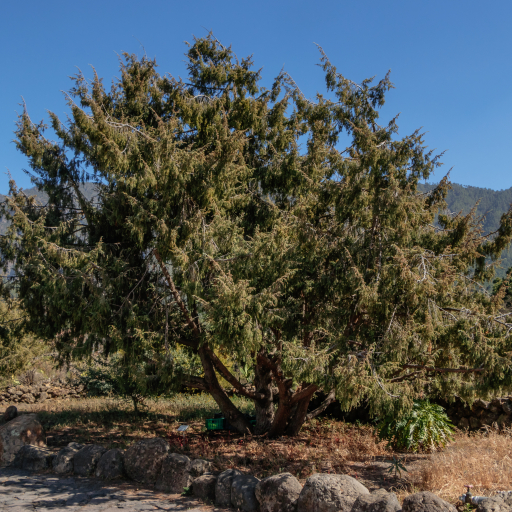
Plant Overview
Often referred to as the Canary Islands Juniper, Juniperus cedrus is a majestic, weeping conifer that feels like a living relic from a prehistoric era. Native to the high-altitude volcanic slopes of the Canary Islands and Madeira, this tree is a true survivor, evolved to withstand harsh winds and intense Atlantic sun. It is often mistaken for a cedar due to its graceful, pendulous branches, which give it a much more elegant silhouette than your average garden juniper.
🔍 How to Identify
- 🌿 The Foliage: Look for needle-like leaves arranged in whorls of three. Each needle features two distinct white "stomatal bands" on the upper surface, giving the tree a shimmering, silvery-green hue.
- 💧 The Weeping Habit: Unlike upright junipers, this species is famous for its "pendulous" branchlets that hang vertically, creating a soft, fountain-like appearance.
- 🍒 The Berries: Technically seed cones, these "berries" start green and mature into a deep orange-red or copper color over 18 months. They are larger and more colorful than most other juniper species.
🏡 In Your Garden
- ⛰️ Volcanic Roots: This plant is adapted to rocky, well-draining soil. In a garden setting, it absolutely loathes "wet feet." If your soil is heavy clay, plant it on a slope or in a raised bed with plenty of grit to mimic its mountain home.
- ☀️ Sun Seeker: To maintain its silvery color and dense growth, it requires full sun. In shaded spots, the branches become "leggy" and lose that iconic weeping density.
- 🌬️ Wind Resistance: Because it evolved on cliffsides, it is incredibly wind-tolerant, making it an excellent choice for coastal gardens or exposed hillsides where other trees might snap.
⚠️ Safety & Toxicity
- 🟢 General Safety: Like most junipers, it is not considered "deadly," but it should be handled with care.
- 🌵 Skin Irritation: The sharp needles can cause mechanical irritation or small rashes on sensitive skin. It is best to wear gloves when pruning.
- 🐾 Pet Warning: If ingested in large quantities, the berries and foliage can cause digestive upset in dogs and cats due to the volatile oils (thujone) present in the plant.
✨ Fun Fact
The Juniperus cedrus is a conservation success story. Once heavily logged for its incredibly durable, scented wood (used to build aromatic chests and even houses), it was pushed to the brink of extinction. Today, it is a protected species, and some of the oldest individuals growing on the cliffs of Teide National Park are estimated to be over 1,000 years old!

Detailed Care Instructions
| Humidity | Normal |
| Lighting | Part Sun |
| Difficulty | Medium |
| Hardiness Zones | 7A - 9B |
To grow Juniperus Cedrus (Juniperus Cedrus brevifolia), also known as the Saharan cypress or Saharan juniper, you can follow these tips:
- Climate and location: Juniperus Cedrus is native to the Sahara Desert and requires a hot, arid climate. Ensure you are in a suitable climate with temperatures averaging between 75-90°F (24-32°C) during the day and dropping to around 50-60°F (10-15°C) at night.
- Soil: Juniperus Cedrus prefers well-draining soil with a slightly alkaline pH. Sandy or gravelly soil works well. If your soil is heavy and retains too much moisture, consider amending it with sand or gravel to improve drainage.
- Sun exposure: Choose a location that receives full sun for at least 6-8 hours a day. These plants love direct sunlight and won't thrive in shady areas.
- Watering: While Juniperus Cedrus is a drought-tolerant plant, it still needs regular watering, especially during its establishment period. In hotter months, water deeply once a week, allowing the soil to dry between waterings. Once established, you can reduce watering frequency.
- Mulching: Apply a layer of organic mulch around the base of the plant. Mulching will help retain soil moisture and prevent weed growth.
- Pruning: Prune any dead or damaged branches to maintain plant health and shape. Avoid heavy pruning, as these plants prefer a more natural and wild appearance.
- Fertilization: Juniperus Cedrus doesn't require much fertilizer. Applying a balanced slow-release fertilizer once a year, during the spring or early summer, should be sufficient.
- Pests and diseases: Saharan junipers are generally resistant to pests and diseases. However, you should regularly monitor the plant for common issues like spider mites, fungi, or scales. If necessary, treat with appropriate insecticides or fungicides.
- Propagation: Juniperus Cedrus can be grown from seeds. Collect ripe cones, break them open, and extract the tiny seeds. Soak the seeds in water for 24 hours and then sow them in a well-draining potting mix. Place the pot in a warm and sunny location, and keep the soil slightly moist until germination occurs.
Remember to consult local gardening experts or visit a nearby nursery to obtain specific advice tailored to your location and growing conditions.

Place in a bright room that is sun drenched almost all day. Or directly in a south-facing window.

To water this plant, ensure that the soil is completely dry before watering again. When it is time to water, pour in a sufficient amount of water to saturate the soil completely. Do not let the soil become waterlogged, as this can cause root rot. Watering should be done sparingly, and only when necessary, as this plant prefers dry soil conditions. Additionally, always water at the base of the plant and avoid getting water on the foliage.
- Choose a well-draining soil mix for your plant.
- Water your plant thoroughly before applying fertilizer.
- Mix your chosen fertilizer according to package instructions.
- Apply the fertilizer evenly to the soil around the base of the plant.
- Water the plant again to help the fertilizer absorb into the soil.
- Fertilize once in the spring and once in the fall.
- Be careful not to over-fertilize, as this can damage the plant.
The ideal soil for Juniperus Cedrus plants is a well-draining and slightly acidic soil that has a pH level between 6.0 to 7.0. It is recommended to use a soil mix that is specifically designed for conifers or evergreens. The soil should be able to retain moisture while also allowing excess water to drain away. Adding organic matter such as compost or peat moss can help improve the soil structure and provide nutrients to the plant. It is important to avoid using heavy clay soils or soil that is too compact as this can lead to poor root development and lack of aeration.
Juniperus Cedrus plants can be propagated through various methods including seeds, cuttings, and layering.
Propagation through seeds involve collecting mature seeds from the plant during the autumn season. The seeds can then be sowed in a container filled with well-draining soil that has been moistened beforehand. The container should be placed in a warm, sunny location and watered regularly until the seeds germinate, which can take anywhere from 1-3 months.
Propagation through cuttings involves selecting a healthy stem from the plant and removing a portion of it. The cutting should then be dipped in rooting hormone and planted in a container filled with well-draining soil. The container should be covered with a plastic bag to create a humid environment and placed in a warm, indirect light location. The cuttings should root within 2-3 weeks, at which point plastic coverings can be removed and the plants can be gradually exposed to brighter light.
Propagation through layering involves selecting a low-lying branch from the plant and making a shallow cut under a node on the branch. The cut should then be held open with a toothpick and covered with soil. The branch should be securely staked into the soil and watered regularly. The branch will root in a few months, at which point the new plant can be cut away from the parent plant and planted separately.








