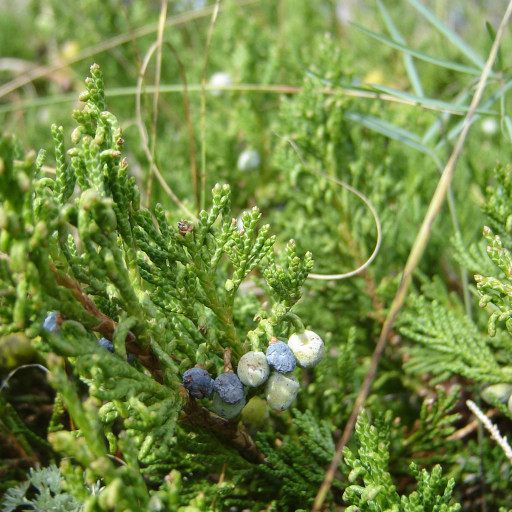
Plant Overview
Often called the "Blue Carpet" or "Creeping Cedar," Juniperus horizontalis is the ultimate ground-hugging champion of the conifer world. Native to the rocky coasts and northern prairies of North America, it behaves more like a living tapestry than a tree, spreading wide to protect the soil from the elements. It is a favorite for those looking to add year-round color without the height of traditional shrubbery.
🔍 How to Identify
- 🌿 Prostrate Growth: Unlike its upright cousins, this juniper rarely rises more than 12 inches off the ground, instead sprawling horizontally to form a dense, prickly mat.
- ❄️ Evergreen Foliage: The leaves are primarily scale-like and overlap tightly. While they are usually a silvery-blue or teal during the summer, many varieties take on a beautiful plum or purplish hue in winter.
- 🫐 Fleshy Cones: It produces small, berry-like cones that are dark blue with a waxy white coating. These are technically not berries, but modified cones containing the plant's seeds.
🏡 In Your Garden
- 🏔️ Erosion Warrior: This plant is a "functional beauty." Because its trailing branches can take root where they touch the ground, it is one of the best choices for stabilizing steep slopes and preventing soil runoff.
- ☀️ The "Tough Love" Philosophy: It thrives in full sun and actually prefers "poor" soil. If you over-fertilize it or plant it in soggy, rich earth, it may lose its compact shape and become susceptible to root rot. It is exceptionally salt-tolerant, making it perfect for coastal gardens or roadside planting.
⚠️ Safety & Toxicity
- 🐾 Mildly Toxic: The foliage and "berries" contain volatile oils (like thujone) that can cause vomiting or diarrhea if ingested by dogs, cats, or horses.
- 🧤 Prickly Skin: Many people experience "Juniper Dermatitis"—a mild, itchy skin rash—after handling the foliage with bare hands. It is always best to wear long sleeves and gloves when pruning.
✨ Fun Fact
- 🕰️ Living Antiques: In the harsh, rocky environments of the northern wild, a single Juniperus horizontalis colony can live for over a century, slowly creeping across the landscape at a rate of only a few inches per year.

Detailed Care Instructions
The cultivar Juniperus horizontalis 'Wiltonii' is a natural mutation that was discovered in 1914 in Maine by Jacob van Heiningen from South Wilton, Connecticut, hence its name. It is not invasive.
How quickly does creeping juniper spread?
It grows about six to 12 inches per year.
Is blue rug juniper soft?
It plume-like texture is finer and softer than that of other junipers but it is still recommended that you wear gloves when handling it, as it can cause skin irritation.
To grow Juniperus Horizontalis plants, you can follow these steps:
- Choose a suitable location: Juniperus Horizontalis plants prefer full sun or partial shade. They can tolerate a wide range of soil types, but well-draining soil is essential to prevent root rot. Consider the mature size of the plant when selecting a location.
- Prepare the soil: If your soil is heavy clay or poorly drained, amend it with organic matter like compost to improve drainage. Remove any weeds or grass from the planting area.
- Dig a hole: Dig a hole that is wider and slightly shallower than the nursery container or the root ball of the plant. Make sure the hole is deep enough to accommodate the roots without bending or crowding them.
- Planting: Gently remove the plant from its container and place it in the hole. Position the plant so that the top of the root ball is level with or slightly above the soil surface. Backfill the hole with soil, and press down gently to eliminate any air pockets.
- Watering: Water the plant thoroughly after planting to settle the soil. Juniperus Horizontalis plants have moderate water needs, so water deeply but infrequently, allowing the soil to dry out slightly between watering.
- Mulching: Apply a layer of mulch around the base of the plant to conserve moisture, suppress weed growth, and moderate soil temperature. Keep the mulch away from the trunk to prevent rot.
- Pruning: While Juniperus Horizontalis is a low maintenance plant, occasional pruning may be required to control its size or shape. Prune in early spring before new growth starts. Remove dead or damaged branches and lightly trim to maintain the desired shape.
- Fertilizing: Juniperus Horizontalis plants generally do not require much fertilization. However, you can apply slow-release, balanced fertilizer in early spring if the plant appears weak or lacks vigor.
- Pests and Diseases: These plants are generally resistant to pests and diseases. However, keep an eye out for common issues like spider mites, bagworms, or root rot. Inspect the plant regularly and take appropriate measures if necessary.
Overall, Juniperus Horizontalis plants are relatively easy to grow and require minimal maintenance once established.

Place in a bright room that is sun drenched almost all day. Or directly in a south-facing window.

Juniperus Horizontalis is a low-growing evergreen shrub that requires frequent and moderate watering in its growing seasons. However, it is important to avoid overwatering, which can cause root rot and other plant diseases. To water appropriately, one should check the soil surrounding the plant and make sure it is evenly moist, but not waterlogged. One should also deep water the roots, rather than just moistening the soil surface, to encourage strong and deep root growth. Additionally, one should water in the early morning or late evening, as watering during the midday heat can cause the water to evaporate too quickly, before the plant has a chance to absorb it. Finally, one should also adjust their watering frequency and amount based on weather conditions and the plant's growth rate to ensure they are providing the proper amount of water for optimal growth.
To fertilize this plant, apply a slow-release fertilizer with a balanced N-P-K ratio in early spring. Use a granular fertilizer and apply it evenly around the base of the plant, taking care not to let it touch the foliage. Water the plant well after fertilizing. Repeat the fertilization process once every year in early spring. Avoid fertilizing during the winter months as it can damage the roots.
When selecting soil for the Juniperus Horizontalis plant, it is important to consider its specific growing requirements. The plant prefers well-draining soil that is able to retain moisture without becoming waterlogged. A soil mixture that contains a balanced blend of organic matter, such as compost or leaf mold, is recommended. Additionally, incorporating a layer of gravel or sand into the soil can help to improve drainage. It is also important to choose a soil that is slightly acidic to neutral with a pH range of 5.5-7.0. Lastly, the soil should be kept consistently moist but not overly wet as this can lead to root rot and other issues. Overall, providing the Juniperus Horizontalis plant with a suitable soil mixture can help to promote healthy growth and improve its overall appearance.
To propagate this plant, take softwood cuttings in mid-spring. Cut a 4- to 6-inch stem that has not yet developed woody bark. Remove all but the top two or three clusters of needles on the stem. Dip the cut end into rooting hormone powder, tapping off the excess. Insert the stem cutting into a container of moistened potting soil. Cover the container with clear plastic or a plastic bag. Place the container in bright, indirect light. Check the soil frequently and water as needed to maintain even moisture. Once roots have formed, remove the plastic covering and move the container to an area with some direct sunlight. After a few weeks, the new plant can be potted up into a larger container or planted directly outside in its permanent location.








