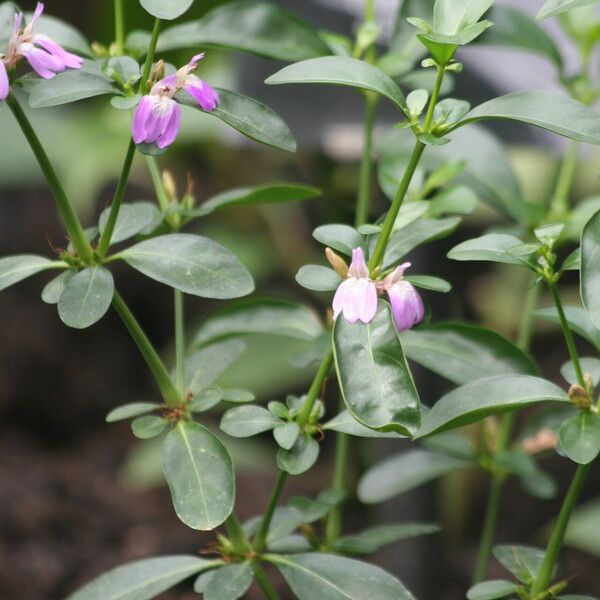
Plant Overview
Known as the Cape Justicia or sometimes the Money Plant in its native South Africa, Justicia capensis is a resilient little shrub that packs a lot of personality into a compact frame. It is a favorite for gardeners who want a "set it and forget it" green companion that thrives even in salty coastal breezes. In the wild, it acts as a hardy ground-stabilizer, proving that tough plants can still look delicate and refined.
🔍 How to Identify
- 🍃 Leaf Structure: Small, dark green leaves grow in opposite pairs along the stems. They are typically oval-shaped with a slightly glossy sheen that helps them retain moisture.
- 🌸 Tubular Blooms: It produces modest but charming two-lipped flowers. These are usually white or pale pink, often featuring tiny purple "nectar guides" inside the throat to signal pollinators.
- 🌿 Growth Habit: It is a multi-stemmed, evergreen shrub that naturally forms a neat, rounded mound. Even without pruning, it maintains a tidy, organized appearance.
🏡 In Your Garden
- 🌊 Coastal Warrior: This plant is exceptionally salt-tolerant. It is a perfect choice for seaside gardens where the briny air and wind might cause other ornamental plants to wither.
- 🦋 Pollinator Haven: While the flowers are subtle to human eyes, they are a primary food source for butterflies and long-tongued insects, turning your garden into a miniature nature reserve.
- 💧 Drought Strategy: It possesses a deep root system that allows it to survive long dry spells. It prefers well-draining soil because it "breathes" through its roots; "wet feet" or waterlogged soil will quickly cause it to decline.
⚠️ Safety & Toxicity
- ✅ Low Risk: Justicia capensis is not known to be toxic to humans or common household pets.
- 🐾 Mild Irritation: While safe, the foliage is quite fibrous. If a curious cat or dog decides to have a snack, the tough leaves may cause minor indigestion or vomiting simply due to the physical texture.
✨ Fun Fact
The genus Justicia was named in honor of James Justice, an 18th-century Scottish horticulturalist. He was so legendary for his plant obsession that he reportedly spent his entire family fortune on rare botanical specimens and gardening experiments!

Detailed Care Instructions








