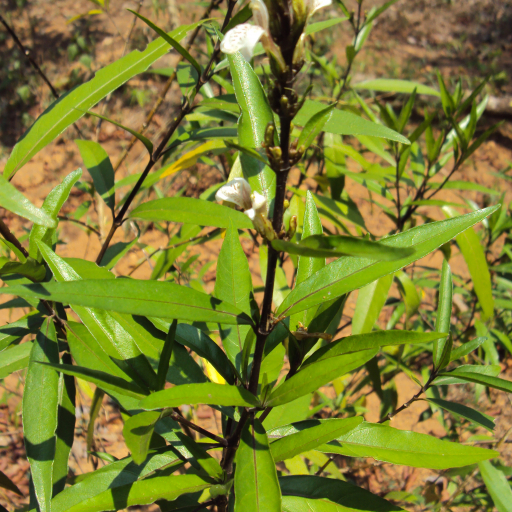
Plant Overview
Known popularly as the Willow-leaved Justicia or Gendarussa, this striking evergreen shrub is as tough as it is beautiful. Often found lining garden paths across Southeast Asia, it is celebrated for its dark, almost ebony stems and its long history in traditional apothecary gardens. It is a favorite for those who want a "set it and forget it" plant that still offers a dramatic, architectural look.
🔍 How to Identify
- 🌿 The Foliage: The leaves are long, narrow, and lance-shaped, bearing a striking resemblance to the leaves of a willow tree. They are typically a deep, glossy green.
- 🖤 Distinct Stems: One of its most identifying features is its smooth, dark purple-to-black stems, which provide a sharp, beautiful contrast against the green canopy.
- 🌸 The Blooms: It produces small, tubular white flowers decorated with delicate purple or pink spots. These appear in upright spikes (bracts) at the ends of the branches.
🏡 In Your Garden
- 🛡️ The Living Fence: Due to its dense growth habit and resilience to heavy pruning, it is frequently used as a "boundary plant" or living hedge to mark garden borders.
- 💧 Thirst for Life: Unlike many tropical plants that rot in soggy soil, Gendarussa is quite thirsty. It can handle "wet feet" better than most, making it an excellent choice for low-lying areas of the garden that hold onto water.
- ☀️ Light Flexibility: While it flourishes in full sun, it is remarkably shade-tolerant. However, if you want those signature dark stems to look their deepest black, give it plenty of bright, indirect light.
⚠️ Safety & Toxicity
- 🐾 Pet Caution: The plant contains various alkaloids. While not typically considered "deadly," ingesting the leaves can cause digestive upset, vomiting, or lethargy in cats and dogs.
- 🧤 Skin Sensitivity: The sap can be an irritant to some individuals. It is always best to wear gardening gloves when pruning or taking cuttings to avoid a potential rash.
✨ Fun Fact
🧪 A Scientific Marvel: In Indonesia, Justicia gendarussa has been used for generations as a traditional form of male contraception. Modern clinical trials have actually confirmed this, showing that a specific compound in the plant interferes with the proteins on human sperm, preventing them from penetrating an egg!

Detailed Care Instructions
| Humidity | High |
| Lighting | Full Sun |
| Difficulty | Easy |
| Hibernation | Cold Period |
To grow a Justicia Gendarussa plant, you can follow these steps:
- Purchase seeds or young plants: Look for reputable nurseries or garden centers that offer Justicia Gendarussa seeds or young plants. You can also try online seed suppliers.
- Choose a suitable location: Justicia Gendarussa plants prefer bright, indirect sunlight. Select a location in your garden or indoors where the plant can receive partial shade or filtered sunlight.
- Prepare the soil: Justicia Gendarussa thrives in well-draining soil with a slightly acidic to neutral pH level (around 6.0 to 7.0). Amend the soil with organic matter, such as compost or aged manure, to improve its drainage and nutrient content.
- Sow or transplant the plant: If you have seeds, sow them directly into the soil at a depth of about 1/4 inch. If you have young plants, dig a hole slightly larger than the plant's root ball and gently place it in the hole, ensuring that the crown of the plant is level with the soil surface. Backfill the hole and pat the soil gently around the plant.
- Water regularly: Justicia Gendarussa plants prefer consistently moist soil. Water the plant regularly, keeping the soil evenly moist but not waterlogged. Avoid allowing the soil to dry out completely between waterings.
- Fertilize occasionally: Apply a balanced, slow-release fertilizer according to the package instructions once or twice a year to provide the plant with essential nutrients. Alternatively, you can use organic fertilizers, such as compost or composted manure.
- Prune as needed: To maintain a compact shape, you can prune Justicia Gendarussa occasionally. Remove any dead or damaged branches, and trim back overgrown areas.
- Monitor for pests and diseases: Keep an eye out for common pests, such as aphids or spider mites, and promptly treat any infestations. Ensure good air circulation around the plant to prevent fungal diseases.
- Harvest as desired: Justicia Gendarussa plants can be harvested for their medicinal properties. Harvest the leaves or other plant parts as needed for your intended use, ensuring not to over-harvest and harm the plant's growth.
Remember to research any specific requirements or considerations for growing Justicia Gendarussa in your particular location, as these guidelines are general recommendations.

Place in a window with dappled sun or a spot in the middle of a room. Or directly in a window facing west or east.

To water this plant, you should wait until the topsoil is partially dry before giving it a good, thorough watering. Avoid overwatering, as it can lead to root rot and other issues. When watering, pour water gently over the soil, ensuring that it reaches the roots. Do not let the plant sit in standing water, as this can also cause damage. Additionally, be sure to provide adequate drainage in the plant's pot or planting area.
To fertilize this plant, use a balanced fertilizer with equal parts nitrogen, phosphorus, and potassium. Apply the fertilizer once a month during the growing season, which is typically from spring to fall. Make sure not to over-fertilize, as this can harm the plant. Water the plant well before and after fertilizing to help the plant absorb the nutrients.
Justicia Gendarussa plants prefer well-draining soil that is slightly acidic to neutral in pH. A sandy loam or loamy soil mixture is ideal for these plants, as it allows for proper drainage while retaining some moisture. Adding organic matter such as compost or peat moss can help improve soil quality and provide essential nutrients for the plant's growth. It is important to avoid heavy clay soils, as they can become waterlogged and lead to root rot. Overall, a well-draining, slightly acidic to neutral soil mixture with added organic matter is recommended for optimal growth of Justicia Gendarussa plants.
To propagate the plant known as Justicia Gendarussa, one can follow the below steps:
- Take a healthy stem cutting that is around six to eight inches long from the parent plant.
- Remove the lower leaves of the stem cutting, leaving two to three leaves at the top.
- Dip the cut end of the stem cutting into rooting hormone.
- Prepare a potting mix by mixing equal parts of perlite, peat moss, and sand.
- Insert the stem cutting into the prepared potting mix, ensuring that the cut end is buried at least one inch deep.
- Water the cutting thoroughly and place it in a shaded spot with indirect light.
- Maintain a stable temperature of around 70-75 degrees F and keep the soil moist.
- After a few weeks, new roots will start to form, indicating that the plant has successfully propagated.
- Once the new plant has grown enough, it can be transferred to a larger pot or planted in the garden.








