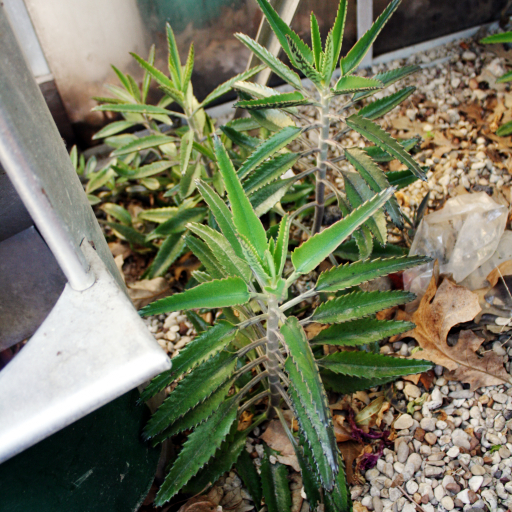
Plant Overview
Often called the "Hybrid Mother of Thousands," this architectural succulent is a botanical marvel and a gardener’s cautionary tale. Born from a cross between two Madagascar natives, it is famous for its uncanny ability to produce hundreds of miniature clones along its leaf edges. While it looks like something from a sci-fi film, its resilient nature makes it a favorite for beginners who want a plant that practically grows itself.
🔍 How to Identify
- 🍃 V-Shaped Leaves: The foliage is long, narrow, and slightly folded like a boat, distinguishing it from its flatter-leaved relatives.
- 👶 The "Babies": Dozens of tiny, fully-formed plantlets (bulbils) line the serrated leaf margins, each equipped with its own tiny roots ready to drop and grow.
- 🎨 Tiger Stripes: The underside of the leaves often features beautiful, dark purple or maroon mottling that contrasts vividly against the dusty green surface.
🏡 In Your Garden
- 🏘️ The Great Escape: Because every fallen plantlet can become a new plant, this species is best kept in a dedicated container. If grown in the ground in frost-free climates, it can quickly become invasive, popping up in neighboring pots and lawn cracks.
- 🏜️ Succulent Stamina: It stores water in its fleshy leaves and can survive months of drought. It prefers gritty, well-draining soil because its only real "weakness" is sitting in soggy dirt, which can lead to root rot.
⚠️ Safety & Toxicity
- 🐾 Toxic to Pets: All parts of the plant contain cardiac glycosides (bufadienolides), which can cause heart palpitations, vomiting, and tremors in cats and dogs if ingested.
- 🚫 Handle with Care: While not typically irritating to the skin, the plantlets are very small and can be easily swallowed by curious toddlers. It is best displayed on a high shelf or hanging basket.
✨ Fun Fact
Every tiny plantlet on the leaf edge is a perfect genetic clone of the mother plant! This method of reproduction is so efficient that the plant rarely needs to rely on its red, bell-shaped flowers to survive—it effectively builds its own "clone army" to colonize new territory.

Detailed Care Instructions
To grow Kalanchoe × Houghtonii, also known as the Mother of Thousands plant, you can follow these steps:
- Planting: Start by choosing a well-draining pot with a drainage hole. Fill the pot with a well-draining soil mix suitable for succulents or cacti.
- Propagation: Kalanchoe × Houghtonii plant can propagate easily from leaf cuttings. Gently remove a healthy leaf from the plant and allow it to dry out for a day or two. Then, place the leaf on top of the soil mix, slightly pressing it down.
- Watering: Water the soil thoroughly, ensuring it is evenly moist. After that, let the soil dry out completely before watering again. Avoid overwatering, as this can lead to root rot.
- Sunlight: Kalanchoe × Houghtonii plants prefer bright, indirect sunlight. Place the pot in a location where it can receive a few hours of direct morning or evening sunlight but avoid direct afternoon sun, as it can scorch the leaves.
- Temperature and Humidity: Kalanchoe × Houghtonii plants thrive in temperatures between 60-75°F (15-24°C). They can tolerate slightly higher temperatures but may suffer damage in prolonged heatwaves. These plants prefer low to moderate humidity levels.
- Fertilization: Apply a balanced liquid fertilizer diluted to half strength every 2-4 weeks during the active growing season (spring and summer). In winter, when the plant's growth slows down, fertilize less frequently or not at all.
- Pruning: As the plant grows, it may become leggy or develop any unhealthy or discolored leaves. Trim these off with clean and disinfected pruning shears to maintain the plant's appearance and health.
- Repotting: If your Kalanchoe × Houghtonii outgrows its current pot or when the roots start to fill the pot completely, consider repotting it into a slightly larger container. Choose a pot with good drainage and use a fresh succulent or cacti soil mix.
Following these steps and providing the right care should help your Kalanchoe × Houghtonii thrive and grow.

Place in a window with dappled sun or a spot in the middle of a room. Or directly in a window facing west or east.

To water this plant, make sure to give it a good soaking once a week. Allow the soil to dry out slightly between watering, but do not let it completely dry out. Avoid getting water on the leaves and flowers to prevent damage. Use room temperature water and water the soil directly, trying not to splash water around the plant. Consider using a watering can with a narrow spout to make watering more precise. If the plant is in a pot with drainage holes, make sure to let excess water drain out completely before putting it back in its saucer or tray.
- Prepare a soil mixture that is well-draining and nutrient-rich.
- Choose a water-soluble fertilizer that is high in phosphorus and potassium.
- Dilute the fertilizer according to package instructions.
- Feed your plant once a month during the growing season (spring and summer).
- Water your plant thoroughly before applying the fertilizer.
- Pour the diluted fertilizer around the base of the plant, being careful not to get any on the leaves.
- Do not fertilize your plant in the fall and winter when it is dormant.
- Monitor your plant for any signs of nutrient deficiency or foliage burn and adjust your fertilizing schedule accordingly.
Kalanchoe × Houghtonii plant requires well-draining soil that is rich in nutrients. The soil must be able to retain moisture but not too much that it becomes waterlogged. It is best to use a soil mix that contains perlite or sand to improve drainage. Avoid using heavy clay soils or soils that do not drain well as it can lead to root rot. The pH of the soil should be slightly acidic to neutral. It is recommended to fertilize the plant regularly with a balanced fertilizer to ensure healthy growth.
To propagate this particular plant, you can take stem cuttings from a healthy parent plant. Make sure the cuttings are around 3-4 inches in length and have at least 2-3 nodes on them. Remove the lower leaves and let the cuttings dry for 1-2 days to prevent rotting. Then, dip the cuttings in rooting hormone and plant them in a well-draining soil mix. Water lightly and place them in a bright, warm location out of direct sunlight. Keep the soil moist but not waterlogged and mist the cuttings occasionally to prevent them from drying out. Within a few weeks, you should see roots developing and new growth appearing. Once the cuttings have established themselves, you can transplant them into individual pots and care for them as you would any other kalanchoe plant.
Common pests of the houghton's kalanchoe include Scale insect, mealybugs, aphids, thrips. Make a habit of checking your houghton's kalanchoe frequently for pests so that any infestations can be caught and managed early.








