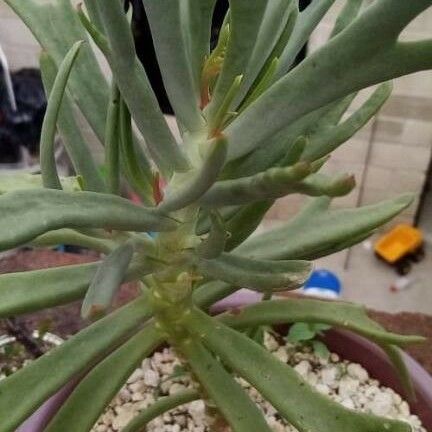
Plant Overview
Often called the "Staghorn Kalanchoe" for its branching, antler-like leaves, this rare hybrid is a living piece of botanical history. Created at the world-famous Royal Botanic Gardens, Kew, over a century ago, it offers a striking architectural silhouette that stands out among more common succulents. It is the perfect "conversation piece" plant for those who love unique textures and low-maintenance greenery.
🔍 How to Identify
- 🌿 Antler Leaves: The most distinct feature is its fleshy, grey-green leaves that split into three or more points, mimicking the shape of a deer's antlers.
- 📏 Upright Stature: Unlike many crawling succulents, this variety grows vertically, developing a thick, woody stem that can reach up to 3 feet in height.
- 🌸 Vivid Clusters: In late winter or early spring, it produces terminal clusters of small, upright, bright pink or magenta flowers that can last for weeks.
🏡 In Your Garden
- ☀️ Light & Lean: This hybrid thrives on "neglect." It needs very bright, filtered light to maintain its compact shape; in low light, the stems become weak and "leggy" as they stretch toward the sun.
- 🪴 The Drainage Rule: It is highly susceptible to root rot. Use a gritty cactus mix and terracotta pots to help moisture evaporate quickly. Only water when the leaves feel slightly soft to the touch.
- ✂️ Pruning for Shape: Because it grows tall and thin, don't be afraid to "pinch" the tops. This encourages the plant to branch out, creating a fuller, bushier appearance.
⚠️ Safety & Toxicity
- 🐾 Toxic to Pets: Like most members of the Kalanchoe genus, this plant contains cardiac glycosides.
- 🚫 Risk Level: It is toxic to cats and dogs if ingested. Symptoms include drooling, vomiting, or in rare cases, heart rhythm abnormalities. Keep it on high shelves or in hanging baskets away from curious nibblers.
✨ Fun Fact
- 🇬🇧 A Royal Pedigree: Kalanchoe kewensis is a "man-made" species. It was first bred in 1901 by botanists in London by crossing Kalanchoe bentii and Kalanchoe flammea. You won’t find this plant growing naturally in the wild anywhere on Earth!

Detailed Care Instructions
To grow a Kalanchoe Kewensis plant, follow these steps:
- Optimal environment: Kalanchoe Kewensis prefers bright light to partial shade. Place the plant near a window where it receives indirect sunlight for at least 6 hours a day. It thrives in temperatures between 60°F to 75°F (15°C to 24°C).
- Soil: Use well-draining soil with good moisture retention. A mixture of regular potting soil and perlite or sand works well. Avoid waterlogged soil, as it can cause root rot.
- Watering: Water the plant when the top inch of soil feels dry. Ensure thorough watering, allowing excess water to drain away. Avoid overwatering, as it can lead to root rot. Kalanchoe Kewensis is drought tolerant and prefers being slightly dry rather than constantly wet.
- Fertilizer: During the growing season, feed the plant with a balanced, water-soluble fertilizer every two to four weeks. Follow the instructions on the fertilizer packaging for dosage and application.
- Pruning: Prune back leggy or overgrown stems to maintain a compact shape. Kalanchoe Kewensis responds well to pruning and can promote bushier growth.
- Propagation: Kalanchoe Kewensis can be propagated through stem cuttings. Take a healthy stem cutting, remove the bottom leaves, and place it in a well-draining potting mix. Keep the soil slightly moist until the cutting develops roots, which usually takes a few weeks.
- Pests and diseases: Kalanchoe Kewensis is generally resistant to pests and diseases. However, keep an eye out for common pests like mealybugs or aphids. Treat them with an appropriate insecticidal soap or neem oil spray.
Remember, it's important to research specific care instructions for the Kalanchoe Kewensis plant, as different plants may have slightly different requirements.

Place in a window with dappled sun or a spot in the middle of a room. Or directly in a window facing west or east.

To effectively water a Kalanchoe Kewensis plant, it is important to understand its basic requirements and needs. This type of plant prefers watering on a moderate basis, usually every two weeks or so, depending on the temperature, humidity, and other environmental factors. When watering, it is important to avoid getting the leaves or stem wet, as this can lead to mold, disease, or rot.
The best method for watering a Kalanchoe Kewensis plant is to wait until the soil is dry to the touch, and then water thoroughly, allowing the water to drain completely from the pot. It is best to use room temperature water and avoid using water that is too cold or too warm, as this can shock the plant.
Another important consideration is the type of soil used for the plant. It is best to use a well-draining soil mix, such as a mix of peat moss, perlite, and sand, to prevent water from becoming stagnant and causing root rot. Additionally, it is important to avoid overwatering, as Kalanchoe Kewensis plants are very sensitive to excess moisture and can quickly develop fungal or bacterial infections.
Overall, a Kalanchoe Kewensis plant requires regular and consistent watering, with an emphasis on avoiding overwatering and maintaining proper drainage. By following these guidelines, it is possible to keep the plant healthy and thriving for many years to come.
To fertilize this plant, use a balanced, water-soluble fertilizer with an N-P-K ratio of 10-10-10 or similar. Dilute the fertilizer according to package instructions and apply it to the soil every two to three weeks during the growing season (spring and summer). Avoid fertilizing in the fall and winter when the plant is dormant. Be sure to water the plant thoroughly after fertilizing to prevent fertilizer burn.
The ideal soil for the Kalanchoe Kewensis plant should be well-draining and slightly acidic with a pH range of 6.0-6.5. It should also have a good balance of organic and inorganic matter to provide the necessary nutrients for growth. A mixture of peat moss, perlite, and vermiculite would make for a fantastic soil blend for this plant. Additionally, it is essential to ensure that the soil does not hold too much moisture as the plant is susceptible to root rot, so watering should be done sparingly.
- Choose a healthy and mature specimen of the plant and take a cutting that is at least 3-4 inches long.
- Make sure the cutting has a few leaves intact, but remove any flowers or buds.
- Allow the cutting to dry out for a day or two, as this will help prevent rot and promote rooting.
- Fill a small container with a well-draining soil mix and make a hole in the center with your finger.
- Dip the cut end of the cutting in rooting hormone to speed up the process (optional).
- Insert the cutting into the hole in the soil, ensuring it is covered up to the first node (where a leaf meets the stem).
- Water the cutting lightly, making sure the soil is moist but not waterlogged.
- Cover the container with a plastic bag or dome to create a humid environment and promote rooting.
- Place the container in a bright area away from direct sunlight and maintain a consistent temperature.
- Keep an eye on the cutting and water it when the soil feels dry to the touch.
- After a few weeks, gently tug on the cutting to check for resistance, which indicates roots have formed.
- Once roots have developed, remove the plastic cover and transplant the cutting into a larger pot with well-draining soil.
- Continue to care for the new plant as you would a mature Kalanchoe Kewensis plant, providing ample light, warmth, and occasional watering.
Common pests of the kalanchoe kewensis include Scale insect, mealybugs, aphids, thrips. Make a habit of checking your kalanchoe kewensis frequently for pests so that any infestations can be caught and managed early.








