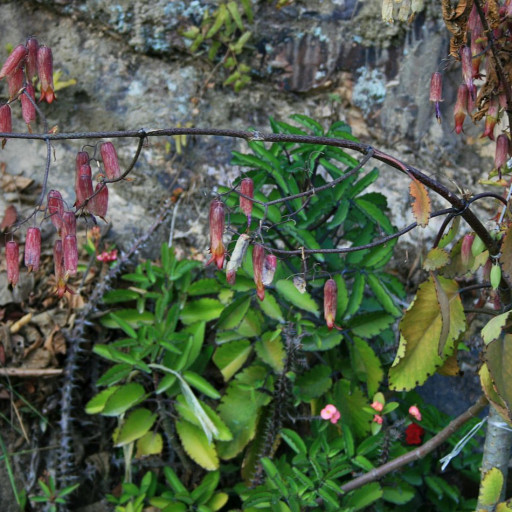
Plant Overview
Known as the "Miracle Leaf," "Cathedral Bells," or "Resurrection Plant," Kalanchoe pinnata is a succulent superstar that seems to defy death. Famous for its incredible ability to grow miniature versions of itself along its leaf edges, this plant has traveled from the dry forests of Madagascar to windowsills worldwide. It is a symbol of persistence, often gifted to friends to represent a "life that keeps on giving."
🔍 How to Identify
- 🍃 Fleshy Foliage: The leaves are thick, succulent, and oval-shaped with distinct scalloped (crenate) edges that often develop a reddish tint when exposed to bright sun.
- 🌱 Viviparous Margins: Its most striking feature is the presence of tiny "plantlets" or bulbils that form in the notches of the leaf edges, each capable of growing into a full-sized plant.
- 🔔 Pendulous Blooms: When it decides to flower, it sends up a tall stalk decorated with drooping, lantern-like flowers that are greenish-yellow or reddish-pink in color.
🏡 In Your Garden
- 🪴 The Survivor’s Choice: This plant earns its "Life Plant" nickname because it is nearly impossible to kill. It stores water in its leaves, allowing it to survive long periods of neglect. If you accidentally snap off a leaf, don't throw it away—simply lay it on some soil, and new plants will sprout from the edges.
- ⚠️ Containment Strategy: Because every fallen leaf can turn into dozens of new plants, it can quickly take over a garden bed in warm climates. If you want to keep your garden tidy, it is best grown in a container to manage its "miraculous" spreading habit.
⚠️ Safety & Toxicity
- 🐾 Toxic to Pets: Kalanchoe pinnata contains bufadienolides, which are cardiac glycosides. This makes the plant toxic to cats and dogs if they decide to have a snack.
- ❤️ Health Risks: Ingestion can lead to digestive upset, drooling, and in rare, high-volume cases, heart palpitations. Keep this beauty on a high shelf away from curious paws and toddlers.
✨ Fun Fact
📜 The Poet’s Muse: The famous German writer Johann Wolfgang von Goethe was so fascinated by this plant’s ability to reproduce from a single leaf that he studied it intensely. He used to send the tiny plantlets in letters to his friends as a botanical symbol of his enduring friendship and the "eternal cycle of life."

Detailed Care Instructions
| Soil Ph | Acidic |
| Humidity | Normal |
| Lighting | Full Sun |
| Toxicity | Toxic |
| Soil Type | Well-Drained |
| Bloom Time | Spring, Summer, Fall, Winter |
| Difficulty | Medium |
| Plant Type | Succulent |
| Mature Size | 12–18 In. Tall, 12–18 In. Wide |
| Native Area | Africa |
| Temperature | 15°C - 29°C |
| Sun Exposure | Full Sun, Partial Shade |
| Hardiness Zones | 10-12 |
To grow a Kalanchoe Pinnata plant, you can follow these steps:
- Choose a healthy Kalanchoe Pinnata plant cutting or a small plant from a nursery.
- Prepare a well-draining pot or container with a good quality potting mix specifically designed for succulents.
- Place the cutting or small plant in the pot and press down the soil gently to ensure good contact between the roots and the soil.
- Water the plant thoroughly but avoid overwatering. Kalanchoe Pinnata is a succulent plant and likes to dry out between waterings. Allow the top inch of soil to dry out before watering again.
- Place the pot in a spot that receives bright indirect sunlight. The plant thrives in bright light conditions but can be sensitive to direct sunlight, which can burn the leaves.
- If you are growing the plant indoors, make sure it is placed near a window that receives adequate sunlight or use artificial grow lights to supplement light requirements.
- Fertilize the plant once a month during the growing season (spring and summer) using a balanced, water-soluble fertilizer diluted to half strength. Follow the instructions on the fertilizer packaging for dosage information.
- Monitor the plant regularly for signs of pests such as mealybugs or aphids. If you notice any pests, treat them accordingly using an appropriate pesticide or insecticidal soap.
- Kalanchoe Pinnata plants may occasionally produce small plantlets around the base of the mother plant. When these plantlets are large enough, gently remove them from the mother plant and plant them in separate pots.
- Repot the Kalanchoe Pinnata plant every two years or when it outgrows its current pot. Choose a slightly larger pot and refresh the potting mix during repotting.
With proper care, your Kalanchoe Pinnata plant should thrive and grow well.

Place in a bright room that is sun drenched almost all day. Or directly in a south-facing window.

To water this plant, you should wait until the top inch of soil is dry to the touch before watering. When you do water it, make sure to give it a thorough soaking until water drains out of the bottom of the pot. Do not let the plant sit in standing water, as this can lead to root rot. During the winter months, you should reduce watering frequency, as the plant's growth slows down.
To fertilize this plant, use a balanced, water-soluble fertilizer every two weeks during the growing season. Dilute the fertilizer to half the recommended strength. Be careful not to over-fertilize as it can cause damage to the plant. During the winter months, reduce the frequency of fertilizing to once a month. It is important to water the plant thoroughly before fertilizing to avoid burning the roots.
The Kalanchoe Pinnata plant prefers well-draining soil that is rich in nutrients and organic matter. A good soil mix for this plant should be loose and crumbly, allowing for good air circulation around the roots. The soil should also be slightly acidic, with a pH level between 6.0 to 7.0.
A mix of equal parts of loam, peat, and sand is generally recommended for Kalanchoe Pinnata. This ensures that the soil is loose and well-draining, with good water and nutrient retention. The addition of perlite or vermiculite to the soil mix can improve drainage even further.
When potting your Kalanchoe Pinnata plant, make sure to choose a pot with good drainage holes to allow excess water to escape. It is also recommended to use a layer of gravel or rocks at the bottom of the pot to promote drainage.
Propagation of this plant can be done by taking leaf cuttings. Choose a healthy, mature leaf, and cut it carefully with a sharp, clean pair of scissors or pruning shears. Make sure the cutting is at least 2 inches long, and remove any small leaves from the bottom half of the stem. Allow the cutting to dry for a few days in a cool, dry place until a callus forms at the base of the stem.
Once the callus has formed, plant the cutting in a pot filled with well-draining soil. Water the cutting lightly, and place it in a warm, bright location out of direct sunlight. Keep the soil moist, but not waterlogged. After a few weeks, new roots should begin to develop, and small plantlets will appear at the base of the stem.
Once the new plantlets have a few leaves, they can be transplanted into their own individual pots. Keep the new plants in a warm, bright location and continue to water them regularly. With proper care, the new plants should grow into healthy, mature specimens over time.
Common pests of the cathedral bells include Scale insect, mealybugs, aphids, thrips. Make a habit of checking your cathedral bells frequently for pests so that any infestations can be caught and managed early.








