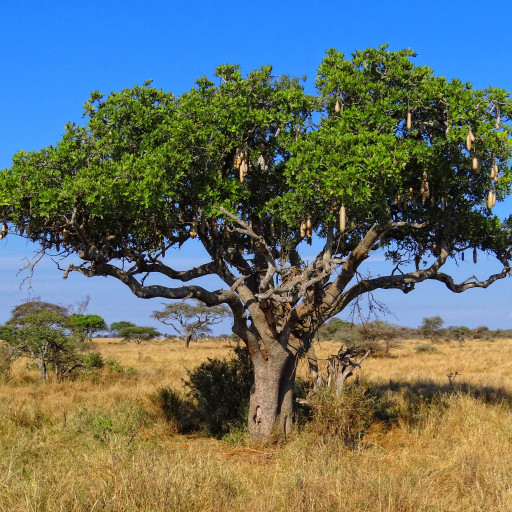
Plant Overview
The Sausage Tree is one of nature’s most peculiar spectacles, famously named for the massive, wood-like fruits that dangle from its branches like oversized salamis. Native to the tropical regions of Africa, this tree is a cornerstone of the savanna, often found lining riverbanks where it provides deep shade and a "buffet" for local wildlife. In folklore, it is often seen as a symbol of fertility and protection, with its hanging fruits acting as natural charms.
🔍 How to Identify
- 🌭 The Fruit: The most iconic feature—long, grayish-brown, sausage-shaped pods that can grow up to 2 feet long and weigh over 15 pounds, hanging from long, rope-like stalks.
- 🍷 The Flowers: Large, velvet-textured, trumpet-shaped blossoms in deep shades of maroon or blood-red. They bloom at night and hang downward to accommodate their nocturnal pollinators.
- 🍃 The Foliage: Evergreen, leathery leaves that are elliptical and arranged in opposite pairs. The bark is smooth and grey when young, becoming peeling and "corky" as the tree ages.
🏡 In Your Garden
- 🌳 Space and Scale: This is a giant that needs "breathing room." Because of its aggressive taproot and massive canopy, it should never be planted near foundations, swimming pools, or power lines.
- 🦇 Pollination Nuance: If you plant one, don't expect honeybees to do the work. The flowers emit a pungent, fermented scent at night specifically to attract fruit bats, who crawl inside the blossoms to drink nectar.
- 🏗️ Infrastructure Caution: Think carefully about placement. A falling "sausage" can easily dent a car roof or crack a windshield, so avoid planting this tree over driveways or walkways.
⚠️ Safety & Toxicity
- 🚫 Raw Consumption: The raw fruit is toxic and highly purgative to humans. While it is used in traditional African medicine and fermented to make beer, it requires specific processing (drying, roasting, or fermentation) to be safe.
- 🐾 Pet Safety: The fruit is generally not appealing to dogs or cats due to its hard, woody exterior, but if ingested raw, it can cause severe gastrointestinal distress.
- 🤕 Physical Hazard: The primary safety concern is the weight of the fruit. In high winds or when fully ripe, the heavy pods can fall without warning, posing a risk to anyone standing beneath the canopy.
✨ Fun Fact
The Sausage Tree has a "hidden" relationship with the cosmetics industry; extracts from the fruit are used in high-end skin creams today because they contain chemicals that help firm the skin and even out complexion!

Detailed Care Instructions
| Lighting | Full Sun |
To successfully grow a Kigelia africana plant, also known as the "sausage tree," follow these steps:
- Climate and location: The Kigelia africana plant prefers warm climates, so choose a location with full sun and a minimum average temperature of 20°C (68°F). It can tolerate some cold, but extreme temperatures can damage the plant.
- Soil requirements: The plant prefers well-draining soil with a pH range of 5.5 to 7.5. Amend the soil with organic matter like compost before planting.
- Propagation: There are two common methods of propagation: by seeds or by cuttings.
- Seeds: Soak the seeds in warm water for 24 hours before planting to improve germination. Sow seeds in nursery trays filled with sandy soil and keep them moist but not waterlogged. Germination can take several weeks to months.
- Cuttings: Take semi-hardwood cuttings with a length of around 15-20 cm (6-8 inches) from the parent plant. Dip the cut end in rooting hormone and plant it in a pot filled with a mixture of peat moss and sand. Keep the soil moist and provide bottom heat to encourage root growth.
- Seeds: Soak the seeds in warm water for 24 hours before planting to improve germination. Sow seeds in nursery trays filled with sandy soil and keep them moist but not waterlogged. Germination can take several weeks to months.
- Planting: Transplant seedlings or rooted cuttings into the ground once they are large enough (around 20-30 cm or 8-12 inches tall). Dig a hole twice as wide and deep as the root ball, ensuring it has enough space to spread. Backfill the hole with soil, firming gently around the base.
- Watering: The Kigelia africana plant needs regular and thorough watering, especially during hot and dry periods. Keep the soil consistently moist but avoid overwatering, as it prefers well-drained soil.
- Fertilizer: Apply a balanced slow-release fertilizer in spring and summer according to the manufacturer's instructions. Avoid applying excessive nitrogen as it can promote excess foliage growth at the expense of flowering.
- Pruning: Prune the tree during its dormant season to remove dead or diseased branches and to shape it. Avoid excessive pruning as it can significantly delay or prevent flowering.
- Pests and diseases: Kigelia africana is generally resistant to pests and diseases. However, some occasional issues may include fungal leaf spots, aphids, or caterpillars. Monitor the plant regularly for signs of pests or diseases and treat accordingly.
Remember, growing a Kigelia africana plant requires patience as it can take several years for the tree to produce its unique sausage-shaped fruits.

Place in a window with dappled sun or a spot in the middle of a room. Or directly in a window facing west or east.

Kigelia Africana is a plant that requires regular watering to thrive. When watering this plant, it is crucial to ensure that the soil is moist but not waterlogged. Overwatering can cause the roots to rot, leading to the plant's demise. To water the Kigelia Africana plant, you can use a watering can or a hose.
The frequency of watering the plant will depend on various factors such as the weather and the soil type. During the summer months when the temperatures are high, you may need to water the plant more frequently. Conversely, during the winter months, you may need to reduce the frequency of watering to avoid waterlogging the soil.
When watering, it is essential to direct the water to the base of the plant and avoid wetting the leaves. Wet leaves are more susceptible to diseases and pests, which can harm the plant's growth. Additionally, water droplets on the leaves can magnify the sun and cause leaf burns.
It is also a good practice to allow the water to soak into the soil before adding more water. This will ensure that the water reaches the roots, where it is needed most. Additionally, water the plant during the early morning or late evening to prevent water evaporation due to the hot sun.
In summary, water the Kigelia Africana plant regularly, but avoid overwatering. Direct the water to the base of the plant and avoid wetting the leaves. Water the plant during the early morning or late evening and allow the water to soak into the soil.
To fertilize the plant, use a balanced, slow-release fertilizer during the growing season. Apply the fertilizer according to the package instructions, typically once every six to eight weeks. Water the soil thoroughly before and after applying the fertilizer to prevent root burn. Avoid over-fertilizing the plant, as this can lead to excessive growth and weak stems. In addition to fertilizer, ensure the plant is planted in well-draining soil and receives adequate water and sunlight for healthy growth.
The ideal soil for Kigelia Africana plant is a well-draining, fertile soil that is rich in organic matter and nutrients. The pH of the soil should be slightly acidic to neutral (between 6.0 and 7.5). The plant prefers sandy loam soil with good water holding capacity to hold moisture, but avoid waterlogged conditions. It requires a soil that is free from weeds, pests and diseases.
When planting Kigelia Africana, it is recommended to amend the soil with organic matter, such as compost or well-rotted manure, to improve the soil structure and fertility. The plant also benefits from the addition of a balanced fertilizer at the time of planting, and regular fertilization throughout the growing season.
It is important to ensure that the soil is well-draining, as Kigelia Africana is susceptible to root rot if the soil becomes waterlogged. The plant should be irrigated regularly, but the soil should not be kept constantly wet.
In summary, the best soil for Kigelia Africana is a well-draining, fertile soil that is rich in organic matter and nutrients, with a slightly acidic to neutral pH. The soil should be free from weeds, pests and diseases, and should be irrigated regularly without becoming waterlogged.
Propagation of this plant can be done through several methods, including seed propagation, cuttings, and layering. In seed propagation, the ripe fruits of the plant are collected, and the seeds are extracted and sowed in well-draining soil. The soil should be kept moist, and the seeds should be kept in a warm and humid environment until they germinate.
Cuttings can be taken from the plant during spring or summer and should have at least one node. The cuttings should be treated with a rooting hormone and placed in a rooting medium. Humidity should be maintained by covering the cuttings with a plastic bag or a mist system.
Layering is another method of propagation where a branch of the plant is bent down, and a small wound is made on the branch. The wounded part of the branch is then covered with soil while still attached to the parent plant. Roots will grow from the wound, and once rooted, the branch can be cut from the parent plant and planted elsewhere.
Regardless of the method used, the propagating medium should always be kept moist with consistent watering until the plant has established itself.
Common pests of the sausagetree include Mealybugs, spider mites, thrips. Make a habit of checking your sausagetree frequently for pests so that any infestations can be caught and managed early.








