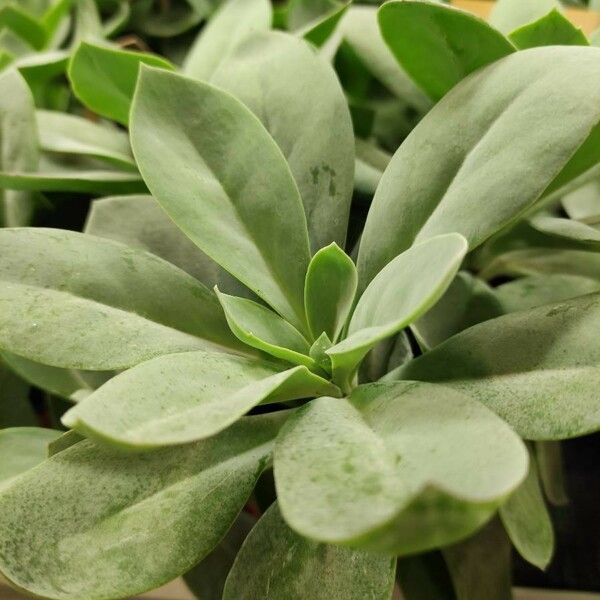
Plant Overview
Often called the "Orange Glaze" or "Flower Dust Plant," Kleinia cephalophora is a striking succulent that looks as though it was plucked from a prehistoric coral reef. Originating from the rocky outcrops of South Africa, it is a favorite among collectors for its architectural form and the dramatic color contrast between its cool, seafoam-blue foliage and its fiery, pom-pom-like blossoms. It is a slow-growing beauty that adds a "desert-chic" aesthetic to any sunny interior.
🔍 How to Identify
- 🍃 The Foliage: Fleshy, spatula-shaped leaves grow in dense, upright rosettes. They are covered in a thick, glaucous (waxy) coating that gives them a soft, powdery, blue-grey appearance.
- 🎨 Sun Stress: When exposed to high levels of sunlight, the leaf margins and tips may develop a beautiful purple or rosy-pink tint.
- 🎈 The Blooms: Unlike daisies, these flowers lack outer petals. Instead, they appear as vibrant, burnt-orange or scarlet "powder puffs" that sit atop thick, sturdy stems, usually appearing in late winter or spring.
🏡 In Your Garden
- ☀️ Natural Sunscreen: That powdery white "dust" on the leaves is actually epicuticular wax. It acts as a natural sunblock and helps the plant retain moisture. Avoid touching the leaves frequently, as the oils from your fingers can rub this coating off, leaving permanent fingerprints.
- 🏜️ The Drought Specialist: This plant has evolved to survive in arid environments by storing water in its thick leaves. It thrives on "neglect" and requires a very gritty, fast-draining cactus mix. It is far more likely to suffer from root rot due to overparenting than it is to dry out.
⚠️ Safety & Toxicity
- 🐾 Toxic Status: Potentially Toxic to Pets and Humans.
- 🚫 Details: Like many members of the Senecioneae tribe, it contains pyrrolizidine alkaloids. If ingested in large quantities, it can cause liver distress in cats, dogs, and horses. The milky sap may also cause mild skin irritation for those with sensitive skin; it is best to wear gloves when pruning or propagating.
✨ Fun Fact
While it looks nothing like a common garden weed, Kleinia cephalophora is a distant relative of the Sunflower and the Daisy! It belongs to the Asteraceae family, but it has evolved "discoid" flower heads, meaning it skipped the flashy outer petals to focus entirely on the fuzzy, pollen-rich center.

Detailed Care Instructions
To grow Kleinia cephalophora (also known as 'pineapple senecio' or 'silver crown') plant, you can follow these steps:
- Obtain a cutting or plant: You can either purchase a small plant from a nursery or obtain a cutting from an existing plant. A cutting can be taken from the stem of the plant, ensuring it is at least 4-6 inches long.
- Choose a pot or container: Select a pot or container with good drainage. Kleinia cephalophora prefers well-draining soil to avoid root rot.
- Soil preparation: Use a cactus or succulent potting mix, or create your own by combining regular potting soil with perlite or sand to improve drainage. Avoid using heavy or water-retaining soils.
- Planting: Gently plant the cutting or small plant into the soil, making sure not to bury it too deeply. Firmly press the soil around the base of the plant to provide stability.
- Light requirements: Place the plant in a location with bright indirect light. Kleinia cephalophora prefers around 6-8 hours of sunlight per day but can tolerate some shade.
- Watering: Water the plant sparingly, allowing the soil to dry out between waterings. Overwatering can lead to root rot, so avoid keeping the soil constantly wet. It is best to use the "soak and dry" method, where you thoroughly water the plant and let the excess water drain out.
- Temperature and humidity: Kleinia cephalophora thrives in warm temperatures, ideally between 65-85°F (18-29°C). It can withstand high humidity but doesn't require it.
- Fertilization: Feed the plant with a balanced, water-soluble fertilizer diluted to half-strength during the growing season (spring and summer). Avoid fertilizing during the dormant period (fall and winter).
- Pruning: If the plant becomes leggy or unruly, you can prune it to maintain a compact shape. Use clean, sharp pruning shears and cut back to just above a leaf or node.
- Propagation: If you want to propagate more Kleinia cephalophora plants, you can take stem cuttings during the active growing season and allow them to callous over before planting them in well-draining soil.
Remember, Kleinia cephalophora is a sensitive plant, so avoid sudden changes in temperature, overwatering, and direct sunlight during the hottest part of the day. With proper care and conditions, your Kleinia cephalophora plant should thrive and grow well.

Place in a bright room that is sun drenched almost all day. Or directly in a south-facing window.

To properly water this plant, you should start by checking the soil moisture level by touching the soil with your finger. If it feels dry to the touch, it is time to water. Use a watering can or a gentle stream of water to water the soil around the plant, taking care not to get any water on the leaves or stem. Allow the soil to absorb the water and drain any excess out of the bottom of the pot. Avoid overwatering, as this plant is sensitive to root rot and can suffer damage if the soil stays too wet for too long. Water this plant approximately once a week, depending on the surrounding temperature and humidity levels.
- Choose a balanced, water-soluble fertilizer for houseplants or succulents.
- Dilute the fertilizer according to the manufacturer's instructions.
- Apply the diluted fertilizer to the soil around the base of the plant.
- Avoid getting fertilizer on the leaves or stems of the plant.
- Water the plant thoroughly after fertilizing.
- Fertilize the plant once a month during the growing season (spring and summer).
- Reduce or stop fertilizing during the dormant season (fall and winter).
The preferred soil for the Kleinia Cephalophora plant is one that is well-draining and aerated. The soil should contain a mixture of organic materials such as compost, perlite, and sand to allow for water and air to penetrate easily through the soil. It should be slightly acidic with a pH range of 6.0 to 7.0. The soil should also be free from any contaminants that may harm the plant's growth. It is important to ensure that the soil is not overly moist, as this may lead to root rot and other soil-borne diseases. In summary, the ideal soil for the Kleinia Cephalophora plant should be well-draining, aerated, slightly acidic, and free from contaminants.
To propagate this plant, you will need to select a healthy stem cutting. Ensure that the stem is at least 4 inches long and has several leaves. Using a sharp, sterile pair of scissors, cut the stem just below a node.
Remove the bottom leaves from the stem, leaving only the top few leaves intact. This will help to reduce moisture loss and allow the plant to focus its energy on rooting.
Prepare a well-draining soil mix, such as a mixture of sand and perlite. Wet the soil mixture and make a small hole in the center.
Insert the stem cutting into the hole and gently press the soil around the stem to hold it in place.
Place the newly planted cutting in a well-lit area, but out of direct sunlight. Keep the soil moist but not waterlogged.
In approximately two to three weeks, the cutting should have developed roots and can be transplanted into a larger pot with well-draining soil mix.
Common pests of the mountain fire include Scale insect, mealybugs, spider mites, thrips. Make a habit of checking your mountain fire frequently for pests so that any infestations can be caught and managed early.








