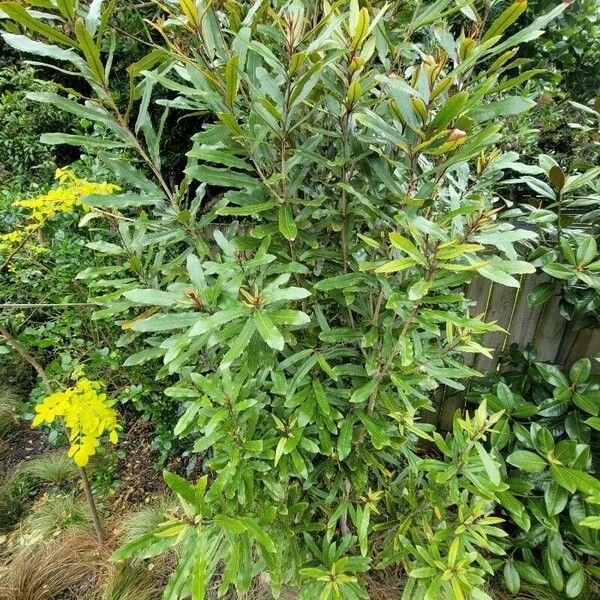
Plant Overview
Known as the Rewarewa or the New Zealand Honeysuckle, this striking evergreen is a true "skyscraper" of the forest. Native to the North Island and the top of the South Island of New Zealand, it stands out with its incredibly narrow, columnar silhouette. In Māori tradition, the tree was valued for its medicinal bark and sweet nectar, which was often harvested for food.
🔍 How to Identify
- 🍃 The Foliage: The leaves are long, leathery, and deeply serrated, resembling the blade of a heavy-duty saw. They are dark green and often have a slightly bronzed underside when young.
- 🏮 The Flowers: Its most iconic feature is the mass of velvety, reddish-brown flower clusters that appear in late spring. These tubular blooms spiral open like tiny fireworks, giving the tree a "bottlebrush" appearance.
- 🌲 The Stature: Rewarewa grows remarkably straight and tall, often reaching heights of 30 meters. From a distance, it looks like a dark green pillar or a narrow torch reaching for the sky.
🏡 In Your Garden
- 🦅 Bird Magnet: If you plant a Rewarewa, prepare for visitors. Its nectar-rich flowers are an absolute favorite for honey-eating birds like the Tui and Bellbird, who play a vital role in its pollination.
- 🏗️ Establishment Nuance: While it is a hardy tree once established, it hates having its feet moved. Because of its deep taproot, you should choose its "forever home" carefully; transplanting an older Rewarewa often results in failure.
- 🌬️ Wind & Soil: It is surprisingly wind-tolerant and thrives in well-drained, slightly acidic soil. It is a pioneer species, meaning it is excellent for "re-wilding" projects or as a dramatic vertical accent in a larger landscape.
⚠️ Safety & Toxicity
- ✅ Status: Non-Toxic.
- 🐾 Details: Rewarewa is generally considered safe for humans and pets. It does not possess any known aggressive toxins or irritants, making it a "friendly" giant for suburban boundaries.
✨ Fun Fact
Rewarewa honey is a world-renowned gourmet delicacy! It is prized for its unique, deep amber color and a complex flavor profile that is often described as smoky, malty, and slightly herbal.

Detailed Care Instructions

Place in a bright room that is sun drenched almost all day. Or directly in a south-facing window.

The presence of a dry surface layer of soil does not indicate that the plant requires water. Instead, stick your finger 1-2" (3-5 cm) deep in the soil to feel dampness or moisture content. If the soil seems dry, it's time to water your greens. If the soil is still moist, however, it is better not to water your plant and instead wait a day or two. Overwatering or waterlogging raises the risk of root rot. So if the soil takes longer than a week to dry, check the light conditions because it's likely that the plant isn't getting enough light. It's fine if the upper layer of soil is dry between waterings, but the deeper soil layer should always have some moisture.







