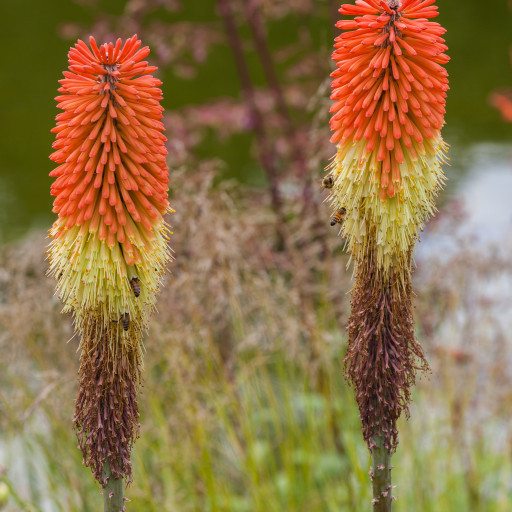
Plant Overview
Imagine a glowing torch rising from a sea of steel-blue swords. Often called the Stemmed Torch Lily, this South African native brings a dramatic, architectural flair to any landscape. Unlike its cousins that stay low to the ground, this variety eventually builds up a thick, woody base, giving it a prehistoric, palm-like appearance that commands attention.
🔍 How to Identify
- 🍃 The Foliage: Striking, arching leaves with a distinct blue-gray or glaucous hue. They are deeply channeled (V-shaped) and grow in dense, symmetrical rosettes.
- 🪵 The "Trunk": Its name caulescens literally means "having a stem." As the plant matures, it develops a visible, thick stem that elevates the foliage off the ground.
- 🔥 The "Poker": Dense, cylindrical flower spikes held high on sturdy stalks. The flowers transition from a fiery coral-red at the top to a soft, creamy yellow at the bottom as they mature.
🏡 In Your Garden
- 🏔️ Mountain Hardiness: Originating from the high-altitude Drakensberg Mountains, this plant is incredibly resilient. It handles cold and wind much better than other Red Hot Pokers, provided its "feet" aren't sitting in soggy winter soil.
- 🏜️ Drainage is King: Because it grows naturally among rocks, it hates heavy clay. It thrives in "lean" soil—if you feed it too much nitrogen, you’ll get plenty of leaves but very few of those iconic glowing torches.
- 🦋 The Pollinator Cafe: The nectar is so abundant it sometimes drips from the bells. It is a primary destination for bees, butterflies, and nectar-seeking birds looking for a high-energy snack.
⚠️ Safety & Toxicity
- ✅ Non-Toxic: This plant is generally considered safe and non-toxic for both humans and curious pets like cats and dogs.
- ✂️ Physical Safety: The edges of the long, sword-like leaves can be quite sharp and serrated. It is best to wear gloves when dividing the plant or tidying up dead foliage to avoid "paper cut" style nicks on your hands.
✨ Fun Fact
The genus name Kniphofia honors Johann Hieronymus Kniphof, an 18th-century German botanist. He was famous for "nature printing," a technique where he would ink the actual plant and press it onto paper to create perfectly detailed botanical illustrations!

Detailed Care Instructions
To grow Kniphofia caulescens, also known as red hot poker or torch lily, follow these steps:
- Location: Kniphofia caulescens requires a sunny location with well-draining soil. Choose a spot in your garden that receives at least 6 hours of direct sunlight each day.
- Soil: The plant prefers slightly acidic to neutral soil with good drainage. Amend heavy clay soil by adding compost or well-rotted manure to improve drainage.
- Planting: Plant Kniphofia caulescens in spring or early summer after the last frost. Dig a hole that is large enough to accommodate the plant's root ball. Place the plant in the hole, making sure the crown is level with the surface of the soil. Backfill the hole with soil and gently firm it around the plant.
- Watering: Water the plant deeply after planting and keep the soil moist but not waterlogged. Once established, Kniphofia caulescens is fairly drought-tolerant but still benefits from regular watering during dry spells.
- Mulching: Apply a layer of organic mulch, such as wood chips or straw, around the base of the plant to help retain moisture and suppress weed growth.
- Fertilizing: Fertilize Kniphofia caulescens in early spring with a general-purpose slow-release fertilizer. Avoid using high nitrogen fertilizers, as they can promote foliage growth at the expense of flowering.
- Pruning: Deadhead spent flowers to encourage more blooms and remove any damaged or old leaves throughout the growing season. In late winter or early spring, cut back the foliage to a few inches above the ground to rejuvenate the plant for the new growing season.
- Pests and diseases: Kniphofia caulescens is generally not prone to serious pest or disease problems. However, watch out for aphids, snails, and slugs. If necessary, treat with appropriate insecticides or use organic pest control methods.
- Propagation: You can propagate Kniphofia caulescens through division in early spring. Dig up the plant and carefully separate the clumps into smaller sections, making sure each section has some healthy roots attached. Replant the divisions in the desired location.
By following these guidelines, you can successfully grow Kniphofia caulescens and enjoy its striking red-orange flower spikes in your garden.

Place in a bright room that is sun drenched almost all day. Or directly in a south-facing window.

To water this plant, it is important to make sure that the soil is slightly moist but not completely saturated. This can be achieved by watering deeply once per week during the summer months, and less frequently in the cooler months. It is also important to avoid getting water on the leaves, as this can lead to fungal diseases. A good way to water this plant is to use a drip irrigation system or a watering can to apply water directly to the soil. In addition, it is important to make sure that the soil is well-draining, as this plant does not tolerate soggy conditions.
To fertilize this plant, begin by selecting a high-quality, balanced fertilizer that is formulated for flowering plants. Follow the manufacturer's instructions carefully, as over-fertilization can damage the plant. Be sure to apply the fertilizer evenly across the soil surface surrounding the plant, taking care not to allow it to come into contact with the leaves or stem. Water the plant thoroughly after fertilization to help release the nutrients into the soil. Repeat the fertilization process every three to four weeks throughout the growing season for optimal results.
Kniphofia caulescens plant requires a well-draining soil that is not too fertile. It grows best in a slightly acidic to neutral soil pH range. The soil should be light, airy, and sandy to promote good drainage. To improve soil drainage, it is recommended to mix organic matter such as compost, sphagnum peat moss, or coarse sand with the soil. Avoid clay soils which may hold too much water and lead to root rot. It is also important to ensure that the soil is not too nutrient-rich as this may cause the plant to produce more leaves than flowers. A good soil mix for Kniphofia caulescens plant can be prepared with a mix of garden soil, compost, and coarse sand or perlite.
Kniphofia Caulescens is a plant that can be propagated through division. To do this, first, wait until the plant is mature enough to handle being divided. Then carefully remove the entire plant from its pot or from the ground. Gently separate the roots of the plant into two or more sections, being sure to keep the root mass intact.
Next, replant each section in its own container or in a new spot in the garden. Ensure that each new planting site has good soil, adequate light, and proper drainage. Keep the plants well-watered for the first few weeks to help them establish themselves. With proper care, the newly propagated plants will take root and thrive.
Common pests of the grey-leaved poke include Spider mites, aphids, thrips. Make a habit of checking your grey-leaved poke frequently for pests so that any infestations can be caught and managed early.








