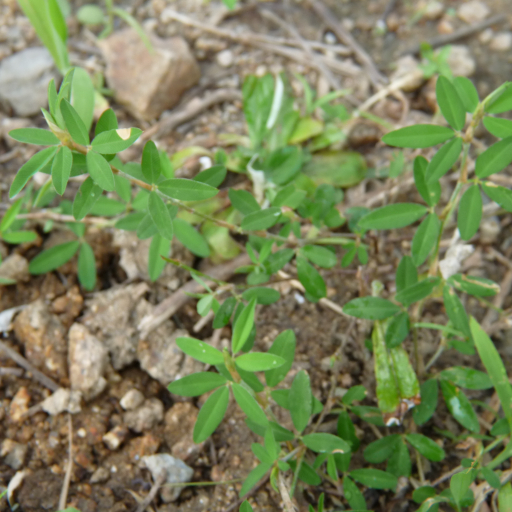
Plant Overview
Often called Japanese Clover or the Hoop-koop-plant, Kummerowia striata is a resilient, low-growing traveler from East Asia. This summer annual is a master of the "under-foot" world, often forming dense, green mats in lawns and fields where other plants struggle to survive. While some gardeners view it as a stubborn weed, it is secretly a soil-healer that pulls nitrogen from the air to enrich the earth beneath it.
🔍 How to Identify
- 🌿 The Foliage: Look for "trifoliate" leaves—meaning they grow in groups of three, much like a traditional clover. Each leaflet is oblong with very distinct, parallel veins that run straight to the edge.
- 🌸 The Flowers: In late summer, look closely for tiny, pink-to-purple pea-shaped flowers tucked discreetly where the leaves meet the stem. They are beautiful but very easy to miss!
- 📏 Growth Habit: It grows prostrate, meaning it hugs the ground tightly. The stems are wiry and can turn a reddish-brown color as the plant matures.
- 🧶 The Stem Hairs: If you look through a magnifying glass, you’ll see tiny hairs on the stems that point downward, a key feature that distinguishes it from its cousins.
🏡 In Your Garden
- 🌱 Soil Improvement: This plant is a legume, meaning it lives in a symbiotic relationship with bacteria to "fix" nitrogen. It’s often the first plant to move into "tired" or compacted soil to help restore its nutrients.
- ☀️ Heat Hero: While your lawn grass might turn brown and thirsty in the August heat, Japanese Clover stays vibrant. It thrives in high temperatures and can handle heavy foot traffic, making it a rugged alternative to delicate groundcovers.
- 🚜 Self-Seeding: Because it is an annual, it lives for only one season, but it drops a massive amount of seeds. If you don't want it to return next year, you’ll need to manage it before those tiny flowers turn into seed pods.
⚠️ Safety & Toxicity
- ✅ Status: Generally non-toxic and safe.
- 🐾 Pets & Livestock: It is considered high-quality forage for cattle and sheep and is non-toxic to dogs and cats. However, in agricultural settings, if the plant becomes moldy, it can occasionally cause issues with blood clotting in livestock—but for the average backyard explorer or pet, it is perfectly safe to touch or be around.
✨ Fun Fact
The nickname "Hoop-koop-plant" comes from a charming old children’s trick: if you carefully snap the leaf across its veins, the tough fibers will often hold the leaf together, allowing you to "jump" the leaf through the resulting hoop!

Detailed Care Instructions
To grow Kummerowia striata, also known as Japanese Clover, follow these steps:
- Choose a suitable location: Japanese Clover prefers full sun, but it can tolerate partial shade as well. Ensure the soil is well-draining and fertile.
- Prepare the soil: Remove any weeds or debris from the planting area. Loosen the soil with a garden fork or tiller and amend it with compost or well-rotted manure to improve fertility.
- Sow the seeds: Scatter the seeds evenly over the prepared soil. The optimal time for sowing is in early spring or early fall. Lightly press the seeds into the soil, ensuring good seed-to-soil contact.
- Water thoroughly: After sowing, water the area gently to moisten the soil. Keep the soil consistently moist during germination and establishment. Avoid overwatering, as it can lead to fungal issues.
- Maintain moisture: To retain moisture and aid germination, cover the seedbed with a thin layer of straw or mulch.
- Weed control: Regularly inspect the seedbed and remove any competing weeds that may hinder the growth of Japanese Clover.
- Fertilize if needed: If the soil is poor or lacks nutrients, you may consider applying a balanced fertilizer according to the package instructions. However, Japanese Clover typically thrives without additional fertilization.
- Regular mowing: Once the Japanese Clover is established, you can mow it regularly to maintain a desired height. Aim to keep it around 4-6 inches tall, as this helps it to spread and fill in empty spaces.
- Watch for pests and diseases: Japanese Clover is generally not prone to serious pest or disease issues, but occasional issues such as aphids or powdery mildew can occur. Inspect the plants regularly and take appropriate measures if any problems arise.
- Additional propagation: Japanese Clover spreads via rhizomes and can self-seed. If desired, you can divide the plants in spring or early fall to propagate and expand your garden.
By following these steps, you can successfully grow Kummerowia striata and enjoy its ground-covering and nitrogen-fixing qualities.

Place in a bright room that is sun drenched almost all day. Or directly in a south-facing window.

Kummerowia striata is a plant that requires regular watering to thrive. The frequency and amount of water needed will depend on factors such as the size of the plant, the soil type and the surrounding environment.
To water this plant, it is important to first check the soil moisture level. This can be done by inserting a finger into the soil up to the first knuckle. If the soil feels dry to the touch, it is time to water.
When watering, it is best to use a watering can or hose with a gentle spray nozzle to avoid damaging the plant. Care should also be taken not to overwater, as this can lead to root rot.
Water should be applied slowly and evenly around the base of the plant until the soil is moistened to a depth of about 6 inches. It is important to avoid getting water on the leaves as this can lead to fungal diseases.
In dry or hot weather, Kummerowia striata may require more frequent watering to prevent the soil from drying out completely. Similarly, in wet or humid conditions, it may be best to water less frequently to avoid waterlogging the soil.
Overall, the key to successfully watering Kummerowia striata is to maintain a consistent level of moisture in the soil without overwatering or underwatering.
- Determine the type of soil in which the plant is growing.
- Test the soil pH to make sure it is between 6.0 and 7.0.
- Use a slow-release fertilizer with balanced NPK values of 10-10-10 or 20-20-20 in early spring.
- Apply the fertilizer evenly around the plant, avoiding the stem.
- Water the plant well after fertilizing to ensure that the nutrients are absorbed properly.
- Reapply the fertilizer once every two months during the growing season.
- Stop fertilizing in early fall to allow the plant to prepare for winter.
Kummerowia Striata prefers a well-drained soil that is rich in nutrients. The ideal pH range for this plant is between 6.0-7.5. When planting, prepare the soil by adding organic matter such as compost or well-rotted manure. This will help to improve soil structure and fertility. It is also recommended to ensure the soil is weed-free before planting. Avoid using soils that are too heavy or compacted as this can impede root growth and cause poor drainage. Sandy loam or loamy sand soils are recommended as they provide good drainage while still retaining moisture.
Kummerowia striata can be propagated through seed germination or vegetative propagation. To propagate through seed germination, collect the seeds from the matured plant, clean the seeds, and let them dry on a paper towel for a few days. Plant the seeds in well-draining soil and keep them moist. It takes about 10-14 days for the seeds to germinate.
Alternatively, Kummerowia striata can be propagated through vegetative propagation by taking stem cuttings. Select a healthy stem that is about 3-4 inches long, without any disease or damage. Remove the lower leaves of the stem and dip the cut end in a rooting hormone powder. Plant the stem cutting in well-draining soil and keep it moist. It takes about 3-4 weeks for the cutting to develop roots and establish itself.
Propagation can be done either in the spring or in the fall. It is important to keep the plant in a warm area with enough light to ensure successful propagation.








