Plant Overview
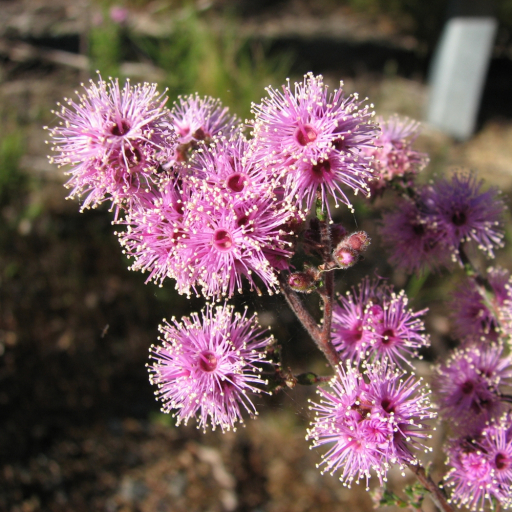
The Kunzea parvifolia, affectionately known as the "Violet Kunzea," is a resilient Australian native that paints the landscape in soft shades of purple every spring. Often found clinging to rocky outcrops or thriving in sandy heathlands, it is a master of survival in harsh, well-drained environments. For gardeners, it provides a spectacular "pom-pom" floral display that looks almost ethereal when the morning dew catches its many delicate stamens.
🔍 How to Identify
- 🌸 Floral Pom-poms: The flowers appear as dense, globular clusters of vibrant pink to violet stamens. They lack prominent petals, giving them a soft, fuzzy "bottlebrush" appearance.
- 🌿 Dainty Foliage: True to its name (parvifolia means "small leaf"), the foliage consists of tiny, narrow, needle-like leaves that grow in a crowded, alternating pattern along the woody stems.
- 🪵 Growth Habit: It typically forms a low-to-medium spreading shrub. Its branches are often fine and wiry, creating a delicate, airy texture in the landscape.
🏡 In Your Garden
- 🦋 Pollinator Magnet: This plant is a powerhouse for local biodiversity; the nectar-rich flower heads are a favorite "pit stop" for native bees, hoverflies, and small butterflies.
- ⛰️ Drainage is Key: Because it naturally evolves in rocky or sandy soils, it has a sensitive root system that cannot tolerate "wet feet." If your garden has heavy clay, consider planting it in a raised bed or a large pot to ensure the roots stay oxygenated.
- ✂️ Post-Bloom Grooming: To prevent the shrub from becoming "leggy" or sparse in the center, give it a light prune immediately after the flowers fade. This encourages a bushier, more compact shape for the following season.
⚠️ Safety & Toxicity
- ✅ Non-Toxic Status: The Violet Kunzea is generally considered non-toxic to humans, dogs, and cats. It does not possess the aggressive irritants found in some other heath-land species.
- 🧤 Mechanical Irritation: While not poisonous, the fine, stiff foliage can be slightly scratchy. If you have sensitive skin, wearing gardening gloves during a heavy pruning session is recommended to avoid minor abrasions.
✨ Fun Fact
The genus Kunzea is named in honor of Gustav Kunze, a 19th-century German professor, botanist, and physician who was also a world-renowned expert on ferns!

Detailed Care Instructions

Place in a bright room that is sun drenched almost all day. Or directly in a south-facing window.

Some plants require more regular watering than others, which should be done every few days. It's critical to maintain the soil moist all of the time. The water requirements of the same plant placed in pots with varying sizes will differ. Because the water in the smaller pot evaporates faster than the water in the larger pot, it will require more watering. Regardless of pot size, the surface should constantly be maintained moist.








