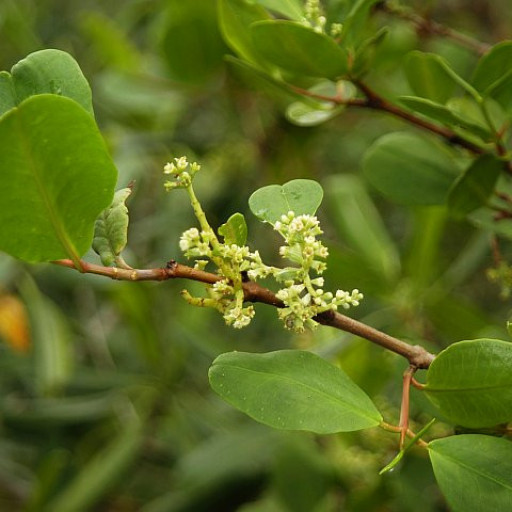
Plant Overview
The White Mangrove (Laguncularia racemosa) is a coastal superstar often called the "land-builder" for its incredible ability to stabilize shorelines. Found gracing the brackish edges of the Americas and West Africa, it is the most cold-hardy and adaptable of the mangrove species. While others stand on high "stilts" in the deep water, the White Mangrove prefers the higher ground, acting as a transition between the sea and the forest.
🔍 How to Identify
- 🍃 The Leaf Glands: The easiest way to spot this plant is by looking at the base of the leaf stalk (petiole). You will see two small, raised bumps or "glands" that look like tiny green salt shakers.
- 🟢 Leaf Shape: The leaves are thick, leathery, and rounded at both ends (elliptical), appearing a bright, waxy green on both sides.
- 🦴 Light Bark: True to its name, the bark is remarkably light-colored, ranging from white to a pale grayish-tan, which stands out against the darker trunks of neighboring trees.
🏡 In Your Garden & Ecosystem
- 🌊 Salt Management: Unlike other plants that die in salt, the White Mangrove thrives by "sweating" salt out through its leaf glands. If you taste a leaf, it might actually be salty!
- 🛡️ Coastal Protector: In a coastal "garden" or natural landscape, these trees are vital. Their root systems create a dense mat that prevents erosion during storms and provides a nursery for young fish and crabs.
- 🪴 Bonsai Potential: Because of its hardy nature and attractive, thick leaves, it has become a favorite for tropical bonsai enthusiasts who enjoy its rugged, aged appearance.
⚠️ Safety & Toxicity
- ✅ Safe for Humans: The White Mangrove is considered non-toxic to humans and is not known to cause skin irritation upon touch.
- 🐾 Pet Friendly: There are no recorded toxic effects for cats or dogs, making it a safe addition to coastal properties or large outdoor enclosures.
- 🛑 Legal Protection: In many regions (like Florida), it is illegal to trim or remove mangroves without a permit. They are protected environmental assets rather than common weeds.
✨ Fun Fact
The White Mangrove is a "viviparous" plant, meaning its seeds actually begin to germinate while they are still attached to the parent tree! Once they fall into the water, they are already "pre-packaged" with a tiny root, ready to latch onto the first mudbank they find.

Detailed Care Instructions
To grow Laguncularia racemosa, also known as white mangrove, you can follow these steps:
- Obtain seeds or seedlings: You can either collect seeds from mature white mangrove trees or purchase seedlings from a nursery or online.
- Choose a suitable planting location: Laguncularia racemosa is a salt-tolerant tree that thrives in coastal areas. Find a location with well-drained soil and full or partial sunlight. This plant can also tolerate brackish water.
- Prepare the planting area: Clear the area of any weeds or debris. If planting in a pot, use a well-draining soil mix consisting of peat moss, sand, and perlite.
- Germinate the seeds (if growing from seeds): Soak the seeds in water for 24 hours to help soften the seed coat. Fill a pot or seed tray with moist soil mix and plant the seeds about 1 inch deep. Keep the soil consistently moist, and germination should occur within a few weeks.
- Plant the seedlings: If using seedlings, dig a hole slightly wider and deeper than the root ball. Place the plant in the hole and backfill with soil, gently pressing it down around the roots to remove air pockets. Ensure the soil is level with the surrounding ground.
- Water regularly: Water the plant regularly, keeping the soil moist but not waterlogged. However, once established, Laguncularia racemosa is fairly drought-tolerant.
- Mulch and fertilize (optional): Adding a layer of organic mulch around the base of the plant can help retain moisture and suppress weeds. You can also apply a slow-release fertilizer formulated for trees in the spring and summer to promote growth.
- Prune if necessary: Laguncularia racemosa generally requires minimal pruning. However, you can trim any dead or damaged branches as needed.
- Protect from extreme cold: If you live in a region with cold winters, young Laguncularia racemosa plants may need protection from frost or freezing temperatures. Cover them with burlap or other protective material during cold spells.
Remember that Laguncularia racemosa is a fast-growing tree that can reach heights of up to 30 feet (9 meters). It is important to provide enough space for it to grow and regularly monitor its growth to ensure it doesn't interfere with neighboring structures or plants.

Place in a bright room that is sun drenched almost all day. Or directly in a south-facing window.

To water this plant, you should first determine its specific needs. Typically, it prefers soil that is consistently moist but not waterlogged. One way to ensure proper moisture levels is to water deeply and infrequently, allowing the soil to partially dry out between waterings. It is also important to avoid getting the leaves wet, as this can promote fungal growth. Additionally, this plant may benefit from periodic misting or humidification to provide optimal growing conditions. Overall, careful attention to the plant's soil and environmental conditions will help ensure it thrives.
To fertilize this plant, first ensure that the soil is moist and not too dry. Use a granular fertilizer with a balanced ratio of nitrogen, phosphorus, and potassium. Apply the fertilizer evenly around the base of the plant, making sure not to cover the stems or leaves. Water the plant well after fertilizing to help the nutrients reach the roots. Repeat the fertilization once per month during the growing season, and reduce or stop fertilization during the dormant season.
Laguncularia Racemosa prefers soil that is well-draining and rich in organic matter. It can tolerate soil that is slightly acidic to slightly alkaline. The soil should also be able to retain moisture without becoming waterlogged. It is recommended to use a mixture of loamy soil and sand for this plant. Mulching with organic matter can also help to maintain moisture and improve soil health. It is important to avoid using heavy clay soil and soil that is low in nutrients.
To propagate this particular plant, you will need to take a cutting from a mature, healthy plant. First, select a stem that is about 6-8 inches long and looks healthy. Cut the stem with a sterilized pair of pruning shears, making sure to make the cut at a 45-degree angle.
Next, remove any leaves from the lower two-thirds of the stem, leaving only a few leaves at the top. Dip the bottom of the stem in rooting hormone powder, which you can purchase from a gardening store.
Then, make a hole in a pot filled with potting soil and insert the bottom of the stem about 2 inches deep into the soil. Pat the soil down gently to make sure the stem is secure.
Water the cutting thoroughly and place the pot in a warm, well-lit area. Make sure the soil stays moist but not too wet, as overly wet soil can lead to root rot.
After a few weeks, you should start to see roots growing from the stem. Once the roots have established themselves, you can transplant the new plant into a larger pot or into the ground if you prefer.








