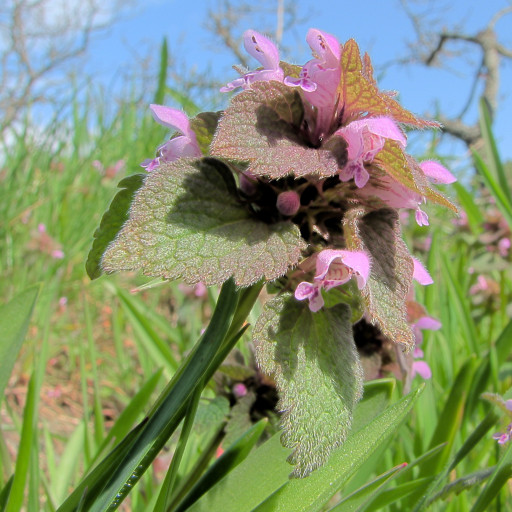
Plant Overview
Commonly known as the Red Dead-nettle or Purple Archangel, this charming member of the mint family is one of the first signs that spring has arrived. Despite the "nettle" in its name, it is a "dead" nettle, meaning it lacks the stinging hairs of its distant cousins. In folklore, it was often associated with lightheartedness and was believed to cheer the spirit of those who gathered it.
🔍 How to Identify
- 🔲 Square Stems: Like most members of the Lamiaceae family, its stems are distinctly four-sided; if you roll it between your fingers, you’ll feel the sharp corners.
- 🎨 Gradient Leaves: The heart-shaped, fuzzy leaves are green at the base but transition into a striking reddish-purple or burgundy hue toward the top of the plant.
- 🌸 Hooded Blooms: Tiny, tubular pinkish-purple flowers peek out from under the upper leaves, looking like miniature helmets or hoods designed to protect the nectar inside.
🏡 In Your Garden
- 🐝 A Bee’s First Meal: This plant is a vital "bridge" species. Because it blooms so early (often in late winter), it provides critical nectar for queen bumblebees and early butterflies when nothing else is available.
- 🌱 The Opportunist: It prefers disturbed soil and can spread quickly through seeds. While some gardeners view it as a weed, its shallow roots make it very easy to pull up or relocate, and it actually helps prevent soil erosion during the rainy spring months.
⚠️ Safety & Toxicity
- 🍽️ Status: Edible and non-toxic.
- 🍵 Details: The leaves are safe for humans and can be used in salads, smoothies, or brewed into a mild herbal tea. It is also considered safe for cats, dogs, and horses, though it is always best to ensure the plant hasn't been sprayed with lawn chemicals before letting a pet near it.
✨ Fun Fact
The seeds of the Red Dead-nettle have a special oily attachment called an elaiosome. This "snack" attracts ants, who carry the seeds back to their nests, eat the oil, and then "plant" the seeds in their nutrient-rich refuse piles!

Detailed Care Instructions
| Color | Purple/Lavender Blooms, White And Yellow/Gold Buds |
| Soil Ph | Alkaline, Acidic, Neutral |
| Invasive | Weed |
| Toxicity | Toxic |
| Soil Type | Sandy, Loamy Soil |
| Bloom Time | Early Spring And Fall |
| Plant Type | Lamiaceae Family, Perennial Weed, Wildflower |
| Mature Size | 6 To 12 Inches Tall With An 18 To 24 Inch Spread |
| Native Area | Europe, Asia And North Africa |
| Sun Exposure | Partial To Full Shade |
| Hardiness Zones | 4-8 |
To grow Lamium Purpureum, also known as Purple Deadnettle, you can follow these steps:
- Select a suitable location: Lamium Purpureum can grow in full sun to partial shade. Choose an area with well-draining soil.
- Prepare the soil: Loosen the soil using a garden fork or tiller. Remove any weeds or rocks from the area and mix in compost or organic matter to improve soil fertility and drainage.
- Sow seeds or plant seedlings: Lamium Purpureum propagates easily from seeds or seedlings. If using seeds, sprinkle them directly on the soil surface and lightly press them in. Water gently to keep the soil moist until germination, which takes around 7-10 days. If using seedlings, dig holes that are slightly larger than the root ball, place the seedlings in the holes, and cover with soil.
- Water regularly: Keep the soil consistently moist but not waterlogged. Water deeply whenever the top inch of soil feels dry to the touch.
- Mulch the area: Apply a layer of organic mulch around the plants to help retain moisture, suppress weeds, and regulate soil temperature.
- Fertilize sparingly: Lamium Purpureum doesn't require heavy feeding. A light application of balanced fertilizer in early spring should be enough to support its growth.
- Prune if necessary: Lamium Purpureum is a low-growing plant that typically doesn't require regular pruning. However, if it becomes leggy or overgrown, trim it back to maintain its shape and encourage bushier growth.
- Monitor for pests and diseases: While Lamium Purpureum is generally resistant to pests and diseases, keep an eye out for any signs of damage or infestation. If necessary, treat the affected plants using appropriate organic or chemical methods.
By following these steps, you can successfully grow Lamium Purpureum in your garden.

Place in a window with dappled sun or a spot in the middle of a room. Or directly in a window facing west or east.

To water this plant, first check the soil moisture level by sticking your finger about 1 inch into the soil. If it feels dry, it is time to water. Use a watering can or hose to water the soil at the base of the plant, taking care not to wet the foliage. Water until the soil is evenly moist but not waterlogged. Avoid letting the soil dry out completely between waterings. In the summer months, this plant may require more frequent watering due to higher temperatures and increased evaporation.
To fertilize this plant, use a balanced, all-purpose fertilizer with equal amounts of nitrogen, phosphorus, and potassium. Apply the fertilizer at a rate of one tablespoon per square foot of soil, and water thoroughly after applying. Repeat this every four weeks during the growing season, which typically runs from late spring to early fall. Avoid fertilizing outside of the growing season, and always follow the instructions on the fertilizer label.
Lamium Purpureum plant prefers a well-draining soil that is rich in organic matter. The soil should be slightly acidic to neutral pH and should not be too heavy or compacted as it can restrict the root growth and affect the overall health of the plant. A mix of peat moss, compost, and loam works well for this plant. It is also important to ensure that the soil stays moist but not waterlogged. Overwatering can cause root rot which can kill the plant. Adding a layer of mulch on top of the soil can help retain moisture and regulate temperature.
To propagate this plant, first prepare a pot or container with well-draining soil. Select a healthy stem from the parent plant and cut a section that is about 5-7 cm long. Strip off the lower leaves of the stem, leaving only a few near the top. Dip the cut end of the stem into rooting hormone powder and gently tap off any excess. Then, make a small hole in the soil with a pencil or your finger and insert the stem into the hole, making sure the bottom 2-3 cm is buried in soil. Water the soil lightly and cover the pot with a plastic bag or clear plastic wrap to create a humid environment. Place the pot in a bright but indirect location and check regularly to make sure the soil stays moist but not waterlogged. After a few weeks, the stem should have rooted and new growth will appear. Once the new plant has developed a few leaves, it can be transplanted into a larger container or planted outside in the garden.








