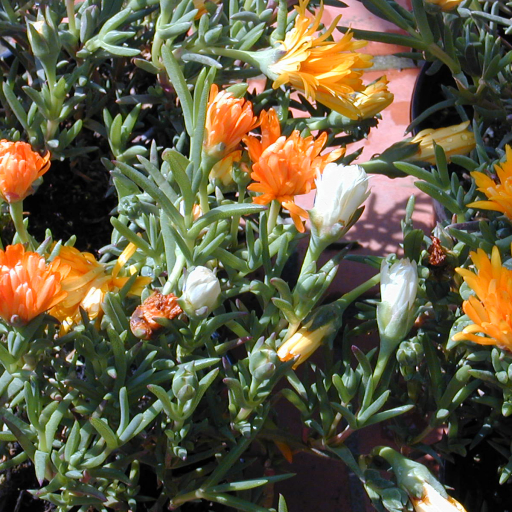
Plant Overview
Often called the Orange Ice Plant or Copper Ice Plant, this South African native is essentially a living sunset for your garden. It is a hardy succulent known for its ability to transform dry, neglected slopes into a shimmering carpet of brilliant neon-orange. In its homeland, it’s a vital part of the "Fynbos" biome, adapted to thrive where other plants might wither under the relentless sun.
🔍 How to Identify
- ☀️ The Flowers: Large, daisy-like blooms that are a shocking shade of metallic orange or copper with yellow centers. These flowers have a unique habit of closing during the night and opening only when the sun is bright.
- 🌿 Succulent Foliage: The leaves are fleshy, gray-green, and roughly triangular in cross-section. They feel firm to the touch and are designed to store water for long periods.
- 🪴 Growth Habit: It forms a low-growing, mounding shrub or spreading groundcover. Over time, the base of the plant becomes slightly woody, while the new growth remains soft and flexible.
🏡 In Your Garden
- 🏜️ Drainage is Non-Negotiable: While it is incredibly tough, it has a "weak heart" for soggy soil. It prefers gritty, sandy, or rocky ground. If its roots sit in water, the plant will quickly rot, so it's best suited for rock gardens or sloping terrain.
- 🌊 Salt and Wind Tolerance: This is a champion for coastal gardeners. It handles salty sea breezes and intense wind with ease, making it a go-to choice for stabilizing dunes or decorating seaside balconies.
- ✂️ Post-Bloom Maintenance: After the spectacular spring show, it can look a bit "leggy." Lightly shearing the top of the plant after the flowers fade encourages fresh, succulent growth and keeps the carpet looking dense.
⚠️ Safety & Toxicity
- ✅ Status: Generally considered non-toxic.
- 🐾 Details: Lampranthus aurantiacus is widely regarded as safe for cats, dogs, and children. However, as with any succulent, ingesting large amounts of the fleshy leaves can cause mild stomach upset or vomiting in curious pets. It is always best to discourage nibbling.
✨ Fun Fact
The name "Ice Plant" doesn't come from its cold tolerance—it actually hates hard frosts! It refers to the tiny, glistening bladder cells on the leaves of some species in this family, which look like tiny frozen crystals or "ice" shimmering in the sunlight.

Detailed Care Instructions
To grow Lampranthus Aurantiacus, also known as Orange Ice Plant or Bokbaai vygie, follow these steps:
- Climate: Lampranthus Aurantiacus thrives in warm, dry climates. It is best suited for USDA hardiness zones 9-11, but it can be grown in colder regions with winter protection.
- Soil: Choose well-draining soil with a sandy or loamy texture. The plant doesn't tolerate heavy, waterlogged soils.
- Location: Select a spot that receives full sun or partial shade. The plant needs at least 6 hours of direct sunlight daily to thrive.
- Planting: Spring is the ideal time to plant Lampranthus Aurantiacus. Dig a hole slightly larger than the root ball and place the plant in it. Ensure that the top of the root ball is level with or slightly above the soil surface. Space multiple plants at least 12-18 inches apart to provide them with enough room to spread.
- Watering: Once established, Lampranthus Aurantiacus is drought-tolerant and can survive with minimal water. However, during the first few months after planting, water the plant regularly to help it establish a strong root system. Afterward, water sparingly, only when the soil feels dry. Avoid overwatering, as it can lead to root rot.
- Fertilization: Lampranthus Aurantiacus doesn't require much fertilization. A light application of a balanced slow-release fertilizer in spring should be sufficient. Avoid excessive nitrogen fertilizers, as they can promote more foliage growth rather than blooming.
- Pruning: Trim back any dead or leggy growth to encourage compact, bushy growth. You can also pinch back the tips of the plant when it is young to promote branching.
- Winter protection: In regions with frost or freezing temperatures, provide winter protection. Cover the plant with a blanket or burlap if temperatures drop below freezing.
By following these guidelines, you should be able to grow and enjoy the vibrant orange flowers of Lampranthus Aurantiacus.
Lampranthus Aurantiacus plant should be watered regularly and deeply to maintain healthy growth. One should avoid overwatering and allowing water to sit in the soil for too long as this can lead to root rot. When watering, one should aim to moisten the soil to a depth of a few inches. A good watering schedule is to water the plant when the top inch of soil feels dry to the touch. This can be done by using a watering can or hose, or by immersing the pot in a saucer of water and allowing it to soak up the water until the soil is moist. It is also important to provide good drainage to prevent water from building up around the roots. This can be achieved by using a well-draining potting mix and adding gravel or perlite to the soil or by ensuring that the pot has drainage holes.
To fertilize this plant, use a balanced fertilizer with equal or slightly higher amounts of nitrogen, phosphorus, and potassium. Apply the fertilizer once every two months during the growing season. Be sure to follow the package instructions for application rates and methods. Water the plant before and after fertilizing to avoid burning the roots. Additionally, it is recommended to prune the plant after flowering to encourage fuller growth and better blooming in the following season.
Lampranthus aurantiacus, a member of the Aizoaceae family, is a perennial succulent plant that requires a well-draining soil mixture. It thrives in soil that is well-aerated and has good water retention. The ideal soil type for this plant is a sandy loam mix with a pH range of 5.5 to 7.0.
When planting, it is crucial to ensure that the soil is well-draining to avoid waterlogging, which can lead to root rot. A mixture of coarse sand, perlite, and peat moss can be used to improve soil drainage.
In addition, it is recommended to mix in organic matter, such as compost or aged manure, to provide nutrients for the plant. This will help improve soil quality and fertility, which is important for the plant's growth and development.
Overall, Lampranthus aurantiacus thrives in well-draining soil that is low in nutrients, but is kept moist. Maintaining good soil quality and providing proper irrigation is vital for the health and well-being of this plant.
There are several methods of propagating this plant, including seed propagation, stem cuttings, and division.
Seed propagation involves collecting the seeds from mature plants and planting them in a growing medium. The seeds should be planted in the early spring and kept moist until they germinate. Once germinated, the seedlings should be thinned to one plant per pot and eventually transplanted into larger containers as they grow.
Stem cuttings can be taken during the spring or summer months. Cuttings should be taken from healthy, mature plants and stripped of their lower leaves. The cuttings should then be dipped in a rooting hormone and planted in a well-draining soil mix. They should be kept moist and out of direct sunlight until they root and can be transplanted into larger containers.
Division is another method of propagation and involves separating the plant into smaller sections or individual plants. This can be done in the spring or fall and should be done when the plant is not actively blooming. The plant should be lifted from the soil and the roots carefully separated. Each section can then be replanted in a well-draining soil mix and kept moist until they establish themselves in their new location.








