Plant Overview
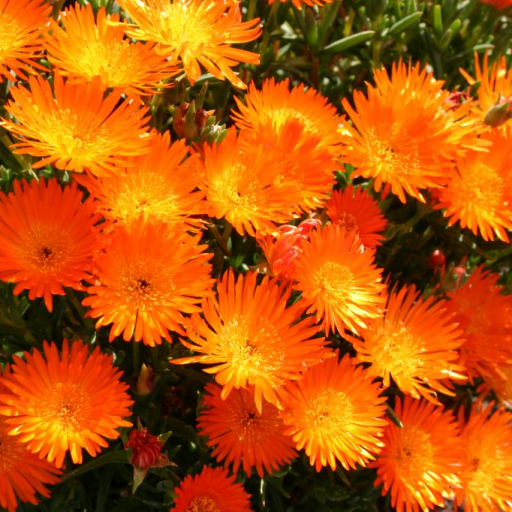
Commonly known as the Golden Vygie or Orange Ice Plant, this South African native is a showstopper that transforms dry garden beds into a carpet of molten gold. It belongs to the Aizoaceae family, a group of resilient succulents famous for their ability to thrive in harsh, coastal environments. In peak bloom, the foliage is often completely hidden by a dazzling sea of silk-textured petals.
🔍 How to Identify
- 🌼 Brilliant Blooms: The flowers are daisy-like with an iridescent, metallic sheen. They range from deep tangerine to bright gold and usually appear in a massive flush during late winter and spring.
- 🍃 Succulent Foliage: The leaves are small, fleshy, and somewhat triangular in cross-section. They are typically a soft grey-green, a color that helps the plant reflect intense heat.
- 🌱 Spreading Habit: It grows as a low, rounded shrub or a spreading groundcover. While it only reaches about 12-15 inches in height, it can spread wide to form a dense, weed-suppressing mat.
🏡 In Your Garden
- ☀️ Sun-Chasers: These flowers are "heliotropic," meaning they only open their petals when the sun is shining directly on them. On cloudy days or at night, they remain tightly closed to protect their pollen.
- 🏜️ Tough Love: Because it evolved for arid cliffs and sandy plains, this plant thrives on neglect. It prefers poor, well-draining soil; providing too much fertilizer or water will actually result in "leggy" growth and fewer flowers.
- ✂️ Pruning Nuance: To keep the plant from becoming woody and sparse in the center, it is best to give it a light trim immediately after the flowering season ends.
⚠️ Safety & Toxicity
- ✅ Safe Status: Lampranthus aureus is generally considered non-toxic to humans and common household pets like cats and dogs.
- 🐾 Pet Friendly: Unlike many other succulents (such as Jade plants or Aloe), it does not contain significant irritants or toxins, making it an excellent choice for low-level landscaping in yards with curious pets.
✨ Fun Fact
🐝 The Bee’s Target: To the human eye, these flowers look like a solid, vibrant orange. However, to bees—who see in the ultraviolet spectrum—the center of the flower glows with a different intensity, acting like a "landing strip" to guide pollinators directly to the nectar!

Detailed Care Instructions
To grow the Lampranthus aureus plant, also known as golden ice plant or golden vygie, follow these steps:
- Choose a suitable planting location: Lampranthus aureus thrives in full sunlight, so select a spot in your garden that receives at least six hours of direct sunlight per day. It also prefers well-draining soil, so make sure the area is not prone to waterlogging.
- Prepare the soil: Before planting, loosen the soil to improve drainage and remove any weeds or rocks from the area. If the soil is heavy or clayey, you can amend it with compost or sand to improve its texture and drainage.
- Planting: Dig a hole slightly larger than the plant's container or root ball. Gently remove the plant from its pot and place it in the hole, making sure the top of the root ball is level with the soil surface. Backfill the hole with soil and lightly firm it around the base of the plant.
- Watering: After planting, water the plant thoroughly to help settle the soil and promote root establishment. Water again whenever the top inch of soil feels dry, but be careful not to overwater, as this plant is drought-tolerant and dislikes excessive moisture.
- Mulching: Apply a layer of organic mulch around the base of the plant to help retain soil moisture, suppress weeds, and regulate soil temperature. Avoid placing the mulch directly against the stem of the plant.
- Pruning: In late winter or early spring, you can lightly prune the plant to remove any dead or damaged growth and promote a more compact and bushy shape. However, avoid excessive pruning, as it may reduce flowering.
- Fertilization: Lampranthus aureus generally does not require regular fertilization, as it is adapted to nutrient-poor conditions. However, if your soil is particularly poor, you can apply a balanced, slow-release fertilizer in spring, following the manufacturer's instructions.
- Monitoring and maintenance: Regularly monitor the plant for any signs of pests or diseases and take appropriate action if needed. Additionally, ensure that the plant is not being crowded or shaded by other plants, as it needs ample sunlight to thrive.
Remember to check the specific care requirements of Lampranthus aureus in your region, as they might slightly vary depending on your climate and soil conditions.

To water this plant, the soil should be checked regularly to ensure it is dry before watering. Overwatering can lead to root rot and should be avoided. Water should be poured gently around the base of the plant, with care taken to avoid getting water on the leaves. The plant should be allowed to drain, and excess water should be removed from the saucer or pot tray. The plant should be watered less frequently during the winter months, as the plant's growth slows down.
To fertilize this plant, a balanced fertilizer should be applied twice a month during the growing season. It is important to dilute the fertilizer to half strength before applying it to the soil around the plant. Avoid over-fertilizing or allowing fertilizer to come into contact with the plant's foliage. Additionally, it is recommended to water the plant thoroughly before and after each application of fertilizer.
Lampranthus Aureus plant requires well-draining soil that is rich in organic matter. The soil should have a pH level between 5.5 and 7.5. Sandy or loamy soil with good drainage is ideal for this plant. Avoid using heavy clay soil. The soil should be moist but not waterlogged, as the plant is susceptible to root rot. Adding perlite or coarse sand to the soil mix can improve drainage. The plant also benefits from occasional fertilization with a balanced fertilizer during its growing season.
Lampranthus Aureus is a beautiful and easy-to-grow plant that originates from the ice plant family. These plants are often propagated from stem cuttings, which can be taken from mature plants. Here are the steps to propagate a Lampranthus Aureus plant from stem cuttings:
- Choose a healthy mature plant that has stem cuttings that are about 4-6 inches in length.
- Use sharp, clean pruning shears to cut the stem at a 45-degree angle just below a leaf node.
- Strip off all the leaves except for the top two to three sets of leaves.
- Dip the cut end of the stem into a rooting hormone powder or gel to promote root growth.
- Fill a pot or container with well-draining potting soil, such as a mix of perlite and peat moss.
- Insert the stem cutting into the soil about 1-2 inches deep.
- Water the soil thoroughly, and place the pot in a bright location, but out of direct sunlight.
- Mist the cutting daily to keep the soil moist and promote rooting.
- After approximately four weeks, gently tug on the cutting to see if it has rooted. If there is resistance, it has rooted.
- Once the cutting has rooted, it can be transplanted into a larger pot or into the ground.
Overall, propagating a Lampranthus Aureus plant from stem cuttings is relatively simple and can be a fun way to expand your collection of these beautiful plants.








