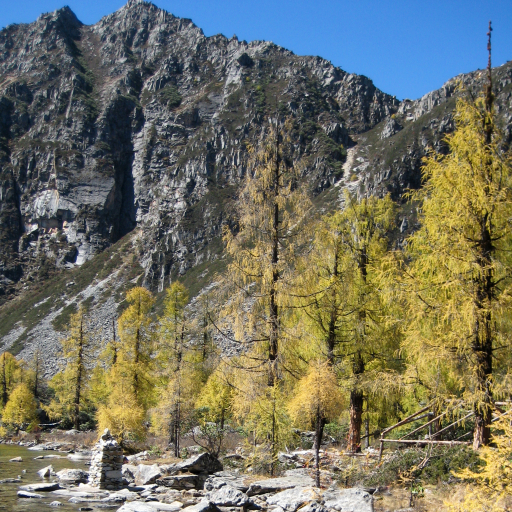
Plant Overview
Known as the Chinese Larch, Larix potaninii is a majestic survivor of the clouds. Hailing from the high-altitude mountain ranges of Western China and Tibet, this "deciduous conifer" breaks the rules of typical evergreens by shedding its needles every winter. It is often referred to as the "Gold of the Peaks" because of the brilliant, fiery transformation it undergoes before the snow falls.
🔍 How to Identify
- 🌲 The Needle Habit: The leaves are soft, slender, and needle-like, growing in tufted clusters. They emerge as a delicate sea-foam green in spring before turning a luminous golden-yellow in autumn.
- 🪵 Distinctive Bark: As the tree matures, its bark turns a rugged grayish-brown with deep, corky fissures. Young shoots are notably smooth and possess a warm, orange-red tint.
- 🎨 Upright Cones: Unlike many pines, its small, egg-shaped cones sit vertically on the branches like tiny wooden lanterns. They start with a violet-purple hue and ripen into a rich cinnamon brown.
🏡 In Your Garden
- 🏔️ Mountain Heritage: Because it originates from high elevations, this larch is exceptionally cold-hardy. However, it is a specialist; it hates "wet feet" and heavy clay. It requires acidic, well-drained soil to mimic its rocky mountain home.
- ☀️ Light & Space: This is not a plant for the shade. It craves full sun and plenty of air circulation. Because it develops a deep taproot to anchor itself against mountain winds, it strongly dislikes being moved once planted—choose its "forever home" carefully!
⚠️ Safety & Toxicity
- ✅ Status: Generally non-toxic.
- 🐾 Details: Larix potaninii is considered safe for households with pets and children. However, the sap (resin) can be very sticky and may cause mild skin irritation for those with sensitive skin. The needles, while soft when fresh, can become prickly and sharp once they dry out on the ground.
✨ Fun Fact
Larix potaninii is one of the highest-climbing trees in the world! It has been found thriving at altitudes of nearly 15,000 feet (4,600 meters) in the Himalayas, where the air is thin and the winters are brutal, making it a true champion of alpine endurance.

Detailed Care Instructions

Place in a bright room that is sun drenched almost all day. Or directly in a south-facing window.

Some plants require more regular watering than others, which should be done every few days. It's critical to maintain the soil moist all of the time. The water requirements of the same plant placed in pots with varying sizes will differ. Because the water in the smaller pot evaporates faster than the water in the larger pot, it will require more watering. Regardless of pot size, the surface should constantly be maintained moist.








