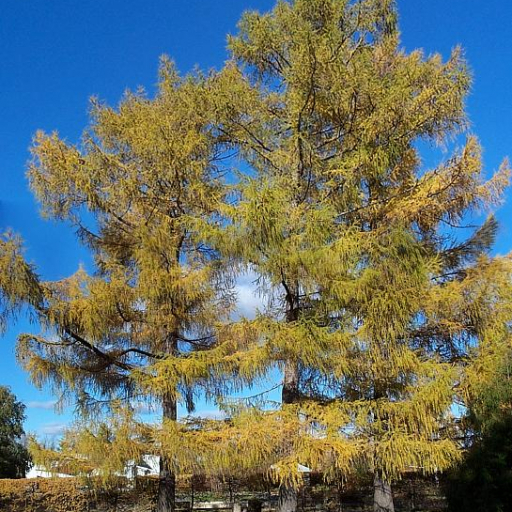
Plant Overview
Known as the "Iron Tree of the Taiga," the Siberian Larch is a botanical paradox—a conifer that behaves like a deciduous tree. Native to the vast, freezing landscapes of Russia and Mongolia, it is legendary for its indestructible wood and its dramatic seasonal transformation, turning from soft green to a glowing gold before shedding its needles for the winter.
🔍 How to Identify
- 🌿 Needle Clusters: Soft, light-green needles grow in brush-like clusters of 20 to 40 on short spur shoots. Unlike most evergreens, these needles are soft to the touch and turn a brilliant, fiery yellow in the autumn.
- 🌲 Upright Cones: Small, egg-shaped cones sit perched upright on the branches. They start with a purple or reddish tint when young, eventually maturing into a woody, light-brown color.
- 🪵 Deeply Furrowed Bark: As the tree ages, the bark becomes thick, rugged, and deeply fissured with grayish-brown scales, providing a natural armor against extreme frost and forest fires.
🏡 In Your Garden
- ❄️ The Ultimate Cold-Warrior: This tree is one of the hardiest species on Earth, easily surviving temperatures as low as -70°F. It is an ideal choice for northern "problem areas" where other conifers might suffer from winter burn or die-back.
- ☀️ Sun Seeker: Siberian Larches are "shade-intolerant." They require wide-open spaces and full sun to thrive. If they are crowded by other trees or buildings, they will quickly drop their lower branches and lose their signature conical shape.
- 💧 Hydration Nuance: While it is surprisingly drought-tolerant once established, it prefers deep, moist, and well-drained soil. It hates "wet feet" (stagnant water) but thrives in areas with high humidity or cool summer breezes.
⚠️ Safety & Toxicity
- ✅ Non-Toxic: The Siberian Larch is generally considered safe and non-toxic for humans, dogs, cats, and horses.
- 🌲 Sticky Resin: The primary "hazard" is the tree’s heavy resin production. The sap is incredibly sticky and can be difficult to remove from pet fur or garden upholstery if branches are pruned during the growing season.
✨ Fun Fact
Much of the city of Venice, Italy, is built on larch pilings driven deep into the lagoon mud. Because the wood is so dense and resinous, it doesn't rot in water; instead, it essentially "petrifies" over centuries, becoming harder and stronger with time.

Detailed Care Instructions
To grow Larix sibirica (Siberian larch) plants, follow these steps:
- Obtain seeds: Find a reputable nursery or garden center that sells Larix sibirica seeds. Alternatively, you can collect seeds from mature cones that have fallen from Siberian larch trees.
- Stratify the seeds: Siberian larch seeds need to undergo a cold stratification period to break dormancy. Place the seeds in a damp paper towel or small container filled with moist peat moss, then seal it in a plastic bag. Keep the bag in a refrigerator or cold location (around 32-41°F or 0-5°C) for 30-40 days.
- Prepare soil: Siberian larch prefers well-draining soil with a pH of 4.5-6.5. Mix equal parts of peat moss, sand, and perlite to create a suitable growing medium.
- Sow the seeds: After stratification, sow the seeds in pots or trays filled with the prepared soil mixture. Sow the seeds shallowly, just beneath the surface, and lightly cover them with a thin layer of soil.
- Watering and sunlight: Keep the soil consistently moist but not waterlogged. Place the pots or trays in a location where they receive full sunlight.
- Germination and establishment: Siberian larch seeds typically take 2-4 weeks to germinate. Once the seedlings have emerged, continue providing adequate water, and gradually expose them to longer periods of direct sunlight.
- Transplanting: After the seedlings have grown to a suitable size (about 6-8 inches tall), transplant them into individual pots or a desired outdoor location. Ensure the new spot offers ample sunlight and sufficient space for the tree to grow.
- Care: Regularly water the newly transplanted seedlings during the first year to help them establish a strong root system. Avoid overwatering, as Siberian larch prefers soils that are slightly moist but not waterlogged.
- Pruning and maintenance: As the tree grows, periodically prune and shape it to maintain the desired form and remove any dead or diseased branches.
- Winter care: Siberian larch is well-suited to colder climates and can tolerate freezing temperatures. However, providing a layer of mulch around the base of the tree during winter can help protect the roots from extreme cold.
By following these steps, you can successfully grow Larix sibirica plants. Remember to be patient, as it takes time for them to reach their full size and maturity.

Place in a bright room that is sun drenched almost all day. Or directly in a south-facing window.

The Larix Sibirica plant requires regular watering to thrive. The best approach is to water the plant deeply, providing enough moisture to reach the roots. This can be achieved by using a watering can or a garden hose with a gentle spray nozzle.
It is important not to over-water the plant, as this can lead to root rot and other diseases. To ensure proper drainage, it is recommended to plant the Larix Sibirica in well-draining soil.
During dry spells, be sure to water the plant more frequently, but always check the soil moisture level before watering. To do this, stick your finger into the soil around the plants' roots. If the soil feels dry to the touch, it's time to water.
Finally, avoid getting water on the plant's foliage as this can cause damage or disease. Focus the water on the soil around the plant instead.
To fertilize this plant, you should apply a slow-release fertilizer in early spring before new growth appears. Use a balanced fertilizer with equal parts nitrogen, phosphorus, and potassium. Apply the fertilizer evenly around the base of the plant, being careful not to get it on the foliage. Water the plant thoroughly after applying the fertilizer. Repeat the fertilization process every year to keep the plant healthy and growing strong.
Larix Sibirica plant prefers soils that are well-draining and slightly acidic. A good soil mixture for this plant would include a combination of sand and organic matter, such as peat moss or compost. Additionally, adding some perlite or vermiculite to the soil mixture can help improve drainage. It is important to avoid using heavy clay soils, which can be too dense and retain too much water. Overall, the soil should be nutrient-rich and sufficiently aerated to support healthy root growth and development.
Propagation of this plant can be done through several methods. One common method is by taking stem cuttings during the dormant season and rooting them in a well-draining medium. Cuttings should be about 6-8 inches long and taken from healthy, mature stems. The bottom leaf should be removed and the cutting should be dipped in rooting hormone before being placed in the growing medium.
Another method of propagation is through layering. This involves bending a lower branch of the plant downwards and burying a portion of it in soil while still attached to the mother plant. Roots will grow from the buried portion and once established, the new plant can be severed from the mother plant.
Seeds can also be sown in the fall and stratified over winter before being planted in the spring. The seeds should be kept moist and at a constant temperature of around 40-50°F during the stratification process. Once planted, the seedlings should be kept in a sheltered area and protected from harsh weather conditions.
Regardless of the method chosen, it is important to keep the newly propagated plants well-watered and protected from extreme temperatures and harsh sunlight until they are established.








