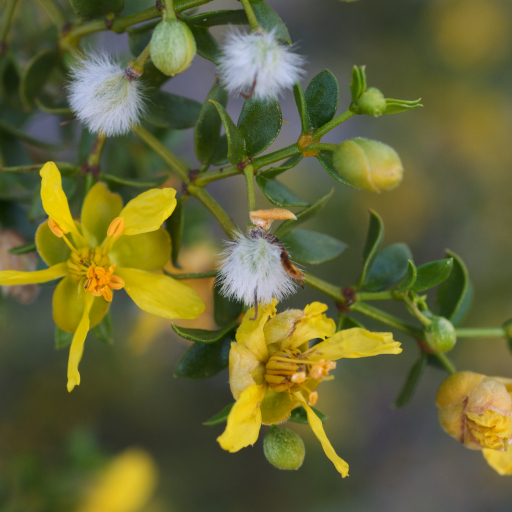
Plant Overview
Known as the "Gobernadora" (The Governess) for its ability to dominate desert landscapes, the Creosote Bush is the aromatic soul of the American Southwest. This hardy evergreen shrub is best known for producing a distinct, medicinal fragrance that many locals describe as "the smell of rain." It is a master of survival, with some individual colonies ranking among the oldest living organisms on Earth.
🔍 How to Identify
- 🌿 Waxy Foliage: The small, dark green leaves are resinous and grow in opposite pairs. This waxy coating isn't just for show—it's a protective shield that prevents precious water from evaporating in the desert heat.
- 🌼 Yellow Blooms: In the spring, the bush is dotted with small, five-petaled yellow flowers that eventually turn into fuzzy, silver-white seed pods.
- 🏗️ Spindly Structure: It typically grows as a multi-stemmed shrub, often reaching 3 to 10 feet in height. Older plants may grow in a circular "ring" pattern as the center dies out and new clones sprout from the periphery.
🏡 In Your Garden
- 🏜️ The Ultimate Xeriscape: Because it evolved in the harshest deserts, this plant is the definition of "low maintenance." It requires almost no supplemental water once established and thrives in the poor, rocky, or sandy soil that would kill most garden plants.
- 🌬️ Chemical Warfare: Creosote bushes practice "allelopathy." They release chemicals into the soil that discourage other plants from growing too close. If you notice a wide, bare patch of earth around a wild Creosote, it’s because the plant is actively defending its water rights!
- 🌧️ Petrichor on Demand: If you live in a dry climate, planting this near a walkway allows you to enjoy its famous "rain scent" every time you lightly mist the leaves with a hose.
⚠️ Safety & Toxicity
- 🟢 General Status: Generally safe for external contact, though the resinous oils can cause mild skin irritation or allergic reactions in sensitive individuals.
- 🚫 Internal Use: While historically used in traditional medicine (Chaparrall tea), modern health experts warn against consuming it. Concentrated doses are linked to potential kidney and liver damage. Keep curious pets from chewing on the resinous branches.
✨ Fun Fact
The Creosote Bush is a champion of longevity. A specific colony in the Mojave Desert, known as "King Clone," is estimated to be nearly 11,700 years old—meaning it was a seedling around the time the last Ice Age was ending!

Detailed Care Instructions
To grow Larrea tridentata, commonly known as creosote bush or chaparral, follow these steps:
- Choose a suitable location: Creosote bushes are native to arid regions and are adapted to full sun and well-draining soil. Select a spot that receives at least 6 hours of direct sunlight daily.
- Prepare the soil: Creosote bushes can tolerate poor soils but prefer sandy or rocky soils. Ensure the soil is well-draining and remove any weeds or grass from the planting area.
- Propagation: You can grow creosote bushes from seeds or cuttings. Seeds can be collected from mature plants or purchased from nurseries. Soak the seeds overnight before sowing them in pots filled with well-draining soil. If using cuttings, take 4-6 inch long stem cuttings from healthy plants.
- Watering: Water the newly planted seeds or cuttings regularly. Keep the soil moist but avoid overwatering, as creosote bushes are drought-tolerant plants.
- Pruning: Once the creosote bush is established, pruning is not necessary. However, you can trim or shape the plant as desired to maintain its size and appearance.
- Pest and disease control: Creosote bushes are generally pest and disease resistant. However, occasionally they can be affected by aphids, scale insects, or fungal diseases. Monitor the plants regularly and apply appropriate organic insecticides or fungicides if necessary.
- Maintenance: Creosote bushes are low-maintenance plants. They can get by with minimal water and fertilizer. However, you can apply a slow-release fertilizer formulated for desert plants in early spring if required.
- Local regulations: If you plan to grow creosote bushes, check with your local authorities or agricultural extension office to ensure that it is allowed and does not pose any risk to the local ecosystem.
Remember to always consult local sources or experts for specific information about growing Larrea tridentata in your region, as climatic conditions may vary.

Place in a bright room that is sun drenched almost all day. Or directly in a south-facing window.

The plant requires watering at regular intervals, but only when the soil has dried completely. Overwatering can harm the plant, so care should be taken to not exceed the required amount of water. The amount of water needed depends on various factors like the size of the plant, the type of soil, and the environment it is growing in. It is recommended to water early in the morning or late in the evening to avoid evaporation. Watering the base of the plant and avoiding getting water on the leaves helps reduce the risk of fungal infections. Mulching can also help retain moisture in the soil, reducing the frequency of watering required.
To properly fertilize this plant, apply a slow-release fertilizer with a balanced N-P-K ratio. Apply the fertilizer in the spring, just before new growth starts, and again in early summer. Do not over-fertilize, as this can lead to excessive growth and reduced drought tolerance. Always follow the manufacturer's instructions for application rates.
Larrea Tridentata plant prefers well-drained soil that is sandy or gravelly in texture. The soil should be slightly alkaline with a pH between 7.0 and 8.5. It is important to avoid heavy clay or soils that retain a lot of moisture as this can lead to root rot. Adding organic matter such as compost or aged manure can help improve soil quality and fertility. Additionally, a layer of gravel or small rocks at the base of the plant can help with drainage. Overall, the soil should be relatively low in nutrients as this plant is adapted to nutrient-poor desert environments.
Larrea tridentata, a desert plant, can be propagated by seed or cuttings. To propagate by seeds, collect mature seeds from the plant when the seed pods start to dry and crack. Sow the seeds in well-draining soil and keep the soil moist but not waterlogged. The seeds will germinate in a few weeks.
To propagate by cuttings, select healthy stems from the parent plant that have at least three nodes and are about 4-6 inches long. Strip off the lower leaves from the stem and dip the cut end of the stem in rooting hormone. Insert the stem into well-draining soil and keep the soil moist but not waterlogged. Cover the cutting with a plastic bag to increase humidity around the cutting. The cutting should root in a few weeks.
Ensure the new plants have access to full sun and well-draining soil to thrive.
Common pests of the creosote include Scale insect, mealybugs, aphids. Make a habit of checking your creosote frequently for pests so that any infestations can be caught and managed early.








