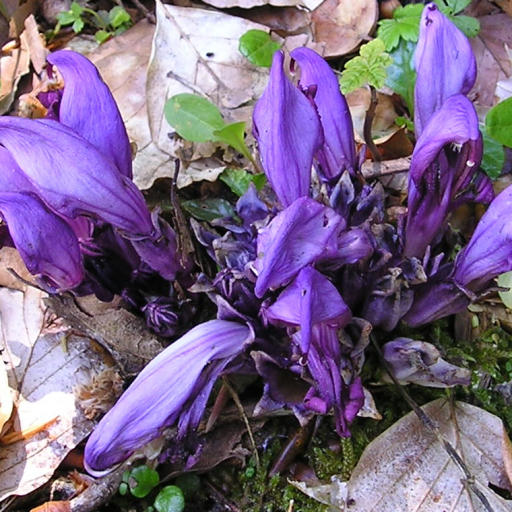
Plant Overview
Known as the Purple Toothwort, this botanical oddity looks more like a cluster of alien jewels than a traditional plant. Lacking any green chlorophyll, it doesn’t bother with photosynthesis; instead, it lives a "clandestine" life underground as a parasite. It only emerges in early spring to show off its vibrant, hood-shaped blossoms before disappearing back into the shadows of the forest floor.
🔍 How to Identify
- 💜 The Color: Deep, saturated shades of violet and royal purple that stand out starkly against brown leaf litter or green grass.
- 🦷 The Structure: It lacks true leaves, possessing instead fleshy, cream-colored scales that hug the base of its host tree.
- 🍄 The Form: Usually appears as a dense, low-growing carpet or mound of flowers, often mistaken for a strange fungus from a distance.
🏡 In Your Garden
- 💧 Moisture Seeker: This plant thrives in damp, shaded woodland conditions, particularly near riverbanks or in boggy ground where its host trees are happiest.
- 🌳 The Host Connection: You cannot grow this plant in a vacuum; it is a "holoparasite" that survives by tapping into the root systems of trees—usually Willow, Poplar, or Alder—to steal nutrients.
- 🌱 Slow to Start: If you are lucky enough to have it in your garden, be patient. It can take several years of underground growth before it finally pushes its first flowers through the soil.
⚠️ Safety & Toxicity
- 🛡️ Low Risk: Purple Toothwort is not considered toxic to humans, and there are no documented cases of severe poisoning.
- 🐾 Pet Safety: While not specifically listed as a dangerous plant for pets, it is not a food source. Its unusual texture and fleshy stems might cause mild stomach upset if a curious dog or cat decides to graze on it.
✨ Fun Fact
Purple Toothwort is a "ballistic" plant! When its seed pods ripen, they build up internal pressure until they explode, catapulting seeds several feet away to ensure they find a fresh patch of host roots to latch onto.

Detailed Care Instructions
| Humidity | Dry |
| Lighting | Part Sun |
| Difficulty | Medium |
| Hardiness Zones | 3 - 9 |
To grow Lathraea Clandestina, also known as the toothwort or purple toothwort, follow these steps:
- Obtain seeds or plants: You can find Lathraea Clandestina seeds or potted plants from online nurseries or specialized plant sellers. This plant is parasitic and usually needs host plants nearby, so consider finding a suitable host plant beforehand.
- Choose a suitable location: Lathraea Clandestina prefers shady areas in moist or wet soil. It does well in woodlands, near streams, or in woodland gardens with suitable host plants.
- Prepare the soil: Ensure the soil is moist and well-drained. Add organic matter like compost or leaf litter to improve soil fertility and moisture retention.
- Planting: If planting seeds, follow the seed packet instructions. Generally, you can lightly scatter the seeds on the soil surface and then press them gently into the soil. If using potted plants, dig a hole that is large enough to accommodate the root ball of the plant.
- Provide host plants: As Lathraea Clandestina is parasitic, it requires suitable host plants nearby. Some common host plants include various species of deciduous trees and shrubs like willows, poplars, birches, or hazels. Make sure the host plant is compatible with Lathraea Clandestina.
- Watering: Keep the soil consistently moist, but not waterlogged. Water as needed, depending on rainfall and environmental conditions.
- Mulch: Apply a layer of mulch around the plants to help retain moisture and suppress weed growth.
- Maintenance: Remove any competitors or invasive plants in the vicinity to prevent them from outcompeting Lathraea Clandestina. Prune nearby trees or shrubs to allow sufficient light penetration.
- Monitor growth: Keep an eye on the plant's growth and monitor its overall health. If necessary, treat any pest or disease issues promptly.
- Propagation: Lathraea Clandestina can produce seeds, or it can spread through its rhizomatous roots. To propagate, you can collect seeds from the dried seed heads or carefully divide the rhizomes and replant them elsewhere.
Remember that Lathraea Clandestina is a specialist plant and requires a specific environment and host plants to thrive. Ensure you have suitable conditions and host plants to provide the best chance for success.

Place in a window with dappled sun or a spot in the middle of a room. Or directly in a window facing west or east.

Lathraea Clandestina is a parasitic plant that requires moisture to grow but does not have any chlorophyll to produce its food from sunlight. Therefore, watering this plant requires a slightly different approach from regular plants.
To water Lathraea Clandestina effectively, you need to keep the soil consistently moist, but not waterlogged. This means that you should water it frequently, but in small amounts. Overwatering can cause root rot, which can be fatal to the plant.
The best way to water Lathraea Clandestina is to use a watering can or a misting sprayer to water the surrounding soil or potting medium. Avoid watering the plant directly as this can damage its leaves and stem. Use room-temperature water that is free from chemicals such as chlorine or fluoride, which can harm the plant.
It’s important to monitor the moisture level of the soil regularly. You can do this by sticking your finger into the soil up to the second knuckle. If the soil feels dry, it’s time to water your plant. If it feels moist or wet, hold off on watering until it dries out a little more.
Overall, watering Lathraea Clandestina requires regular attention and careful monitoring to ensure the plant receives the proper moisture it needs to thrive.
To fertilize this plant, choose a high-quality, balanced fertilizer with equal amounts of nitrogen, phosphorus, and potassium. Use this fertilizer sparingly, as the plant is sensitive to over-fertilization. Apply the fertilizer during the growing season, every two weeks. Avoid getting fertilizer on the plant's leaves, as this can cause burning. Instead, apply the fertilizer around the base of the plant and water it in thoroughly.
The ideal soil for this particular plant is a loamy soil with a high organic content. It should have good drainage but retain moisture well, as the plant prefers moist conditions. It is also recommended to add a layer of mulch to the soil around the plant to help retain moisture and suppress weeds. The soil should be slightly acidic with a pH between 5.5 and 6.5. It is important not to over-fertilize the soil, as this can harm the plant.
Lathraea clandestina is a parasitic plant that belongs to the family Orobanchaceae. It lacks chlorophyll and depends on its host plant for its foods and nutrients. Below are the steps to propagate Lathraea clandestina:
- Find a healthy host plant: L. clandestina parasitizes the roots of a few specific host plants. It is essential to find a healthy host before attempting to propagate the parasitic plant.
- Cut off a stem: With a sharp knife or scissors, cut off a piece of the stem that has some attached roots from the base of the L. clandestina plant.
- Find a new host plant: Look for a plant that is of the same species or a closely related one as the original host.
- Insert the cutting: Gently bury the roots of the L. clandestina cuttings into the soil around the roots of the new host plant.
- Water the plant: Water the new host plant to help the L. clandestina cutting establish itself to the new host.
- Monitor the progress: Keep an eye on the new plant closely. Check for any signs of reduced growth, wilting, or discoloration which might indicate potential problems.
- Repeat the process: If successful, repeat the process to propagate more L. clandestina plants.
It is important to note that because L. clandestina is a parasitic plant, it is not an ideal plant to cultivate, especially if you do not have a suitable host.








