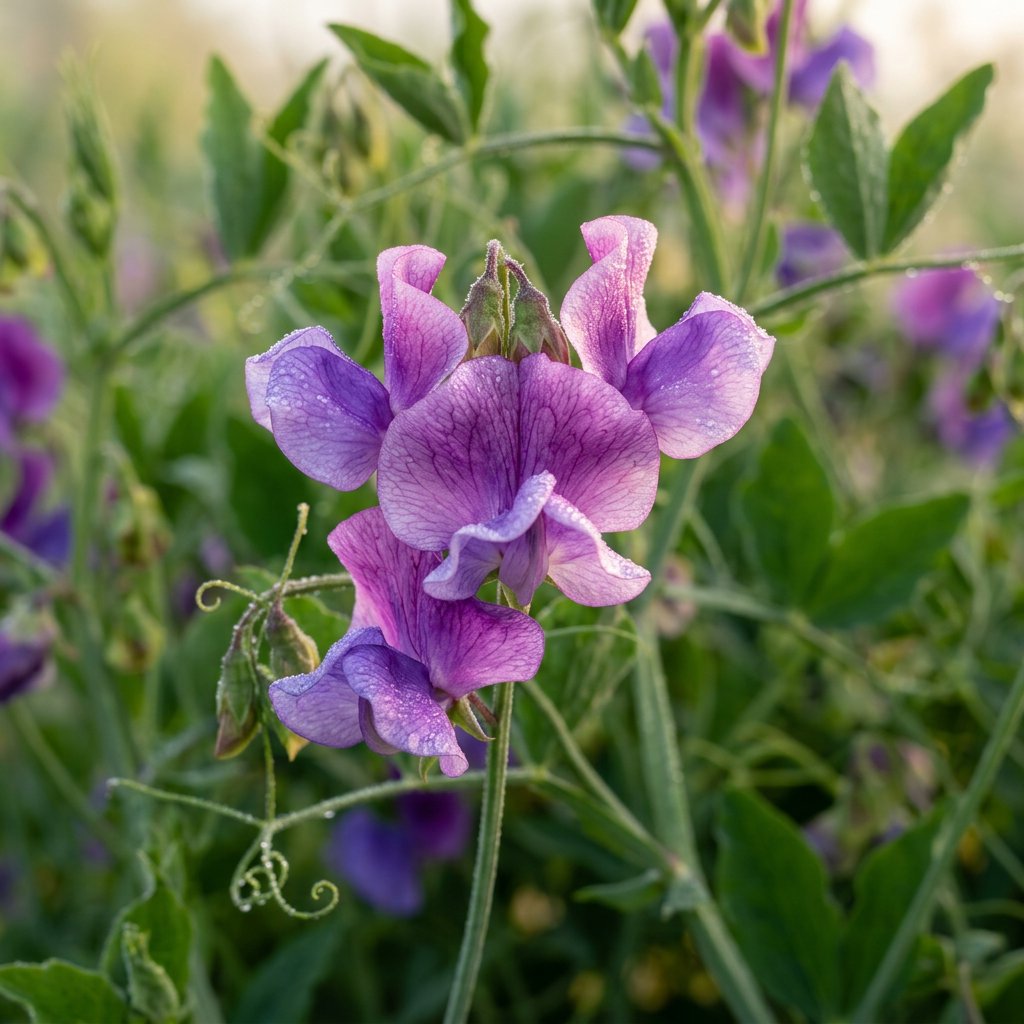
Plant Overview
Known as the "Queen of Annuals," the Sweet Pea is a beloved climbing vine famous for its intoxicating fragrance and ruffled, butterfly-like blooms. Originally discovered by a Sicilian monk in the late 17th century, these Mediterranean natives have become a staple of cottage gardens worldwide. They are often associated with blissful pleasure and are a favorite for delicate, aromatic floral bouquets.
🔍 How to Identify
- 🌸 The Blooms: Features clusters of 2–5 delicate, "papilionaceous" (butterfly-shaped) flowers. They come in almost every color except true yellow, often showcasing soft pastels, deep bicolors, or streaked patterns.
- 🌿 The Foliage: Light green leaves grow in pairs along the stem, ending in thin, wiry tendrils that the plant uses to "lasso" its way up supports.
- 📏 The Stem: Most varieties have unique "winged" stems that look slightly flattened or bordered by a thin membrane, rather than being perfectly round.
🏡 In Your Garden
- 🧗 The Climbing Habit: Because Sweet Peas use tendrils to climb, they require thin supports like netting, twine, or a trellis. They struggle to grip thick wooden poles, so help them out by providing something thin to wrap around.
- 🧊 Cool Roots, Sunny Heads: These plants are sensitive to heat. They thrive when their "feet" (roots) are kept cool and shaded—often by mulch or low-growing companion plants—while their "heads" (flowers) bask in the full sun.
- ✂️ The "Pinch" Secret: To prevent a single lanky vine, gardeners should "pinch out" the growing tip when the plant is about 6 inches tall. This forces the plant to branch out, resulting in more stems and more flowers.
⚠️ Safety & Toxicity
- 🚫 Status: TOXIC. Do not let the name "Pea" fool you; these are not the same as the garden peas we eat.
- 🤢 Details: The seeds contain lathyrogens, which can cause a condition called lathyrism if ingested in large quantities. Symptoms include weakness and lack of coordination. Keep them away from curious children and pets (dogs, cats, and horses) who might mistake the pods for edible vegetables.
✨ Fun Fact
The modern Sweet Pea owes its fame to Henry Eckford, a Victorian-era Scotsman who cross-bred the original wild Sicilian variety to create the "Grandiflora" types. His work turned a small, relatively plain purple flower into the explosion of colors and shapes we see in gardens today!

Detailed Care Instructions
| Color | Red, Pink, Blue, White, And Lavender |
| Soil Ph | About 7.5 |
| Humidity | Normal |
| Lighting | Part Sun |
| Toxicity | Toxic |
| Soil Type | Rich But Well-Drained Soil |
| Bloom Time | Late Winter To Early Summer |
| Difficulty | Medium |
| Plant Type | Legume, Annual Vine |
| Hibernation | Cold Period |
| Mature Size | 6-8 Ft. Tall |
| Native Area | Southern Italy, Aegean Islands |
| Temperature | 5°C - 25°C |
| Sun Exposure | Full Sun |
| Hardiness Zones | 2-11 |
To grow Lathyrus odoratus, commonly known as sweet peas, you can follow these steps:
- Germination:
- Soak the sweet pea seeds in a bowl of water for 24 hours before sowing.
- Fill a seed tray or pots with well-draining potting soil, or prepare an outdoor bed with similar soil conditions.
- Sow the seeds 1 inch deep and 2 inches apart.
- Keep the soil moist but not waterlogged.
- Place the seed tray or pots in a warm and sunny location or under grow lights.
- Soak the sweet pea seeds in a bowl of water for 24 hours before sowing.
- Transplanting:
- After seedlings have developed their first true leaves, generally about 3-4 weeks after sowing, they can be transplanted.
- If growing in pots, you can transplant the seedlings into larger pots or transfer them to the garden bed. If transplanting in the garden bed, make sure to space them at least 6 inches apart.
- Ensure the soil in the new location is well-prepared with compost or organic matter and provides good drainage.
- Water the transplanted seedlings well after the process.
- After seedlings have developed their first true leaves, generally about 3-4 weeks after sowing, they can be transplanted.
- Support:
- Sweet peas are climbing plants and require support to grow vertically.
- Install a trellis, fence, or other support structure near the seedlings, ensuring it is sturdy enough to hold the growing vines.
- Sweet peas are climbing plants and require support to grow vertically.
- Care:
- Water the plants regularly, ensuring the soil remains consistently moist but not waterlogged.
- Apply mulch around the base of the plants to help retain moisture and suppress weeds.
- Fertilize them every two weeks with a balanced fertilizer to promote healthy growth and blooming.
- Pinch off the spent flowers to encourage continuous blooming and prevent seed production.
- Monitor for pests such as aphids or slugs, and take appropriate measures to control them.
- Water the plants regularly, ensuring the soil remains consistently moist but not waterlogged.
- Harvesting:
- Sweet pea flowers can be harvested once they have fully opened.
- Cut the flowers early in the morning or late in the evening when temperatures are cooler.
- Place them in a vase with water immediately after harvesting to keep them fresh.
By following these steps, you can successfully grow Lathyrus odoratus plants and enjoy their beautiful, fragrant flowers.
- Sweet pea flowers can be harvested once they have fully opened.

Place in a window with dappled sun or a spot in the middle of a room. Or directly in a window facing west or east.

Lathyrus Odoratus is a flowering plant that requires adequate watering to thrive. Watering should be done regularly, especially during warmer months and dry spells.
When watering, ensure that the water is not too cold or too hot and use water that is at room temperature or slightly warmer. Water the plant thoroughly, ensuring that the soil is saturated. However, avoid overwatering as this could lead to waterlogging, which could cause root rot or fungal diseases.
It is important to water the soil around the plant, and not the foliage, as wet leaves can encourage fungal growth. Avoid watering late in the day or evening when the sun has set, as this can also promote fungal growth.
The frequency of watering Lathyrus Odoratus may vary depending on factors such as temperature, humidity, and soil type. As a general rule of thumb, water the plant whenever the top one inch of the soil feels dry to the touch.
During the growth and blooming season, it is essential to maintain consistent watering to encourage healthy growth and prolific flowering.
In summary, water Lathyrus Odoratus regularly, avoiding overwatering and wetting the foliage, and ensuring the soil is evenly moist. This will help ensure healthy growth and vibrant blooms.
To properly fertilize this plant, it is recommended to use a balanced fertilizer with an N-P-K ratio of 10-10-10 or 20-20-20. Fertilizer should be applied to the soil around the plant, avoiding contact with the foliage. It is important to follow the manufacturer's instructions for application rates and frequency. Over-fertilizing can lead to excessive foliage growth with minimal flower production. Fertilizer should be applied regularly throughout the growing season, typically once every 2-3 weeks. Additionally, mulching around the plant can help retain moisture and provide slow-release nutrients for the plant.
The ideal soil for Lathyrus Odoratus plant should be well-draining and somewhat sandy, yet rich in nutrients and organic matter. It is also important that the soil PH is slightly acidic to neutral, between 6.0 and 7.5. The plant tends to grow best in soils that are moist but not waterlogged. A loamy soil is also an excellent option for this plant, and it should be prepared with compost or well-rotted manure before planting. The soil should also be free from weeds, as these can cause competition with the plant for nutrients and water. Additionally, the plant requires regular fertilization with a balanced fertilizer to promote healthy growth and development.
The process of propagating this plant involves collecting seeds from the mature plant and sowing them either directly into the soil or starting them in individual containers. When starting seeds in containers, it is important to use a well-draining soil mix and keep the planting medium consistently moist until the seedlings emerge. Once the seedlings have several sets of true leaves, they can be transplanted into the garden or larger containers. Lathyrus Odoratus plants can also be propagated by taking stem cuttings from mature plants and rooting them in water or a rooting hormone before planting them in soil. It is important to keep newly propagated plants consistently moist and protect them from harsh weather conditions until they are well-established.
Common pests of the sweet pea include Spider mites, aphids, thrips, larvae. Make a habit of checking your sweet pea frequently for pests so that any infestations can be caught and managed early.








