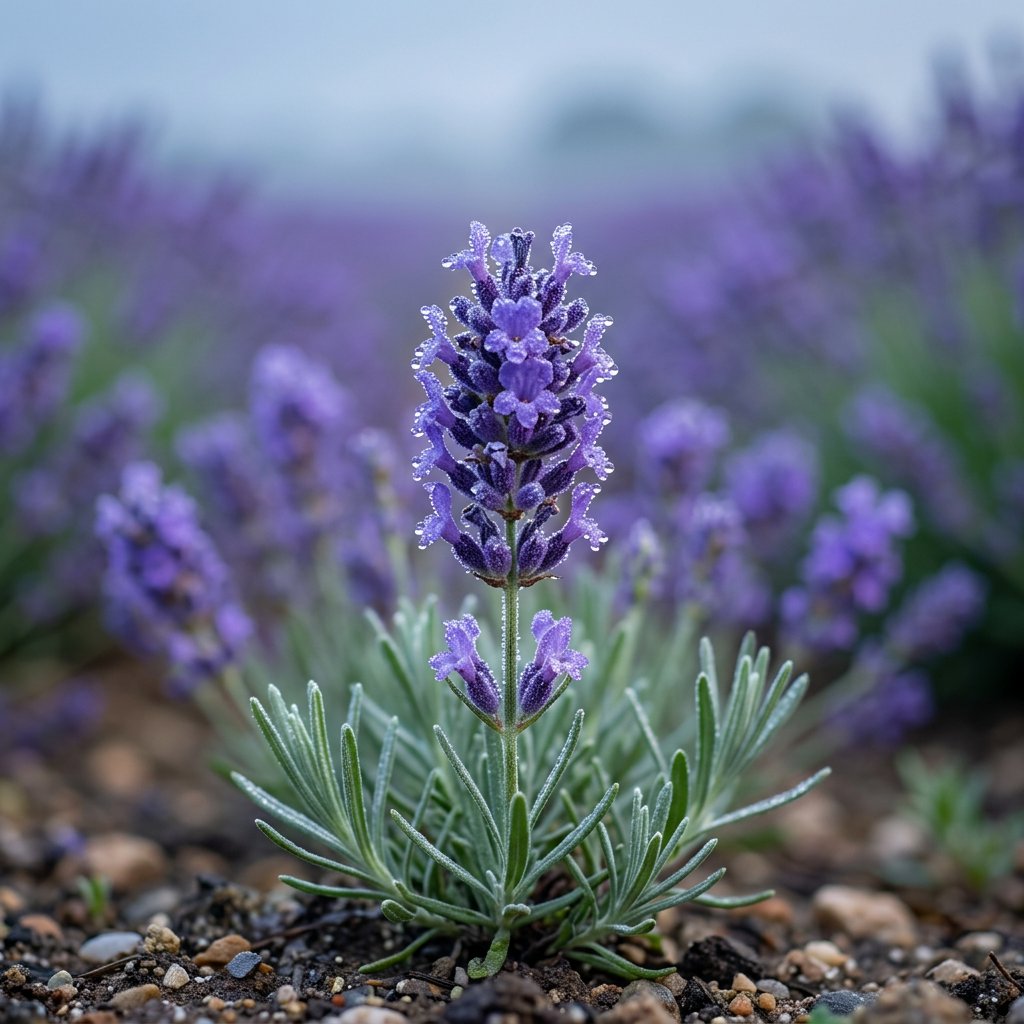
Plant Overview
Known as the "English Lavender," this Mediterranean native is the gold standard of the herb world. Often called the "Queen of Herbs," it has been used for centuries in everything from royal perfumes to calming teas. Unlike its hybrid cousins, Lavandula angustifolia is prized for its sweet, delicate fragrance and its ability to survive colder winters.
🔍 How to Identify
- 🍃 Narrow Foliage: The name angustifolia literally means "narrow leaf," referring to its slender, silver-green leaves that grow in a dense, mounded habit.
- 💜 Flower Spikes: It features unbranched, leafless stems topped with short, compact spikes of tiny, tubular violet-purple flowers.
- 👃 The "True" Scent: When the foliage or flowers are bruised, they release a clean, floral aroma without the harsh, medicinal camphor smell found in other lavender varieties.
🏡 In Your Garden
- ☀️ Lean & Mean: This plant actually prefers "poor" soil. Over-fertilizing or using rich potting soil will lead to lots of green leaves but very few fragrant flowers.
- 💧 Drainage is Vital: Lavender hates "wet feet." It thrives in rocky or sandy spots where water can move away from the roots quickly, making it a perfect candidate for xeriscaping or rock gardens.
- ✂️ The Pruning Rule: To prevent the plant from becoming "leggy" or splitting open, prune it back by about one-third every year after blooming, but be careful not to cut into the old, leafless wood.
⚠️ Safety & Toxicity
- 🐱 Pet Warning: Lavender contains small amounts of linalool and linalyl acetate, which are toxic to cats, dogs, and horses if ingested in large quantities. It can cause nausea or vomiting.
- 👶 Human Use: Generally considered safe and even medicinal for humans. It is widely used in culinary dishes and aromatherapy, though the concentrated essential oil should never be swallowed.
✨ Fun Fact
🛁 Ancient Roman Bathing: Its name comes from the Latin word lavare, which means "to wash." The Ancient Romans used lavender to scent their public bathhouses and laundry long before modern soaps were invented!

Detailed Care Instructions
It's very easy to maintain if the plant is growing in the right conditions: medium to dry infertile soil in full sun. It dislikes fertile soil, humidity, soggy soil, and overly hot conditions.
How fast does English lavender grow?
It has a moderately slow growth rate. Prune new growth in the spring to maintain a rounded shape; do not prune its woody stems.
What is the difference between English and French lavender?
The French variety of lavender (Lavandula stoechas) prefers a warmer climate and is not as cold-hardy as its English cousin. It is also somewhat more sensitive and less durable than English lavender. Because nursery labeling is sometimes inaccurate, make sure you are buying true English lavender (Lavandula angustifolia), especially if you live in the colder zones of its hardiness range.
Can English lavender grow indoors?
English lavender is typically grown outdoors, but it can thrive when potted indoors if the plant is given a minimum of four to six hours of bright, direct sunlight each day. It also prefers low-humidity environments with consistent, moderate temperatures.
| Color | Purple, Violet-Blue, Pink |
| Soil Ph | 6.7-7.3 |
| Humidity | Normal |
| Lighting | Full Sun |
| Toxicity | Toxic |
| Soil Type | Sandy, Gritty, Dry To Medium, Well-Drained |
| Bloom Time | Mid-Summer |
| Difficulty | Medium |
| Plant Type | Herbaceous Flowering Perennial |
| Hibernation | Cold Period |
| Mature Size | 2 To 3 Feet Tall |
| Native Area | Mediterranean |
| Temperature | 15°C - 21°C |
| Sun Exposure | Full Sun |
| Hardiness Zones | 5-8 |
To grow Lavandula angustifolia, also known as English lavender, follow these steps:
- Choose a suitable location: Find a spot that receives full sun for at least 6-8 hours a day. Lavender prefers well-drained soil, so make sure it is not clayey or too wet.
- Prepare the soil: Lavender thrives in sandy or loamy soil. If your soil is heavy clay, amend it by adding compost or sand to improve drainage.
- Plant in spring or fall: Lavender can be planted either in early spring or late fall when the soil is workable. Space the plants about 12-24 inches apart to allow for airflow and discourage disease.
- Dig the hole: Dig a hole slightly larger than the root ball of the lavender plant. Make sure the hole is deep enough to accommodate the roots without bending.
- Plant the lavender: Place the lavender plant in the hole, ensuring that the top of the root ball is level with or slightly above the soil surface. Backfill the hole with soil, gently firming it around the plant.
- Watering: Lavender is drought-tolerant once established, so avoid overwatering. Only water when the top inch of soil feels dry. Young plants require regular watering until they are established.
- Mulch: Apply a layer of organic mulch, such as wood chips or straw, around the base of the plant. Mulch helps conserve moisture and suppresses weeds.
- Pruning: Prune lavender lightly in the first year to encourage bushiness. After that, an annual pruning in early spring or after flowering helps shape the plant and promotes new growth.
- Fertilizing: Lavender doesn't require much fertilization, but if the soil is poor, you can apply a balanced, slow-release fertilizer in spring.
- Protect from extreme cold: In regions with harsh winters, protect the lavender by mulching heavily around the base of the plant or covering it with burlap.
By following these steps and providing proper care, Lavandula angustifolia should grow well, producing fragrant lavender flowers and attracting pollinators to your garden.

Place in a bright room that is sun drenched almost all day. Or directly in a south-facing window.

Lavandula angustifolia needs to be watered regularly but not excessively. It prefers moist but well-draining soil, so it is important to ensure that the soil does not become waterlogged. Overwatering can lead to root rot, which can be fatal to the plant.
To water the plant, fill a watering can with lukewarm water and pour slowly onto the soil. Make sure to water the base of the plant and not the leaves or flower buds. You can also use a hose with a gentle spray nozzle to water the plant.
The frequency of watering depends on the environmental conditions and the soil type. As a general rule, water the plant when the top inch of soil feels dry to the touch. In hot and dry weather, the plant may need to be watered more frequently. In cooler and wetter conditions, less frequent watering may be needed.
It is also good practice to mulch around the plant to help retain moisture in the soil and reduce evaporation. Applying a layer of organic material such as compost or bark chips can also help to improve soil quality and regulate moisture levels.
To fertilize the lavender plant, evenly apply a slow-release organic fertilizer to the soil surface around the plant's base. Avoid getting the fertilizer on the foliage or stems. Water the plant thoroughly after fertilizing. Repeat this process once every spring.
Lavandula angustifolia plant prefers a well-draining soil with a neutral to slightly alkaline pH level. The soil should be nutrient-rich without being too fertile, as excessive nutrients may cause the plant to grow too vegetatively at the expense of its flowers and fragrance. A sandy or loamy soil with good drainage is ideal. Adding organic matter such as compost, aged manure or leaf mold can improve soil structure and fertility. Avoid using heavy clay soils, as these can cause root rot and poor drainage. It is important to avoid overwatering, as Lavandula angustifolia plant is susceptible to root rot. Water sparingly, and allow the soil to dry out between waterings. Additionally, it is beneficial to mulch around the plant to conserve moisture and regulate soil temperature.
To propagate this plant, take a cutting of approximately 5-6 inches in length from a healthy mother plant. The cutting should have leaves on the upper half and should be taken from the lower side of the stem. Use sterilized scissors or pruning shears to make a clean cut just below a leaf node. Remove all the leaves from the lower half of the cutting, leaving only a few leaves on the upper half.
Prepare a potting mix of equal parts perlite and peat moss. Dip the lower end of the cutting in rooting hormone powder and plant it about an inch deep in the potting mix. Water the cutting well and cover it with a clear plastic bag to maintain humidity. Place the pot in a bright, but not direct, light and maintain a temperature of 70-75°F.
Check the cutting daily and mist it if necessary to maintain the humidity level and prevent the soil from drying out. In about 2-3 weeks, the cutting will start to produce new roots and leaves. When the new growth is 2-3 inches tall, it can be transplanted into a larger pot or in the garden.
Common pests of the english lavender include Spider mites, thrips, whiteflies. Make a habit of checking your english lavender frequently for pests so that any infestations can be caught and managed early.








